
Net Metering: The Complete Guide to How It Works, Benefits, and Savings (2026)
Introduction
If you’re thinking about installing solar panels on your home or business, you’ve probably come across the term net metering more than once. It’s one of the most important financial mechanisms that makes solar power affordable — and understanding it can help you decide whether going solar is the right move for you.
In simple terms, net metering is a billing arrangement that lets solar panel owners send excess electricity back to the grid in exchange for credits on their utility bill. This guide breaks down exactly how net metering works, why it matters, the different types of net metering policies, and how to make the most of it in 2026.

What Is Net Metering?
Net metering (sometimes called net energy metering or NEM) is a system that allows owners of renewable energy systems — most commonly rooftop solar panels — to feed surplus electricity back into the public grid. In return, the utility company credits their account for that energy.
Here’s the basic idea: solar panels often generate more electricity than a home needs during sunny daylight hours. Without net metering, that extra energy would simply go to waste. With netmetering, it flows back into the grid, and the homeowner earns a credit that offsets electricity used at night or on cloudy days.
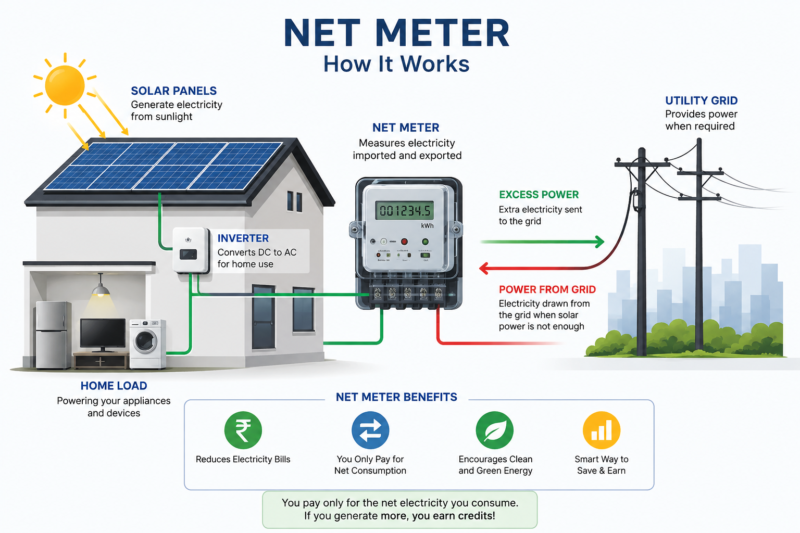
Your utility meter essentially runs in two directions:
- Forward when you draw power from the grid
- Backward when you send excess solar power to the grid
At the end of the billing cycle, you’re only charged for your net energy usage — hence the name “net metering.”
How Does NetMetering Work? (Step-by-Step)
Understanding how net metering works can help you estimate your potential savings before installing a solar system. Here’s a simplified breakdown:
- Solar panels generate electricity. During the day, your solar panel system produces electricity from sunlight.
- Your home uses what it needs. Any electricity you use immediately is drawn directly from your panels.
- Excess energy goes to the grid. If your panels produce more than you’re using, the surplus is exported to the local utility grid.
- Your meter tracks the exchange. A bidirectional meter records both the electricity you draw from the grid and the electricity you send back.
- You receive credits. These credits are applied to your account and can be used to offset your bill when your panels aren’t producing enough power (like at night).
- You pay only the net difference. At the end of the billing period, you’re billed for the net amount of electricity you consumed from the utility.
This cycle allows solar owners to essentially “bank” energy with their utility provider instead of needing expensive battery storage for every kilowatt-hour they generate.
Why NetMetering Matters for Solar Savings
Net metering is often described as the backbone of residential solar economics. Without it, solar panel owners would need to either use all their generated electricity in real time or invest in costly battery storage systems to avoid wasting excess power.
Here’s why netmetering matters:
- Maximizes the value of your solar investment. Every kilowatt-hour your panels produce has value, even if you don’t use it immediately.
- Shortens the solar payback period. By reducing wasted energy, net metering helps homeowners recoup their solar investment faster.
- Reduces dependence on batteries. Homeowners can rely on the grid as a “virtual battery” instead of purchasing expensive storage systems.
- Encourages renewable energy adoption. By making solar more financially attractive, net metering policies help accelerate the shift toward clean energy.
Types of NetMetering Policies
Not all net metering programs are created equal. Policies vary significantly by state, country, and utility provider. Here are the most common types:
1. Full Retail Net Metering
Under this model, exported electricity is credited at the same rate you’d pay to buy electricity from the utility. This is the most favorable arrangement for solar owners.
2. Net Billing (Avoided Cost Rate)
Some utilities credit excess solar energy at a lower “avoided cost” rate rather than the full retail rate. This reduces the financial benefit compared to full retail net metering.
3. Time-of-Use (TOU)
Under TOU plans, the value of your exported electricity depends on when it’s sent to the grid. Energy exported during peak demand hours may be credited at a higher rate than energy sent during off-peak hours.
4. NetMetering 2.0 and 3.0 (Evolving Policies)
Many regions are moving toward updated netmetering frameworks that reduce compensation rates for exported solar energy while introducing new incentives for pairing solar with battery storage. It’s important to check your local utility’s current policy, since these rules are updated frequently.
Net Metering vs. Net Billing: What’s the Difference?
Many people confuse net metering with net billing, but they aren’t the same thing.
| Feature | Net Metering | Net Billing |
|---|---|---|
| Credit rate | Full retail rate | Avoided cost or wholesale rate |
| Meter type | Bidirectional meter | Two separate meters or import/export tracking |
| Financial benefit | Higher | Lower |
| Common use | Traditional solar programs | Newer policy frameworks replacing net metering |
If you’re evaluating a solar quote, always ask your installer or utility which billing method applies in your area, since it significantly affects your long-term savings.
Benefits of NetMetering
1. Lower Electricity Bills
The most obvious benefit is financial. Net meter can significantly reduce — and in some cases nearly eliminate — a household’s monthly electricity bill.
2. No Need for Expensive Battery Storage
Instead of paying thousands of dollars for a home battery system, net metering allows the grid to act as storage, crediting your account for excess production.
3. Environmental Impact
By enabling more efficient use of solar energy, net meter supports greater adoption of renewable power, reducing reliance on fossil fuels.
4. Increased Home Value
Homes with solar panel systems — especially those benefiting from favorable net metering policies — often see increased resale value.
5. Grid Stability
Distributed solar generation, supported by net meter, can help ease strain on the power grid during high-demand periods.
Potential Drawbacks of Net Metering
While net metering offers major advantages, it’s not without limitations:
- Policy changes: Many states and countries are reducing net metering benefits in favor of net billing, which can lower long-term savings for new solar customers.
- Utility fees: Some utilities charge grid connection fees or minimum bill amounts for net metering customers.
- Credit expiration: In some programs, unused credits expire at the end of the year instead of rolling over indefinitely.
- Rate structure complexity: Time-of-use net meter can make it harder to predict exact savings.
How to Maximize Your NetMetering Benefits
If you already have solar panels or are planning to install them, here are a few tips to get the most out of net metering:
- Understand your utility’s specific policy before signing a solar contract.
- Size your solar system appropriately — oversizing may lead to wasted credits if your utility doesn’t allow rollover.
- Shift high-energy usage to daylight hours when possible, especially under time-of-use plans.
- Monitor your usage and production using a solar monitoring app to ensure you’re maximizing credits.
- Ask about battery pairing incentives, especially if your region has moved to a net billing model with reduced export rate
Frequently Asked Questions
Q: Does it work with all types of renewable energy systems? A: While most commonly associated with rooftop solar, net meter can also apply to small wind turbines and other qualifying renewable energy systems, depending on local policy.
Q: What happens to unused net metering credits? A: This depends on your utility. Some allow credits to roll over indefinitely, while others require an annual true-up where unused credits are forfeited or paid out at a reduced rate.
Q: Do I need a smart meter for net metering? A: Yes, a bidirectional or “smart” meter is typically required to accurately track both the electricity you consume and the electricity you export to the grid.
Q: Can businesses use net metering, not just homeowners? A: Absolutely. Net meter programs are widely available to commercial and industrial solar customers as well as residential ones.
Final Thoughts
Net metering remains one of the most powerful tools for making solar energy financially viable. By allowing homeowners and businesses to earn credit for excess electricity, it shortens payback periods, reduces the need for expensive battery storage, and supports the broader shift toward renewable energy.
That said, policies are shifting in many regions, so it’s essential to research your local utility’s current net metering or net billing rules before investing in a solar system. Staying informed will help you make the most financially sound decision for your energy future.
Have questions about net metering in your specific area? Consult a licensed solar installer or your local utility provider for the most accurate, up-to-date policy details.