String Inverter vs Micro Inverter: Which Solar Inverter Actually Wins in 2026?
If you’ve started planning a rooftop solar panel system, you’ve probably hit the same wall every homeowner and installer hits eventually: String Inverter vs Micro Inverter — which one do I actually need?
It sounds like a small technical detail. It isn’t. The inverter you choose decides how much electricity your solar panel system produces on a shaded afternoon, how easily you can expand your array later, how you’ll monitor performance, and — over 20 to 25 years — how much money stays in your pocket. This guide breaks the String Inverter vs Micro Inverter decision down in plain language, backed by the numbers installers and manufacturers actually use, so you can walk into a quote conversation and ask the right questions instead of nodding along.
Quick Answer: String Inverter vs Micro Inverter at a Glance
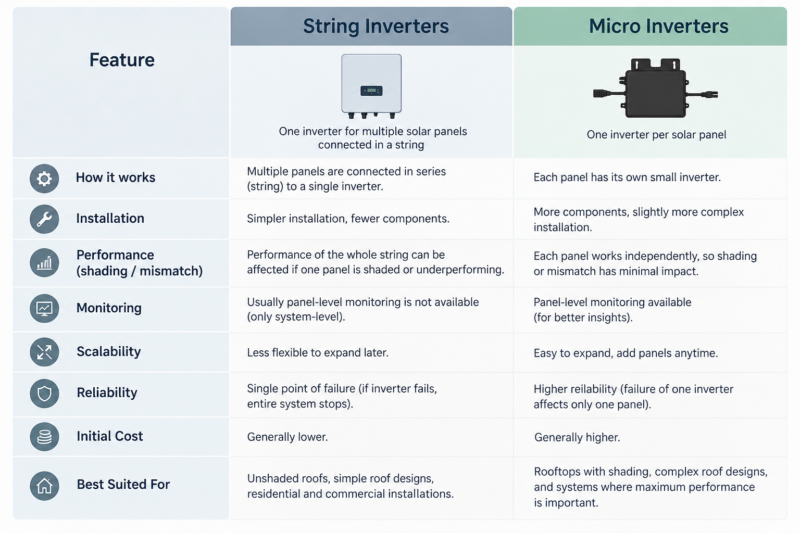
If you only have thirty seconds, here’s the short version of the String Inverter vs Micro Inverter debate:
| Factor | String Inverter | Microinverter |
|---|---|---|
| Upfront cost | Lower | Higher (15–40% more) |
| Best for | Simple, unshaded, single-direction roofs | Complex roofs, partial shade, multiple angles |
| Panel-level monitoring | No (string-level only) | Yes |
| Shading impact | High — one weak panel drags down the whole string | Low — each panel works independently |
| Typical lifespan | 10–15 years | 20–25 years |
| Installation complexity | Simple, one central unit | More labor, one unit per panel |
| Safety (rapid shutdown) | Requires added equipment | Built-in, panel-level shutdown |
| Scalability | Harder to expand | Easy to add panels over time |
What Is a String Inverter?
A string inverter is a single, centrally located device — usually mounted near your utility meter or garage wall, roughly the size of a small suitcase — that takes the direct current (DC) electricity produced by a group (“string”) of solar panels wired in series and converts it into the alternating current (AC) your home actually uses.
Think of a string inverter as one translator standing at the bottom of the roof, listening to an entire row of panels speak at once and converting their combined output into a language your home’s electrical panel understands. Every panel in that string is tied to the performance of its weakest member — more on why that matters in a moment.
String inverters have been the default choice in the solar industry for decades because they’re simple, proven, and inexpensive. For a straightforward roof with a single orientation and no shading obstacles, a string inverter converts power efficiently and reliably, and it remains the most common solar inverter type installed on new residential solar panel system projects worldwide.
Key traits of a string inverter:
- One central unit for an entire array (or one per string, on larger systems)
- Lower equipment and installation cost
- Fewer components to fail, which historically means solid reliability
- Monitoring happens at the string level, not per panel
- Requires additional rapid-shutdown hardware to meet modern fire-safety codes
What Is a Microinverter?
A microinverter flips the string inverter model on its head. Instead of one large box converting power for an entire array, a small microinverter is attached to the back of each individual solar panel, converting that single panel’s DC output into AC right at the source.
Picture it as giving every panel on your roof its own personal translator instead of sharing one. If a cloud shadow, a chimney, or a stray tree branch shades one panel, that panel’s microinverter simply produces less — it doesn’t drag down the panels around it. This panel-by-panel independence is the single biggest reason microinverter adoption has grown so sharply in the last few years, and it’s why “microinverter” itself has become one of the fastest-rising search terms in the solar industry.
Key traits of a microinverter:
- Installed at every solar panel, not centrally
- Panel-level monitoring — you can see exactly which panel underperforms and when
- Built-in rapid shutdown, satisfying strict electrical safety codes without extra parts
- Higher solar energy efficiency on roofs with partial shade, multiple angles, or mixed orientations
- Longer manufacturer warranties, often matching the 25-year lifespan of the panels themselves
- Higher upfront hardware and labor cost, since every panel needs its own unit
String Inverter vs Micro Inverter: The Real Differences That Matter
Now let’s go deeper. When you compare String Inverter vs Micro Inverter side by side, six factors decide the outcome for almost every real-world solar panel system.
1. Cost: Upfront Price vs Long-Term Value
This is usually the first question in any String Inverter vs Micro Inverter conversation, and it’s where the two technologies diverge most sharply.
A string inverter is the budget-friendlier option. Because one unit handles an entire string of panels, hardware and labor costs stay low — which is why string inverters remain the default recommendation for cost-sensitive residential solar panel system installs. Microinverters, by contrast, typically add somewhere between $1,000 and $2,000 to a standard 5kW residential system, since every panel needs its own unit and its own labor time to install and wire.
However, cost isn’t the whole story. A microinverter setup often comes with warranties stretching to 25 years, matching panel lifespans, while a typical solar inverter (string-style) needs replacement once or even twice over the life of a system, since its average lifespan sits closer to 10–15 years. Run the numbers over two decades, and the gap narrows — sometimes it closes entirely.
2. Efficiency and Shading Performance
This is where the String Inverter vs Micro Inverter comparison gets genuinely technical. In a string inverter setup, all panels in a string are electrically linked, which means the entire string’s output is capped by its weakest-performing panel. Shade a single panel by 30%, and you can lose a meaningful chunk of that string’s total production — not just that one panel’s share.
Microinverters sidestep this entirely. Because each unit converts power independently, one shaded, dirty, or damaged panel has zero impact on its neighbors. Depending on roof conditions, this can translate into a real solar energy efficiency gain — industry estimates commonly cite anywhere from 5% to 25% more usable energy from microinverter-based solar panel system installs on roofs with partial shading, multiple roof faces, or obstructions like chimneys and vents.
If your roof gets full, unobstructed sun all day with a single orientation, this efficiency gap shrinks to almost nothing — which is exactly why a plain string inverter is still the smarter pick for simple installs.
3. Monitoring and Diagnostics
A traditional solar inverter (string-type) reports performance at the string level. If output drops, you’ll know something is wrong somewhere in that group of panels — but pinpointing which panel is the culprit usually means a technician physically inspecting the roof.
Microinverters report panel-by-panel data straight to an app. You can watch each panel’s output individually, spot a failing or shaded unit within days instead of months, and schedule a targeted fix instead of guessing. For homeowners who like data, or installers managing dozens of systems remotely, this alone can tip the String Inverter vs Micro Inverter decision toward microinverters.
4. Safety and Code Compliance
Fire codes in many regions now require rapid shutdown capability — the ability to de-energize panels quickly in an emergency. Microinverters build this in by design, since each panel is already isolated at the module level. A string inverter setup needs additional rapid-shutdown devices bolted onto the system to meet the same requirement, adding cost and complexity that’s easy to forget about when comparing sticker prices.
5. Installation and Maintenance
Here the string inverter wins cleanly. One central box is faster to install, easier to access, and simpler to service — if it fails, you replace one unit and you’re back online. A microinverter-based solar panel system means dozens of small units scattered across the roof; if one fails, that’s usually not a big deal for total output, but troubleshooting means climbing back onto the roof to find the specific unit, which adds labor time and cost.
6. Scalability
Planning to add more panels down the road, maybe alongside a battery storage system? Microinverters make this simple — new panels each arrive with their own inverter, and you just tie them into the existing monitoring network. Expanding a string inverter system is trickier, since adding panels to an existing string can throw off the voltage the string inverter was calibrated for, sometimes forcing you to add a whole new string and inverter rather than a few extra panels.
Which Should You Actually Choose?
The honest answer to the String Inverter vs Micro Inverter question is: it depends on your roof, your budget, and your goals — not on which one a salesperson prefers to sell.
Choose a string inverter if:
- Your roof has one clear, unobstructed orientation
- There’s little to no shading throughout the day
- Budget is your top priority
- You want the simplest possible install and the most field-proven solar inverter technology
Choose a microinverter if:
- Your roof has multiple angles, dormers, or facing directions
- Trees, chimneys, or neighboring buildings cast partial shade for part of the day
- You want panel-level monitoring and maximum solar energy efficiency
- You’re planning to expand your solar panel system in phases
- Long-term performance and warranty length matter more to you than the lowest sticker price
Some installers even recommend a hybrid approach: string inverters for the unshaded majority of a roof, paired with power optimizers or microinverters only on the panels that see partial shade. It’s worth asking any solar installer whether this middle path fits your home before committing fully to either side of the String Inverter vs Micro Inverter debate.
Emerging Trends: Where Solar Inverter Technology Is Headed
The solar microinverter market has been one of the fastest-growing corners of the renewable energy industry, driven by rising rooftop solar adoption, tighter fire-safety regulations, and demand for smarter, app-connected energy monitoring. As more homes pair solar with battery storage and home-automation systems, microinverters’ plug-and-play compatibility with these add-ons is accelerating their adoption even further.
At the same time, string inverter manufacturers haven’t stood still. Newer string inverter models now include built-in rapid shutdown, higher MPPT (Maximum Power Point Tracking) precision, and smarter string-level monitoring that narrows the diagnostic gap with microinverters. The String Inverter vs Micro Inverter race is pushing both technologies to improve — which is good news no matter which one ends up on your roof.
Pros and Cons Recap
String Inverter
- ✅ Lower upfront cost
- ✅ Simple, proven, easy to service
- ✅ Great for full-sun, single-orientation roofs
- ❌ Vulnerable to shading losses
- ❌ Only string-level monitoring
- ❌ Shorter typical lifespan (10–15 years)
Microinverter
- ✅ Panel-level monitoring and diagnostics
- ✅ Minimal shading losses, higher solar energy efficiency on complex roofs
- ✅ Built-in rapid shutdown safety
- ✅ Longer warranties (often 25 years)
- ❌ Higher upfront hardware and labor cost
- ❌ More units to potentially service if something fails
Real-World Scenarios: Putting the Decision Into Practice
Numbers and comparison tables are useful, but most people find it easier to decide once they see themselves in a scenario. Here are three common situations and how the String Inverter vs Micro Inverter choice tends to play out in each one.
Scenario A — The simple south-facing roof. A single-story home with an unobstructed, south-facing roof and zero shading is close to the ideal case for a string inverter. There’s no weak-panel problem to solve, so the extra cost of a microinverter buys very little real-world benefit here. Most installers will (rightly) steer this homeowner toward a string inverter setup.
Scenario B — The shaded, multi-angle roof. A two-story home with a chimney, a dormer window, and panels split across east- and west-facing sections is the textbook case for microinverters. Shading and mismatched angles hurt a string inverter’s output disproportionately, and the panel-level independence of a microinverter setup usually pays for its price premium within several years through recovered solar energy efficiency.
Scenario C — The phased expansion. A homeowner who plans to add a home battery and more panels within the next few years benefits from the flexibility microinverters offer. Since each new panel simply brings its own inverter along, there’s no need to redesign an existing string or worry about voltage mismatches — a common headache when expanding a string inverter system after the fact.
Seeing your own roof in one of these scenarios is often the fastest way to cut through marketing claims and settle on the right inverter for your specific home.
Frequently Asked Questions
Is a microinverter always better than a string inverter? No. A microinverter usually wins on complex, shaded, or multi-angle roofs, but for a simple, fully sunlit roof, a string inverter can deliver nearly identical performance for meaningfully less money.
How much more does a microinverter-based solar panel system cost? Expect roughly $1,000–$2,000 more on a typical 5kW residential system, mainly due to the extra hardware and per-panel labor.
Do microinverters really last longer than a string inverter? Generally, yes. Microinverters commonly carry 25-year warranties matched to panel lifespans, while a typical solar inverter (string-type) is rated closer to 10–15 years and may need replacing at least once over the system’s life.
Can I mix string inverters and microinverters on the same roof? Yes — many installers use string inverters on the unshaded majority of a roof and microinverters (or power optimizers) only on partially shaded sections, balancing cost against solar energy efficiency.
Which option is easier to expand later? Microinverters. Adding panels is as simple as adding more individually inverted units, whereas expanding a string inverter system often requires rebalancing or adding an entirely new string.
Does the String Inverter vs Micro Inverter choice affect resale value of my home? Indirectly, yes — buyers and appraisers increasingly favor systems with panel-level monitoring and longer warranties, both of which microinverters typically offer, though a well-maintained string inverter system with solid production history won’t hurt resale value either.
How to Read an Inverter Line-Item on a Solar Quote
Once you’ve decided which side of the debate fits your roof, it helps to know what to actually look for on a quote so you’re not comparing apples to oranges.
Check the warranty length separately from the panel warranty. Panels and inverters often carry different warranty periods — a 25-year panel warranty paired with a 10-year string inverter warranty means budgeting for at least one inverter replacement down the line. Ask your installer to write both numbers on the quote explicitly.
Ask what “per-panel monitoring” actually includes. Some string inverter quotes bundle in a basic monitoring app that only shows string-level or whole-system data, while marketing language can make it sound more granular than it is. If panel-level visibility matters to you, confirm in writing whether the proposed solar inverter setup delivers it.
Compare total system cost, not just inverter cost. A quote for a microinverter-based solar panel system may show a higher line item for inverters but a similar or lower cost elsewhere (for example, in reduced rapid-shutdown hardware). Always compare the full installed price, not an isolated component.
Ask about future expansion in writing. If there’s any chance you’ll add panels or a battery later, have the installer state clearly whether the current string inverter or microinverter setup can accommodate that expansion without a costly redesign.
A little diligence here saves homeowners far more money, long-term, than agonizing over the String Inverter vs Micro Inverter decision itself.

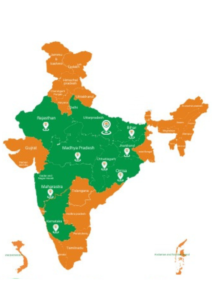
Trusted by 50000+ Customers
Anya Green Energy is a leading solar company and Solar Energy service provider established in 2013. We are recognized by startup India and customer best choice award 2022.
Our Achievements :
Recognized byStartup India.
Purvanchal’s first solar company to operate exclusively with solar products.
Certified by well-known institutions such as MSME, IndiaMart, and Just Dial and many more.
Winner of the Best Customer Choice Award 2022.
Over 50,000 happy customers across India.