Delhi Solar Scheme 2025: Free Rooftop Solar for 400-Unit Households Explained
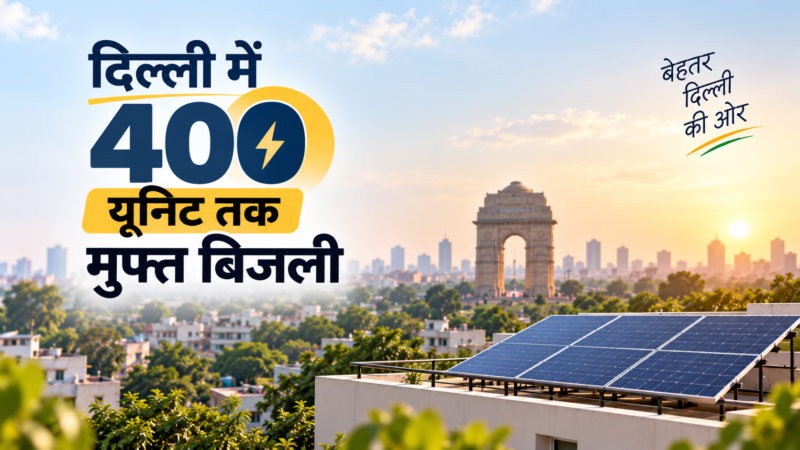
Your electricity bill in Delhi could soon drop to zero — not because of a subsidy on your existing meter, but because of a solar panel sitting on your own roof. That’s the real story behind the Delhi Solar Scheme, the capital’s newly expanded push to bring free rooftop solar to households within the 400 units electricity bracket. This blog cuts through the confusion — including the viral misunderstanding around “400 free units” — and lays out exactly what the Delhi Rooftop Solar Yojana offers, who qualifies, and where things stand today.
What Is the Delhi Solar Scheme?
The Delhi Solar Scheme is a revised rooftop-solar policy under which eligible households can get a 3 kW solar system installed on their roof without paying any upfront installation cost. It builds on the earlier Delhi Solar Policy 2023, but the 2025 version goes further: instead of consumers paying first and claiming subsidies later, this Delhi Rooftop Solar Yojana removes the upfront burden completely for qualifying homes.
Under the current structure, domestic consumers with average monthly consumption of up to 400 units electricity are eligible. This is where most people trip up online — this is not a promise of 400 free electricity units every month from the grid. Delhi’s existing subsidy already gives zero bills for consumption up to 200 units, with a separate support slab for 201–400 units. The Delhi Solar Scheme is a different, additional benefit: it’s about installing free rooftop solar for anyone in that consumption bracket, not about handing out more free grid units. Getting this distinction right is exactly why the Delhi Rooftop Solar Yojana deserves a clear explainer rather than another confusing headline.
Funding comes from two pockets stacked together: the central government’s PM Surya Ghar Yojana offers up to ₹78,000 for a 3 kW residential system, and Delhi’s own policy adds a matching capital subsidy, with a state top-up bridging any remaining gap — effectively making the Delhi Solar Scheme free for eligible households.
Goals and Objectives of the Delhi Solar Scheme
The Delhi Solar Scheme is built around a few clear objectives:
- Eliminate the upfront cost barrier that has historically stopped middle-class households from going solar, even when subsidies existed on paper.
- Expand rooftop solar capacity by roughly 500 MW by March 2027, reducing daytime pressure on Delhi’s conventional power grid.
- Bring around 2.3 lakh households under one free rooftop solar rollout — one of the capital’s largest residential clean-energy drives to date.
- Cut long-term electricity bills for families consuming up to 400 units electricity monthly, who don’t currently get full subsidy relief on the grid.
- Support India’s broader clean-energy push by aligning the state policy tightly with the central PM Surya Ghar Yojana.
- Reduce pollution and carbon footprint in a city that regularly battles some of the worst air quality in the country.
Every one of these goals under the Delhi Rooftop Solar Yojana points to the same underlying idea: make solar the default choice, not the expensive alternative.
Who Can Benefit from the Delhi Solar Scheme?
The eligibility net for this Delhi Solar Scheme is wider than many assume:
- Domestic consumers with monthly consumption up to 400 units electricity — a large share of Delhi’s residential base falls into this bracket.
- Homeowners with suitable rooftop space, subject to technical feasibility checks by the local DISCOM.
- Tenants with roof-access permission, since the policy doesn’t restrict benefits to owner-occupied homes alone.
- Housing societies and RWAs, who can potentially pool rooftop space for shared installations.
- Indirectly, the whole city benefits through lower grid demand and improved air quality as more homes shift to free rooftop solar.
If your household sits in that consumption range and you’ve been paying full price for electricity beyond the free 200-unit slab, the Delhi Solar Scheme is arguably the biggest financial relief announcement aimed at you this year.
Benefits of the Delhi Rooftop Solar Yojana
Here’s what makes this free rooftop solar initiative genuinely stand out from earlier subsidy attempts:
- Zero upfront installation cost for eligible households — no need to arrange the full payment and wait for reimbursement later.
- Combined central + state subsidy, meaning support from PM Surya Ghar Yojana and Delhi’s own capital subsidy stack together instead of overlapping.
- Long-term electricity savings, since a 3 kW rooftop system can significantly offset or eliminate monthly bills for years.
- Five years of free maintenance planned for installed systems, reducing the usual worry about upkeep costs.
- No conflict with existing subsidies — reports indicate the current 200-unit free electricity benefit can continue alongside the new solar installation.
- Net metering support, letting households earn credit for any surplus power sent back to the grid.
- Cleaner air for the city, as wider rooftop solar adoption chips away at Delhi’s dependence on conventional power source
Application Process for the Delhi Solar Scheme
Unlike some welfare schemes that run entirely in the background, the Delhi Solar Scheme does need active steps from interested households:
- Check eligibility — confirm your average monthly consumption falls within the 400 units electricity bracket via your electricity bill.
- Choose an empanelled vendor — installations typically need to go through vendors approved under PM Surya Ghar Yojana guidelines or the state programme.
- Apply through your DISCOM — submit your application along with your electricity connection details for feasibility assessment.
- Roof and technical feasibility check — officials verify whether your rooftop can structurally and technically support a 3 kW system.
- Subsidy processing — once approved, the combined central and state subsidy amounts are adjusted so the household bears little to no upfront cost.
- Net meter installation — the final step connects your rooftop system to the grid, enabling both consumption offset and export credit.
Because vendor empanelment, exact subsidy disbursement, and grievance-redressal rules are still being finalised, applicants are strongly advised to confirm the latest process and figures directly with their DISCOM or the official Delhi Solar Portal before making any payment.
Current Scenario: Where Does the Delhi Solar Scheme Stand Today?
As things stand, this Delhi Rooftop Solar Yojana has Cabinet approval and a public target — but it is still in the early implementation phase. The government has set March 2027 as the deadline to cover around 2.3 lakh households and add 500 MW of rooftop capacity, yet the full operational rulebook, including vendor lists and detailed subsidy flow under PM Surya Ghar Yojana, is still being published in stages.
This gap between announcement and on-ground rollout is exactly why so much confusion has spread online about “400 free electricity units.” To be clear once more: the entire framework revolves around one number — 400 units electricity — the exact cutoff separating existing subsidy consumers from new rooftop-solar beneficiaries. The two benefits run alongside each other rather than replacing one another.
For now, the smartest move for eligible Delhi households is to track official DISCOM communication and the state solar portal closely, since implementation details under PM Surya Ghar Yojana are expected to firm up over the coming months as this initiative moves from Cabinet approval to real rooftops.

Trusted by 50000+ Customers
Anya Green Energy is a leading solar company and Solar Energy service provider established in 2013. We are recognized by startup India and customer best choice award 2022.
Our Achievements :
Recognized by Startup India.
Purvanchal’s first solar company to operate exclusively with solar products.
Certified by well-known institutions such as MSME, IndiaMart, and Just Dial and many more.
Winner of the Best Customer Choice Award 2022.
Over 50,000 happy customers across India.