Unlocking 30%+ Efficiency: The Commercial and Economic Case for Perovskite-Silicon Tandem Cells
The global transition toward clean, renewable energy has reached a critical turning point. While utility-scale ground-mounted solar farms played a pivotal role over the last decade, state governments and regional energy planners face a growing spatial constraint: land scarcity. As urbanization expands, forest conservation tightens, and prime agricultural soil is preserved for food production, finding vast tracts of open land for conventional photovoltaic arrays has become increasingly difficult.
To overcome this bottleneck, public authorities and energy developers are looking beyond standard single-junction silicon panels and turning toward next-generation photovoltaic architectures.
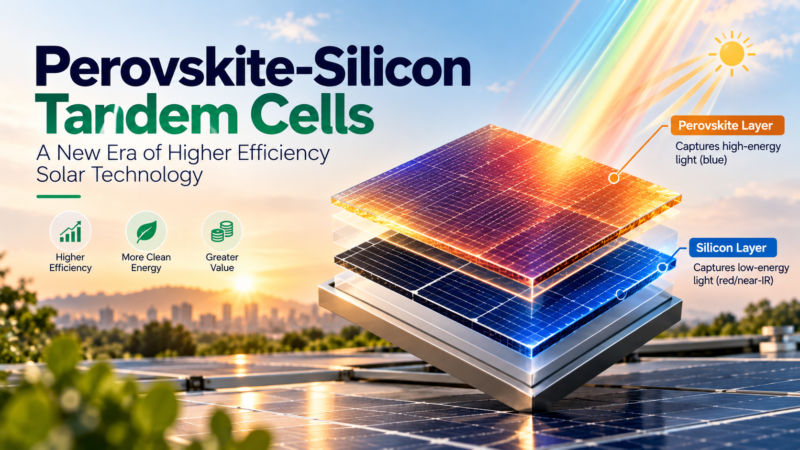
Perovskite-silicon tandem cells—technically engineered by layering a high-bandgap perovskite top cell directly onto a silicon base—have emerged as a transformative solution. By deploying these high-efficiency multi-junction arrays across utility solar parks, rooftop installations, and space-constrained urban environments, states can rapidly add gigawatts of clean generation capacity without expanding land footprints.
Below is an in-depth analysis of why state governments across the globe are aggressively prioritizing perovskite-silicon tandem cells to secure their clean energy futures.
Zero Land Acquisition: Unlocking Clean Energy Without Real Estate Conflict
The most immediate barrier to traditional clean energy expansion is securing land. Acquiring thousands of contiguous acres for a utility-scale solar project usually requires navigating complex property rights, negotiating long-term land leases, and enduring years of legal hurdles. In densely populated states or agricultural regions, converting arable land into energy parks frequently triggers intense local pushback, legal disputes, and regulatory gridlock.
By dramatically increasing energy output per square meter, perovskite-silicon tandem cells alleviate these real estate challenges by enabling zero land acquisition expansion—generating significantly more megawatt-hours from pre-existing energy sites.
Eliminating Agricultural and Forest Displacement
When energy planners select perovskite-silicon tandem cells, they protect fertile topsoil for farming and eliminate the need to clear forests or disturb native terrestrial ecosystems. State agricultural departments favor this high-density model because it safeguards rural farming economies while expanding clean power generation simultaneously.
Accelerating Permitting and Construction Timelines
Land acquisition for traditional ground-mounted projects often consumes up to 50% of the pre-construction timeline. Land-lease negotiations, eminent domain challenges, title clearing, and site leveling can delay grid connection by years. Because upgraded tandem retrofits utilize existing substation infrastructure, transmission corridors, and designated energy zones, licensing processes are streamlined. Deploying perovskite-silicon tandem cells allows state planners to bypass multi-party property disputes, cutting project development timelines dramatically.
Revitalizing Underutilized Infrastructure
Commercial rooftops, brownfields, parking canopies, and highway sound barriers represent previously underutilized spatial assets. Transforming these artificial surfaces into high-density energy generation hubs generates immediate public revenue through state-level power generation without adding zero land acquisition expenses to the taxpayer burden.
The Cooling Efficiency Advantage: Maximizing Output via Thermal Regulation
Beyond solving spatial limitations, perovskite-silicon tandem cells offer a distinct physical advantage over standard silicon panels: superior thermodynamic spectrum harvesting and operational water-cooling thermal resilience.
Standard silicon photovoltaic modules are sensitive to heat. As ambient temperatures rise, a panel’s internal electrical resistance increases, causing its energy output to decline. In hot climate zones, ground-mounted panels can reach operating temperatures between 65°C and 75°C during summer peak hours, causing significant performance degradation.
The Water-Cooling Microclimate
When deployed over water reservoirs or floating pontoon installations, tandem architectures benefit immensely from a localized water-cooling microclimate. The constant ambient evaporation underneath the array regulates operating temperatures, keeping both the perovskite layer and silicon substrate running far closer to their standard test condition (STC) efficiency ratings.
Higher Energy Generation Yield
Engineers and energy research laboratories consistently document that combining multi-junction spectrum optimization with effective thermal regulation boosts power generation.
Lower Temperature Coefficients: Multi-junction tandem cells distribute solar absorption across two tuned energy gaps, reducing thermal dissipation losses during peak summer radiation periods.
Increased Generation Yield: Combining advanced tandem absorber layers with a passive water-cooling substrate yields a measurable jump in total annual power generation compared to conventional installations.
For state energy departments evaluating lifecycle return on investment (ROI), this continuous performance bonus offsets initial manufacturing setup costs.
Evaporation Control and Water Conservation: Supporting Regional Hydrology
Energy production and water security are deeply intertwined—a dynamic known as the energy-water nexus. State governments operating in drought-prone regions, arid climates, or areas dependent on seasonal rainfall face a constant struggle to retain water in open reservoirs.
Deploying perovskite-silicon tandem cells across floating solar infrastructures addresses this challenge directly by serving a dual utility purpose.
Shielding Reservoirs from Solar Radiation
Open water surfaces exposed to direct sunlight, high ambient temperatures, and surface winds experience massive evaporation losses annually. When high-efficiency perovskite-silicon tandem cells are installed on floating platforms, the dense covering of dark tandem modules acts as a physical shield over the reservoir.
By blocking direct sunlight and reducing wind velocity across the water surface, these floating tandem installations reduce water evaporation by 25% to 40% over covered areas.
Preserving Agricultural and Municipal Supplies
The water saved through evaporation suppression offers substantial economic and community benefits:
Agricultural Protection: Retaining millions of gallons of water in agricultural canals and farm storage dams guarantees irrigation access during dry summer seasons, stabilizing crop yields.
Drinking Water Security: Municipal drinking water reservoirs retain their volume longer during heatwaves, reducing the need for costly water rationing or emergency pumping operations.
Biological Impact: Shading water surfaces suppresses unwanted biological growth, such as toxic algal blooms, which preserves raw water quality and lowers municipal treatment costs. The mitigation of surface water evaporation preserves vital hydro-reserves for drought-vulnerable populations.
Key Performance and Deployment Metrics
To understand why state energy boards prefer land-optimized and floating tandem deployment models, it helps to analyze how perovskite-silicon tandem cells compare against traditional renewable installations across operational, environmental, and performance metrics:
Standard Ground Silicon: High land acquisition requirements (4–5 acres per MW), baseline energy generation yield (~20-22%), neutral or negative water conservation impact, complex permitting processes, and single-junction spectrum utilization.
Standard Rooftop Silicon: Zero extra land required, baseline energy generation yield (~19-21%), neutral water conservation impact, variable permitting complexity, and single-junction spectrum utilization.
Perovskite-Silicon Tandem Cells: Zero land acquisition needed for retrofit expansions, maximized energy generation yield (>30%), reduces water evaporation by 25%–40% on floating setups, streamlined permitting on existing grids, optimized performance via water-cooling, and dual-junction spectrum utilization.
Strategic Grid Integration and Hydropower Hybridization
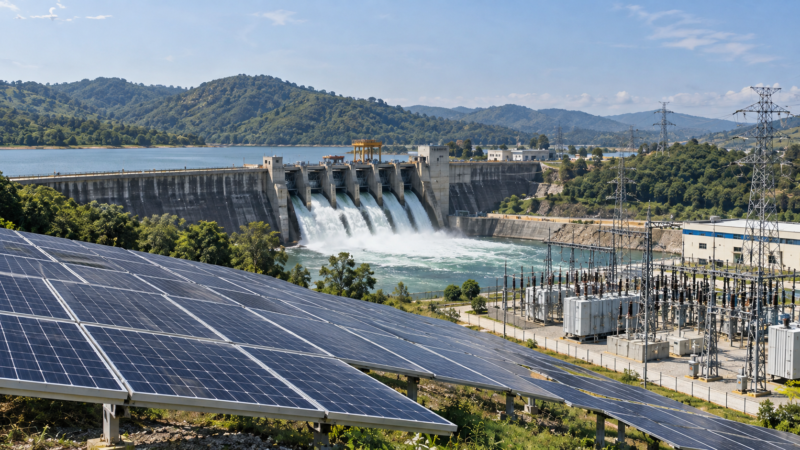
A compelling driver behind the rise of perovskite-silicon tandem cells is their ability to integrate seamlessly with existing power infrastructure—particularly hydroelectric dams and utility grid ties.
Hydro-Solar Hybridization
Deploying high-output perovskite-silicon tandem cells directly over the reservoir of an operating hydroelectric power plant creates a highly efficient hybrid system:
Shared Transmission Infrastructure: Tandem plants mounted on hydro reservoirs connect directly to the dam’s pre-existing substations and high-voltage transmission lines. This eliminates the need to build expensive new power corridors, saving states millions of dollars in capital expenditure.
Day-Night Balancing: During daylight hours, the high generation yield from tandem arrays provides peak energy output, allowing dam operators to hold back water reserves. At night or during demand spikes, the hydro turbines open, providing continuous power generation. This combination turns intermittent solar energy into a reliable, dispatchable power source without relying on battery storage.
Maximizing Energy Generation Yield
Because perovskite-silicon tandem cells absorb a broader spectrum of sunlight—the top perovskite layer absorbing high-energy blue photons and the bottom silicon layer harvesting lower-energy infrared photons—their overall generation yield per square meter is unparalleled. Combining this dual-absorption spectrum with reduced surface dust accumulation on floating platforms delivers a higher daily generation yield across all seasonal weather patterns.
The Path Ahead for State Energy Planners
State governments face the challenge of expanding clean power generation quickly while managing land constraints, grid reliability, and water conservation.
Perovskite-silicon tandem cells meet these demands simultaneously. By providing zero land acquisition friction, delivering a water-cooling performance boost, mitigating surface evaporation losses, and delivering an unprecedented generation yield, tandem photovoltaics are no longer a distant lab concept—they are becoming a cornerstone of modern state energy planning.
As manufacturing scales and encapsulation technology matures, perovskite-silicon tandem cells will continue to turn underutilized real estate, rooftops, and water bodies into clean, highly efficient power sources for millions of homes worldwide.

Trusted by 50000+ Customers
Anya Green Energy is a leading solar company and Solar Energy service provider established in 2013. We are recognized by startup India and customer best choice award 2022.
Our Achievements :
Recognized by Startup India.
Purvanchal’s first solar company to operate exclusively with solar products.
Certified by well-known institutions such as MSME, IndiaMart, and Just Dial and many more.
Winner of the Best Customer Choice Award 2022.
Over 50,000 happy customers across India.