Monocrystalline vs. Polycrystalline: Choosing the Right Panel Efficiency
Are you considering rooftop solar for your home, only to feel instantly overwhelmed by the sudden flood of technical jargon? Between cell architectures, temperature coefficients, inverter compatibility, and panel ratings, the process of buying solar energy can quickly feel like studying for a physics exam.
One of the first major technical crossroads every prospective solar buyer encounters is simple yet critical: Should you choose monocrystalline or polycrystalline solar panels?
While both technologies capture sunlight and convert it into usable electricity for your household appliances, they are built differently, perform differently under real-world weather conditions, and carry distinct price tags. Choosing between them isn’t just a matter of aesthetics or brand preference—it fundamentally determines how much clean power your roof can produce, how well your system handles intense summer heat, and how fast your initial investment pays for itself.
In this deep-dive guide, we will evaluate cell structures, compare real-world efficiency ratings, examine temperature coefficients, analyze aesthetic differences, and provide a clear decision framework to help you choose the right panel efficiency for your roof space and budget constraints.
Core Concept: Monocrystalline vs polycrystalline panels
To understand why solar panels perform differently on a roof, you have to look down at the molecular level where the silicon cells are created. The primary divider between monocrystalline and polycrystalline panels comes down to silicon purity and the manufacturing process used to grow the silicon ingots.
Monocrystalline Panels: The Single-Crystal Standard
Monocrystalline solar cells are manufactured using the Czochralski process. In this method, a single seed crystal of high-purity silicon is dipped into a vat of molten silicon and slowly pulled upward while rotating. This creates a single, continuous cylindrical silicon ingot.
Because the resulting ingot consists of one unbroken crystal lattice, electrons generated when sunlight hits the panel have an unobstructed path to travel through. This high purity minimizes internal electrical resistance and carrier recombination losses.
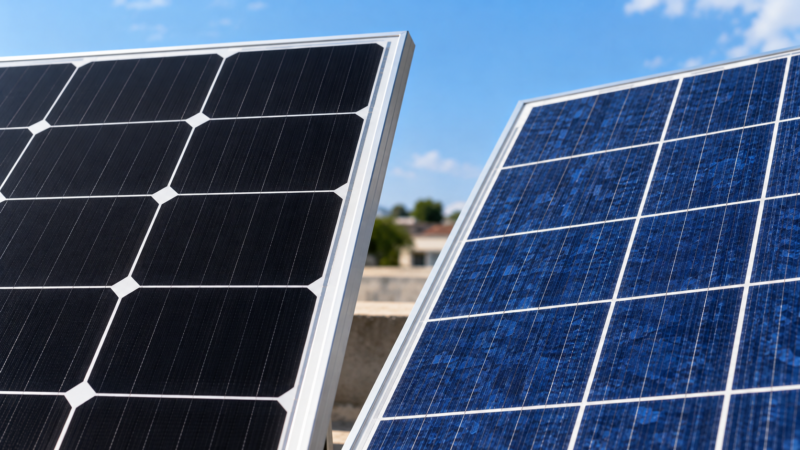
Cell Appearance: Deep, uniform black color with distinctive Octagonal cut-outs (chamfered corners) caused by slicing rounded silicon cylinders into flat square wafers.
Silicon Purity: Exceptionally high (single-crystal structure).
Polycrystalline Panels: The Multi-Fragment Alternative
Polycrystalline (sometimes referred to as multi-crystalline) panels are manufactured using a simpler, less energy-intensive casting process. Instead of growing a single continuous crystal, raw silicon fragments are melted together in a square mold and allowed to cool slowly.
As the molten silicon cools, thousands of individual silicon crystals fuse together within a single block. These boundaries between individual crystal fragments—known as grain boundaries—create internal barriers that impede the smooth flow of electrons.
Cell Appearance: Speckled blue, marbled texture that shimmers under direct sunlight, featuring perfectly square edges without cut corners.
Silicon Purity: Moderate (multi-crystal structure with internal boundaries).
Efficiency Ratings: How Much Sunlight Turns Into Power?
Solar panel efficiency measures the percentage of sunlight hitting the panel’s surface that is successfully converted into usable direct current (DC) electricity under Standard Test Conditions (STC: 1,000 W/m² irradiance, 25°C cell temperature).
Comparing Modern Conversion Rates
Polycrystalline Panels: Standard polycrystalline arrays typically deliver conversion efficiencies between 15% and 17.5%. On a standard physical module frame (roughly 6.5 ft × 3.5 ft), a poly panel generates between 380 and 420 Watts of power.
Monocrystalline Panels: Standard Monocrystalline PERC (Passivated Emitter and Rear Cell) and advanced N-type TOPCon panels deliver efficiency ratings ranging from 20% to 23.5%. The exact same physical module frame yields 540 to 580 Watts or more.
What the Efficiency Gap Means for Your Roof Area
Higher cell conversion rates translate directly to higher power density—generating more Watts per square foot of available roof space.
If your home requires a 5 kW rooftop system to offset your utility bills, consider how panel efficiency impacts the required surface area:
| Technical Parameter | Polycrystalline Setup (16.5% Eff.) | Monocrystalline Setup (21.5% Eff.) |
| System Capacity | 5,000 Watts (5 kW) | 5,000 Watts (5 kW) |
| Individual Panel Rating | 400 W per panel | 550 W per panel |
| Total Modules Needed | 13 Panels | 9 Panels |
| Roof Area Required | ~450 Square Feet | ~310 Square Feet |
| Roof Space Savings | Baseline Footprint | 31% Less Roof Space Needed |
Key Spatial Takeaway: Choosing high-efficiency monocrystalline panels allows you to generate the exact same total household energy using 30% to 35% less physical roof space.
Real-World Environmental Factors: Heat & Low-Light Performance
Laboratory efficiency scores are measured under ideal room conditions (25°C or 77°F). However, real solar panels live outdoors exposed to scorching summer heatwaves, ambient dust, monsoon clouds, and indirect ambient sunlight. How do these two cell structures hold up in real-world weather?
Temperature Coefficient: Performance Under Summer Heat
Contrary to popular belief, solar panels do not run better when they get hotter. As solar modules heat up on a sunny roof, their operating voltage drops, causing total power output to decline. This thermal loss is measured by the temperature coefficient (% loss per degree Celsius above 25°C).
Monocrystalline Thermal Coefficient: Typically ranges between -0.30% and -0.37% per °C.
Polycrystalline Thermal Coefficient: Typically ranges between -0.40% and -0.48% per °C.
During peak summer months when panel back-temperatures reach 65°C (40°C above test conditions), a polycrystalline panel loses up to 18% to 20% of its rated capacity due to heat degradation. A monocrystalline module under the exact same heat loses only 12% to 14%, ensuring higher overall energy yields during the hottest months of the year.
Low-Light Performance (Monsoon & Cloud Cover)
In areas subject to prolonged cloud cover, winter fog, or rainy monsoon seasons, monocrystalline silicon performs noticeably better in low-light environments. Because single-crystal silicon lacks internal crystal fragment barriers, it captures broader spectrum light wavelengths more efficiently, generating 10% to 15% more power during overcast or low-light daylight hours than equivalent polycrystalline setups.
Aesthetics, Longevity & Structural Degradation
While electrical performance is paramount, solar arrays are prominent architectural additions to your home. How do the two panel options compare visually and structurally over a 25-year lifespan?
Visual Appearance
Monocrystalline: Features a uniform, dark black appearance that blends seamlessly with modern architectural roofing tiles. For high-end residential installations, “all-black” monocrystalline panels (black cells, black backsheets, and dark aluminum frames) provide a clean, modern aesthetic.
Polycrystalline: Displays a bright, multi-hued blue color pattern caused by light reflecting off multiple internal silicon fragments. While functional, the bright blue marble pattern stands out prominently against dark or tiled roof surfaces.
Long-Term Degradation Rates
All solar panels experience minor annual degradation as silicon materials age under constant ultraviolet (UV) exposure:
Polycrystalline Degradation: Averages 0.6% to 0.8% per year. After 25 years of continuous outdoor operation, a polycrystalline module typically functions at roughly 78% to 80% of its original factory rating.
Monocrystalline Degradation: Averages 0.35% to 0.5% per year (especially N-type TOPCon modules). After 25 years, monocrystalline panels retain 85% to 88%+ of their original generating output.
Target Audience Decision Matrix: Choosing the Right Panel for Your Home
Now that we have evaluated cell structures, thermal limits, and efficiency ratings, how do you decide which technology fits your specific household situation? Your choice comes down to balancing two primary real-world constraints: available shadow-free roof space and upfront budget flexibility.
Scenario A: Limited Roof Space or Shaded Layouts
Your Situation: You live in an urban home, townhouse, or property with restricted shadow-free rooftop area (e.g., under 350 sq. ft.), or surrounding trees create partial afternoon shading.
The Recommendation: Choose Monocrystalline Panels.
Why: You need maximum power density. Monocrystalline panels allow you to fit a fully sized 3 kW or 5 kW capacity onto a tight roof footprint. Additionally, modern half-cut monocrystalline modules handle partial shading significantly better without shutting down entire panel strings.
Scenario B: Unrestricted Roof Space with Strict Upfront Capital Limits
Your Situation: You own an independent home, farm, or rural property with vast, unshaded flat concrete roof area, and your top priority is minimizing upfront hardware expenses.
The Recommendation: Consider Polycrystalline Panels.
Why: If you have 600+ sq. ft. of unused, unshaded roof space, you can afford the larger physical footprint required by lower-efficiency poly modules. The lower price per watt allows you to set up basic solar capacity at a reduced upfront capital outlay.
Scenario C: Optimizing Long-Term Financial ROI (The Modern Standard)
Your Situation: You want the absolute highest total lifetime return on investment (ROI) over a 25-year horizon, leveraging government subsidy structures (such as PM Surya Ghar).
The Recommendation: Choose Monocrystalline (Mono PERC or TOPCon).
Why: In today’s market, manufacturing scale has driven the price gap between mono and poly panels down to a modest margin. The additional power generated by monocrystalline panels during summer heat waves, monsoon seasons, and Years 15 through 25 easily repays the minor initial price difference.
Summary: The Verdict on Panel Efficiency
While polycrystalline panels played a crucial historic role in making solar energy affordable over the past two decades, the market balance has shifted. Rapid advancements in monocrystalline manufacturing have narrowed the price gap, making monocrystalline panels the undisputed standard for modern residential solar installations.
If you face tight roof constraints, intense summer heat, or want to maximize long-term financial returns over the next quarter-century, monocrystalline technology is worth the investment. Evaluate your available roof space, examine your household power needs, and choose the panel efficiency that will keep your home powered reliably for decades to come.
Trusted by 50000+ Customers
Anya Green Energy is a leading solar company and Solar Energy service provider established in 2013. We are recognized by startup India and customer best choice award 2022.
Our Achievements :
Recognized by Startup India.
Purvanchal’s first solar company to operate exclusively with solar products.
Certified by well-known institutions such as MSME, IndiaMart, and Just Dial and many more.
Winner of the Best Customer Choice Award 2022.
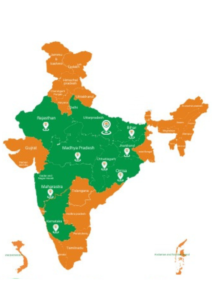
Over 50,000 happy customers across India.