CEA's New Safety Regulations: What Every Stakeholder Must Know
Every year, India records thousands of electrical accidents — many of them preventable through better compliance, stricter standards, and modernized safety frameworks. As the country’s power infrastructure rapidly evolves with rooftop solar, battery storage, and EV charging stations multiplying across cities and villages alike, the regulatory framework governing electrical safety needed a serious update. That’s precisely what has arrived through CEA’s new safety regulations — a comprehensive overhaul designed to address both traditional grid risks and the safety challenges introduced by India’s fast-changing energy landscape.
As one power sector consultant recently noted, “the grid of 2025 looks nothing like the grid of 2010 — and our safety regulations finally reflect that reality.” In this blog, we’ll break down exactly what’s changed, why it matters, and how different stakeholders — from utilities to homeowners — need to respond.
What Is the CEA and Why Its Regulations Matter
The Central Electricity Authority is the apex technical body under India’s Ministry of Power, responsible for setting standards across generation, transmission, distribution, and safety for the entire electricity sector. Any regulation issued by this body carries significant weight, as state electricity boards, private utilities, and infrastructure developers are legally required to comply.
CEA’s new safety regulations were introduced to modernize the existing framework — much of which hadn’t been substantially revised in over a decade — to account for emerging technologies, rising electrical accident rates, and the integration of renewable energy sources into increasingly complex grid systems.
Key Highlights of CEA's New Safety Regulations
Mandatory Earthing and Insulation Standards
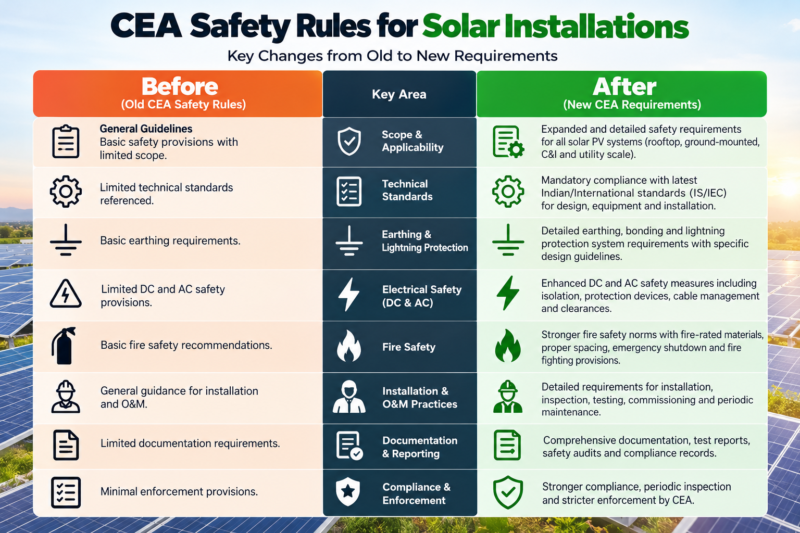
One of the central pillars of CEA’s new safety regulations involves stricter mandatory earthing requirements for all new electrical installations, including residential, commercial, and industrial connections. Insulation resistance testing has also been made compulsory at defined intervals, reducing the risk of electrical fires and shock hazards.
Battery Energy Storage System (BESS) Safety Protocols
With battery storage rapidly scaling alongside solar and wind projects, CEA’s new safety regulations introduce dedicated protocols for battery energy storage safety, including thermal runaway prevention measures, fire suppression system requirements, and mandatory safety clearances for installations above specified capacity thresholds. This addresses growing global concerns following several high-profile battery storage fire incidents internationally.
EV Charging Infrastructure Safety
As electric vehicle adoption accelerates, the regulations now mandate specific safety certifications for EV charging stations, covering overload protection, grounding standards, and periodic inspection requirements — ensuring that India’s rapidly expanding charging network doesn’t compromise on electrical safety standards.
Rooftop Solar Safety Compliance
Given the explosive growth of rooftop solar under schemes like PM Surya Ghar, CEA’s new safety regulations introduce specific guidelines for solar installation safety, including mandatory circuit breakers, surge protection devices, and certified installer requirements to reduce fire risks associated with poorly installed residential systems.
Enhanced Penalties for Non-Compliance
Unlike previous frameworks with relatively weak enforcement mechanisms, the new regulations introduce significantly higher penalties for utilities and contractors found violating safety standards, alongside mandatory incident reporting timelines for any electrical accident resulting in injury or major property damage.
Impact on Utilities and Power Distribution Companies
For state electricity boards and private distribution companies, CEA’s new safety regulations mean substantial operational changes. Utilities must now conduct more frequent infrastructure audits, upgrade aging transformers and substations that don’t meet updated insulation standards, and invest in digital monitoring systems capable of detecting faults before they escalate into accidents.
Compliance Costs:
Industry estimates suggest utilities nationwide may need to invest upwards of ₹8,000-10,000 crore collectively over the next three years to bring existing infrastructure in line with the new electrical safety standards, though this is expected to significantly reduce long-term accident-related liabilities and outage costs.
Grid Modernization Push:
The regulations indirectly accelerate India’s broader grid modernization efforts, as utilities upgrading for compliance often simultaneously integrate smart grid technologies, improving overall power grid safety and reliability beyond just meeting minimum regulatory requirements.
Ready to switch to Solar?
solar solutions with Anya Green Energy and discover how you can reduce your electricity bills.
Contact UsImpact on Renewable Energy and Battery Storage Developers
Given India’s aggressive renewable energy expansion, CEA’s new safety regulations carry particular significance for solar, wind, and battery storage project developers. Projects now require safety certification at multiple project stages — from design approval through commissioning — rather than relying solely on post-installation inspections.
Battery Storage Specific Requirements:
With India targeting over 50 GWh of battery storage capacity by 2030, the new battery energy storage safety protocols require developers to incorporate fire detection systems, thermal management solutions, and emergency shutdown mechanisms as standard design features rather than optional add-ons.
Impact on Project Timelines:
While these requirements add upfront compliance steps, industry analysts suggest they ultimately protect developers from costly post-installation retrofits or accident-related project shutdowns, making compliance a long-term cost-saving measure despite short-term delays.
Impact on Residential and Commercial Consumers
For everyday consumers, particularly those installing rooftop solar or home EV chargers, CEA’s new safety regulations translate into mandatory use of certified installers and equipment meeting updated safety benchmarks. While this may slightly increase installation costs, it significantly reduces risks of electrical fires, shocks, and equipment failures that have historically plagued poorly regulated residential installations.
Consumer Awareness Requirements:
The regulations also mandate that installers provide clear safety documentation and usage guidelines to consumers, improving transparency around maintenance requirements and warning signs of potential electrical hazards in homes and small businesses.
Broader Implications for India's Clean Energy Transition
As India scales renewable energy, battery storage, and EV infrastructure simultaneously, robust safety frameworks become essential rather than optional. CEA’s new safety regulations essentially function as a foundational layer ensuring that rapid infrastructure growth doesn’t come at the cost of public safety — a balance that’s often difficult to strike during periods of fast technological adoption.
This regulatory modernization also sends a strong signal to international investors and technology partners that India’s power sector is maturing its governance frameworks alongside its capacity expansion, potentially improving investor confidence in large-scale renewable and storage projects.
Real-World Context: Why These Regulations Were Necessary
India has witnessed several concerning incidents in recent years that underscore the urgency behind CEA’s new safety regulations. Electrical fires linked to poor rooftop solar installations, battery storage thermal incidents at renewable energy sites, and outdated transformer failures causing prolonged outages have all highlighted gaps in the previous regulatory framework.
As one electrical safety expert explained in an industry panel discussion, “we were essentially running 2024-level technology on 2010-level safety rules — this update was overdue, not optional.” The new framework directly responds to these documented gaps rather than operating as a purely preventive or theoretical exercise.
Challenges in Implementation
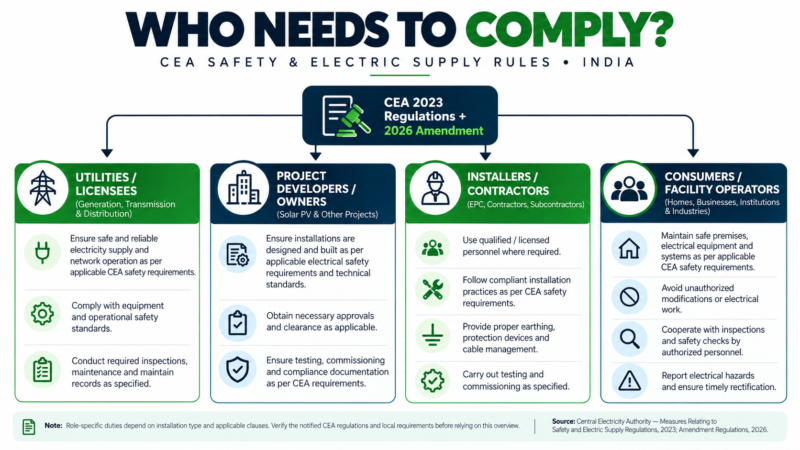
Despite their necessity, CEA’s new safety regulations face real implementation hurdles:
Skilled Workforce Shortage: Certified installers and inspectors trained specifically for new compliance requirements remain limited, particularly in smaller cities and rural areas where solar and EV infrastructure is rapidly expanding.
Retrofit Costs for Existing Infrastructure: Older buildings, industrial facilities, and legacy grid infrastructure require significant investment to meet updated standards, creating financial strain particularly for smaller utilities and businesses.
Enforcement Consistency: Given India’s federal structure, actual enforcement of central regulations can vary significantly across states, potentially creating compliance gaps despite uniform national standards.
Awareness Gaps: Many small-scale installers and even some consumers remain unaware of updated requirements, risking unintentional non-compliance during the transition period.
What Stakeholders Should Do Now
For businesses, developers, and consumers navigating CEA’s new safety regulations, several immediate steps are recommended:
- Utilities should prioritize infrastructure audits to identify non-compliant equipment requiring upgrades
- Renewable energy and battery storage developers should integrate safety certification processes into project planning from the design stage rather than treating it as a final-step formality
- Homeowners and businesses installing solar or EV charging infrastructure should verify installer certifications explicitly tied to the new regulatory requirements
- Industry associations should invest in training programs to address the certified workforce shortage highlighted as a key implementation barrier
Conclusion: Building a Safer Foundation for India's Energy Future
CEA’s new safety regulations represent a necessary and overdue modernization of India’s electrical safety framework, directly responding to the realities of a power sector being reshaped by renewable energy, battery storage, and electric vehicle adoption. While implementation challenges around workforce readiness, retrofit costs, and enforcement consistency remain real, the long-term benefits — fewer accidents, more reliable infrastructure, and stronger investor confidence — far outweigh the short-term compliance burden.
As India continues scaling its clean energy ambitions at an unprecedented pace, frameworks like CEA’s new safety regulations ensure that this growth happens on a foundation of genuine safety rather than regulatory gaps playing catch-up with technological change. For every stakeholder — from large utilities to individual homeowners — understanding and adapting to these changes isn’t just about compliance; it’s about building a fundamentally safer energy ecosystem for the decade ahead.
FAQs About CEA's New Safety Regulations
Q: What is the CEA and what authority does it have?
A: The Central Electricity Authority is India’s apex technical power sector body under the Ministry of Power, with legal authority to set binding safety and technical standards across the electricity sector.
Q: Do CEA’s new safety regulations apply to residential rooftop solar?
A: Yes, the regulations include specific safety compliance requirements for rooftop solar installations, including certified installer mandates and mandatory protective equipment.
Q: How do the new regulations affect battery storage projects?
A: Battery energy storage systems must now incorporate thermal runaway prevention, fire suppression systems, and safety certifications as standard requirements under the updated framework.
Q: What happens if utilities or developers don’t comply?
A: The new regulations introduce significantly higher penalties for non-compliance, along with mandatory incident reporting requirements for safety violations.
Trusted by 50000+ Customers
Anya Green Energy is a leading solar company and Solar Energy service provider established in 2013. We are recognized by startup India and customer best choice award 2022.
Our Achievements :
Recognized by Startup India.
Purvanchal’s first solar company to operate exclusively with solar products.
Certified by well-known institutions such as MSME, IndiaMart, and Just Dial and many more.
Winner of the Best Customer Choice Award 2022.
Over 50,000 happy customers across India.