Off-Grid or On-Grid Solar for Home: Which Is Actually Better for You?
If you’ve started researching solar, you’ve probably run into this exact fork in the road: off-grid or on-grid solar for home — and nobody seems to explain the difference in plain language. Installers throw around terms like “net metering” and “battery backup” assuming you already know what they mean, and most online content just defines the terms without actually telling you which one fits your situation.
This guide fixes that. We’ll break down exactly how an on-grid solar system differs from an off-grid solar system, where a hybrid solar system fits in, and how to decide which setup is genuinely right for your home — not just in theory, but based on your actual electricity situation.
The Core Difference: On-Grid vs Off-Grid Solar for Home
At the simplest level, deciding between off-grid or on-grid solar for home comes down to one question: do you want to stay connected to the electricity grid, or go completely independent of it?
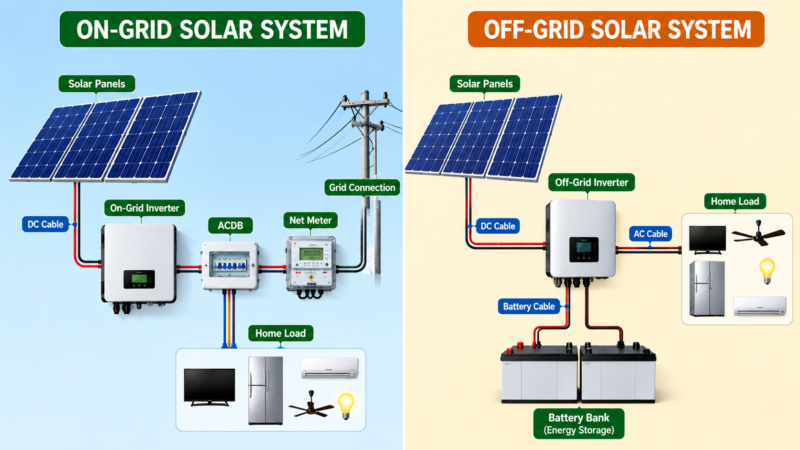
An on-grid solar system stays connected to the grid and uses net metering to export excess power you generate and import power when you need more than you’re producing. An off-grid solar system disconnects entirely from the grid and relies on battery storage to power your home around the clock, with no backup from the utility company at all.
Both have real advantages depending on your situation — let’s break each one down.
Ready to switch to Solar?
solar solutions with Anya Green Energy and discover how you can reduce your electricity bills.
Contact UsOn-Grid Solar System: How It Works and Who It's For
An on-grid solar system is by far the most common setup for Indian homes, and for good reason. It’s simpler, cheaper, and works well wherever grid supply is reasonably reliable.
How Net Metering Works
With an on-grid solar system, any electricity you generate beyond your immediate consumption gets exported to the grid, and your electricity meter tracks this as a credit. When your panels aren’t producing enough (like at night), you draw power back from the grid as usual. Your monthly bill reflects the net difference between what you exported and what you imported — hence “net metering.”
Advantages of On-Grid Solar
- Lower upfront cost — no expensive battery bank required
- Simpler installation — fewer components, faster setup
- Government subsidy eligibility — most subsidy schemes are designed around grid-connected systems
- Full use of excess generation — exported power earns bill credits rather than going to waste
Limitations of On-Grid Solar
The biggest drawback of an on-grid solar system is simple: when the grid goes down, so does your power — even if the sun is shining. Since these systems are designed to automatically shut off during grid outages (a safety requirement to protect utility workers), you lose power along with everyone else on the grid during a cut.
Hybrid Solar System: The Middle Ground
For homeowners who want backup power without fully disconnecting from the grid, a hybrid solar system offers a practical middle path.
A hybrid solar system stays grid-connected (retaining net metering benefits) while also including battery storage for backup power during outages. This means you get the cost efficiency and subsidy eligibility of an on-grid solar system, plus a safety net during power cuts — without needing the oversized battery capacity an off-grid solar system requires, since the grid still handles your power needs most of the time.
The trade-off is cost: a hybrid solar system costs more upfront than a pure on-grid solar system, though generally less than a full off-grid solar system, since the battery only needs to cover typical outage durations rather than complete energy independence.
Side-by-Side Comparison
| Factor | On-Grid Solar System | Hybrid Solar System | Off-Grid Solar System |
|---|---|---|---|
| Upfront cost | Lowest | Moderate | Highest |
| Works during power cuts | No | Yes | Yes (always) |
| Subsidy eligibility | Yes, widely available | Partial, varies | Generally no |
| Battery required | No | Yes (moderate size) | Yes (large capacity) |
| Maintenance complexity | Low | Moderate | Higher |
| Best suited for | Stable grid areas | Frequent but short outages | Remote/no grid access |
This table makes the off-grid or on-grid solar for home decision much clearer once you see your priorities laid out against each option directly.
How to Decide: A Practical Framework
Rather than picking based on which sounds more impressive, use these questions to guide your off-grid or on-grid solar for home decision:
- How reliable is your grid supply? Stable grid areas rarely justify the extra cost of an off-grid solar system.
- How frequent and long are your power outages? Occasional short cuts favor a hybrid solar system; near-total absence of grid access favors going fully off-grid.
- What’s your budget? An on-grid solar system offers the fastest payback and lowest entry cost by a significant margin.
- Do you want subsidy support? This strongly favors an on-grid solar system or hybrid setup, since most schemes are structured around grid connectivity.
- Is your location genuinely off the grid? True off-grid solar system setups make the most sense where grid connection simply isn’t available, not just where it’s occasionally unreliable.
For the vast majority of Indian homeowners living in grid-connected areas — even ones with occasional outages — a standard on-grid solar system or a hybrid solar system delivers better overall value than going fully off-grid.
As one renewable energy engineer put it in a recent industry explainer: “People often go off-grid because they want independence, but most of them actually just want backup power during outages — which a hybrid system solves at a fraction of the cost.” That distinction is worth sitting with before committing to the more expensive option.
Common Misconceptions
A few myths consistently confuse the off-grid or on-grid solar for home decision:
- “Off-grid means free electricity forever” — true, but only after a much higher upfront investment and ongoing battery replacement costs
- “On-grid systems work during power cuts” — false by design; standard on-grid solar system setups shut off automatically during grid outages for safety reasons
- “Hybrid systems are just expensive off-grid systems” — not accurate; hybrid systems are specifically designed to need smaller batteries since they still rely on the grid most of the time
Clearing up these misconceptions is often the key moment where homeowners realize which option actually fits their needs.
Final Verdict: Which Should You Choose?
For most homes with reasonably stable grid access, an on-grid solar system remains the smartest choice — lower cost, faster payback, and full subsidy eligibility. If outages are frequent but short, a hybrid solar system adds valuable backup power without the expense of full energy independence. A true off-grid solar system only makes sense for homes genuinely disconnected from grid infrastructure, where there’s simply no alternative.
The off-grid or on-grid solar for home decision isn’t about which sounds more self-sufficient — it’s about matching the system to your actual grid reliability, budget, and backup power needs.
If you’re still unsure which setup fits your home, Anya Green Energy offers free consultations to assess your grid reliability, outage patterns, and budget — helping you choose confidently between on-grid, hybrid, and off-grid options.
FAQ Section
Q1: Off-grid or on-grid solar for home — which is cheaper?
An on-grid solar system is significantly cheaper upfront since it doesn’t require battery storage, making it the better choice for most homes with stable grid access.
Q2: Does an on-grid solar system work during a power cut?
No — a standard on-grid solar system automatically shuts off during grid outages for safety reasons, unless paired with battery backup in a hybrid setup.
Q3: Is an off-grid solar system eligible for government subsidy?
Generally no — most government subsidy schemes are structured around grid-connected systems, so a fully off-grid solar system typically doesn’t qualify.
Q4: What is a hybrid solar system and who should get one?
A hybrid solar system combines grid connectivity with battery backup, making it ideal for homeowners who experience frequent but short power outages and want backup power without full off-grid costs.
Q5: How do I decide between off-grid or on-grid solar for home?
The decision should be based on your grid reliability, outage frequency, budget, and subsidy eligibility — stable grid areas favor on-grid, frequent short outages favor hybrid, and no grid access favors off-grid.
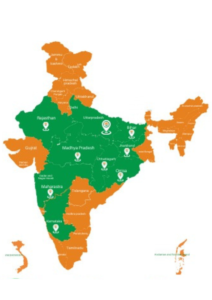
Trusted by 50000+ Customers
Anya Green Energy is a leading solar company and Solar Energy service provider established in 2013. We are recognized by startup India and customer best choice award 2022.
Our Achievements :
Recognized by Startup India.
Purvanchal’s first solar company to operate exclusively with solar products.
Certified by well-known institutions such as MSME, IndiaMart, and Just Dial and many more.
Winner of the Best Customer Choice Award 2022.
Over 50,000 happy customers across India.