Residential vs Commercial Solar: Which Option Fits Your Energy Needs?
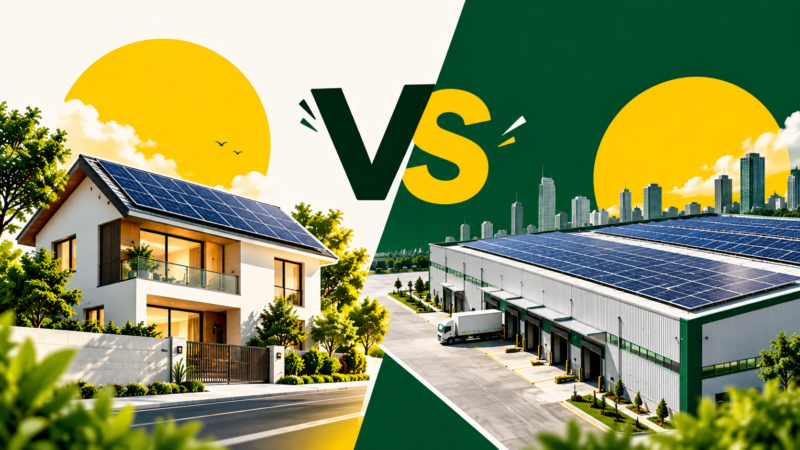
Choosing between residential vs commercial solar isn’t just a matter of system size — it affects your financing options, payback period, subsidy eligibility, and even the type of paperwork involved. Whether you’re a homeowner weighing rooftop panels or a business owner evaluating a larger installation, understanding the difference between residential solar systems and commercial solar systems is the first step toward making the right decision.
This blog breaks down the real distinctions in residential vs commercial solar setups — covering cost, scale, regulation, and return on investment — while comparing home solar vs business solar on the metrics that actually matter for decision-making.
Why the Residential vs Commercial Solar Comparison Matters
When people search for residential vs commercial solar differences, they’re usually trying to decide which path applies to them — because the needs of a household differ enormously from a business’s solar panel installation for business requirements. A home consumes a relatively small, predictable amount of electricity, while a business or factory may have variable loads, higher daytime consumption, and far more roof or land area to work with.
Understanding Residential Solar Systems
Energy Needs and System Size
Residential solar systems typically range from 3kW to 10kW, sized to match a household’s average monthly consumption. Unlike large-scale commercial solar systems that serve factories, offices, or warehouses, home installations are designed around rooftop space constraints and family-sized energy usage patterns — making system design relatively standardized.
Cost and Financing for Homes
Homeowners financing residential solar systems usually rely on consumer solar loans, EMI plans, or capital subsidies offered directly to individual households. The residential vs commercial solar cost gap is significant mainly due to scale — commercial projects involve far larger capital outlay, but also larger returns through bulk electricity savings.
Understanding Commercial Solar Systems
Energy Needs and System Size
Commercial solar systems are designed to offset high daytime electricity loads typical of offices, retail spaces, and manufacturing units. A proper solar panel installation for business must account for peak load timing, three-phase power requirements, and often significantly larger rooftop or ground-mounted arrays than any home would need.
Cost and Financing for Businesses
Businesses opting for commercial solar systems benefit from accelerated depreciation benefits, which can offset a large portion of the investment through tax savings alone — something unavailable to individual homeowners. This is one area where residential vs commercial solar truly diverges: the financing and tax treatment are built on entirely different frameworks.
Residential vs Commercial Solar: Key Differences
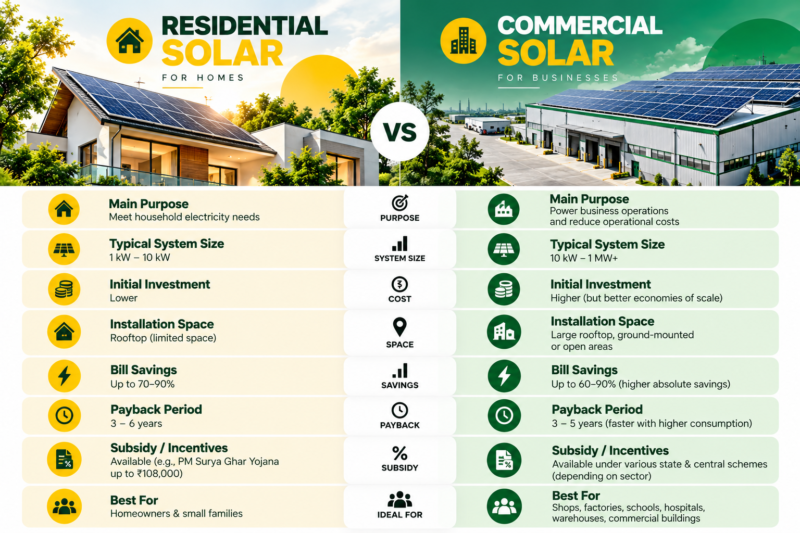
| Factor | Residential Solar | Commercial Solar |
|---|---|---|
| Typical System Size | 3kW – 10kW | 50kW – several MW |
| Ownership | Individual homeowner | Business/company |
| Financing | Consumer loans, EMI, capital subsidy | Business loans, accelerated depreciation |
| Subsidy Type | Central/state capital subsidy | Tax depreciation benefits |
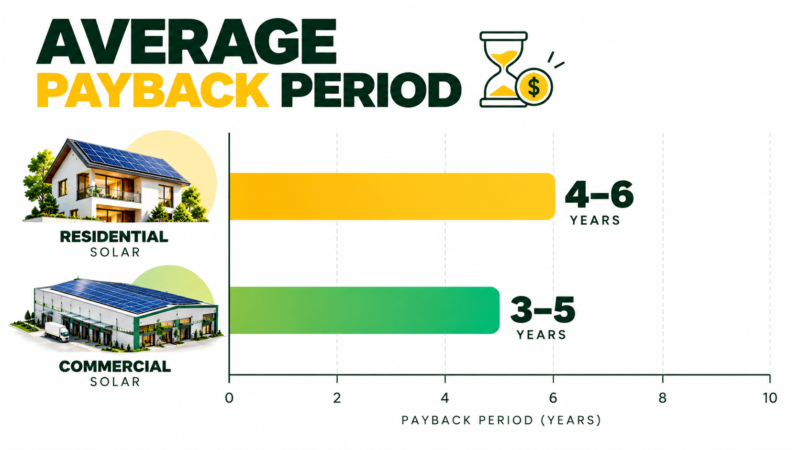
| Payback Period | 5–7 years | 3–5 years (higher consumption) |
| Approval Complexity | Simple, standardized | More documentation, structural checks |
As the table shows, residential vs commercial solar decisions hinge largely on scale, ownership structure, and how each party is able to recover their investment over time.
Solar Panel Installation for Business: What's Different
A solar panel installation for business typically requires a structural load assessment, electrical load study, and sometimes approval from multiple stakeholders before work begins — steps rarely needed for a home rooftop. Compared to a standard residential setup, a solar panel installation for business project also needs to account for uninterrupted operational hours, meaning installation scheduling and downtime planning become real considerations. These added layers are part of why commercial solar systems generally involve longer lead times than home installations.
Ready to switch to Solar?
solar solutions with Anya Green Energy and discover how you can reduce your electricity bills.
Contact UsHome Solar vs Business Solar: ROI and Payback
When comparing home solar vs business solar payback periods, the numbers tell an interesting story. Residential systems typically pay back in 5–7 years, while commercial solar systems may pay back faster — often within 3–5 years — due to significantly higher daytime electricity consumption and the added benefit of depreciation-based tax savings. This home solar vs business solar gap matters for decision-makers evaluating where solar investment delivers the fastest return.
Regulatory and Subsidy Differences
Indian policy treats residential solar systems and business-scale installations quite differently. Capital subsidies apply to residential solar systems under defined capacity slabs set by state and central schemes, while a solar panel installation for business instead relies on accelerated depreciation and, in some cases, state industrial incentives. This regulatory divide is central to any honest residential vs commercial solar evaluation, since the incentive structure can materially change the effective cost of going solar.
Which One Is Right for You?
Ultimately, the residential vs commercial solar choice comes down to your energy profile, ownership status, and financial goals. If you’re a homeowner looking to cut monthly bills and reduce dependence on grid tariffs, residential solar systems make practical sense at a manageable investment size. If you run a business with high daytime load and available roof or land space, a solar panel installation for business is often the smarter long-term investment, given the faster payback and tax advantages available.
Expert Perspective
As one renewable energy consultant put it, paraphrased here: the residential vs commercial solar debate isn’t really about which is “better” — it’s about matching system scale to actual consumption, because an oversized home system or an undersized business system both waste money in different ways. The real home solar vs business solar distinction isn’t technology — it’s how each system is financed, taxed, and sized against real-world usage.
Conclusion
Understanding residential vs commercial solar differences helps you make an informed, financially sound decision rather than a one-size-fits-all assumption. Both residential solar systems and larger business installations contribute meaningfully to India’s clean energy growth, but the home solar vs business solar divide in financing, subsidy, and payback means due diligence matters before you commit. Whether your priority is cutting a household electricity bill or optimizing operational costs for a business, the residential vs commercial solar conversation ultimately comes down to matching the right system to your real energy needs.
FAQs
Q1: What is the main difference in residential vs commercial solar systems?
A: The primary differences lie in system size, financing structure, and subsidy type — residential systems are smaller and subsidy-driven, while commercial systems are larger and depreciation-driven.
Q2: Do commercial solar systems have a faster payback period?
A: Generally yes — due to higher daytime consumption and tax depreciation benefits, commercial solar systems often pay back in 3-5 years compared to 5-7 years for residential systems.
Q3: Is solar panel installation for business more complex than residential?
A: Yes, it typically involves structural load assessments, three-phase electrical considerations, and more documentation — one of the clearest points in the home solar vs business solar comparison.
Q4: Can a home have a commercial-sized solar system?
A: Technically yes, if roof space and sanctioned load allow, but the financing and subsidy eligibility would still follow residential rules unless registered under a business entity.
Q5: Which is a better investment — residential or commercial solar?
A: Neither is universally “better” — the right choice in the residential vs commercial solar decision depends on your consumption pattern, ownership structure, and available capital.

Trusted by 50000+ Customers
Anya Green Energy is a leading solar company and Solar Energy service provider established in 2013. We are recognized by startup India and customer best choice award 2022.
Our Achievements :
Recognized by Startup India.
Purvanchal’s first solar company to operate exclusively with solar products.
Certified by well-known institutions such as MSME, IndiaMart, and Just Dial and many more.
Winner of the Best Customer Choice Award 2022.
Over 50,000 happy customers across India.