
AI for Grid Management: How Artificial Intelligence Is Keeping the Lights On
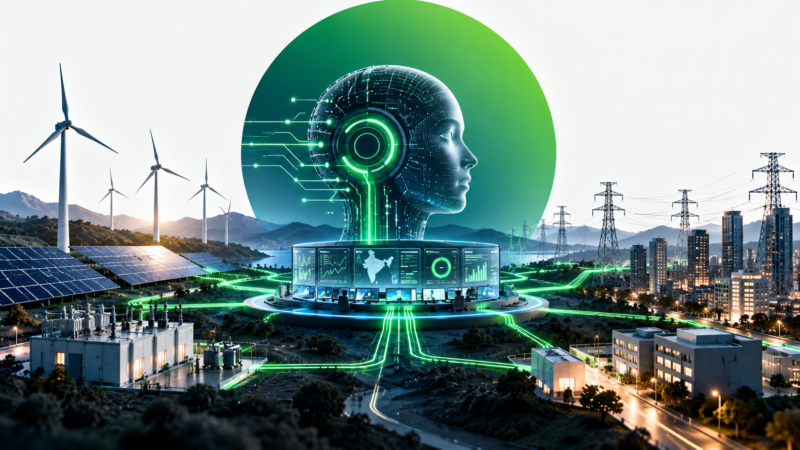
Modern power grids are facing a level of complexity they were never originally designed for — thousands of rooftop solar systems feeding power back in, electric vehicles charging unpredictably, and weather-dependent wind and solar generation fluctuating by the hour. Managing this complexity manually is no longer realistic, which is exactly why AI for grid management has moved from experimental pilot projects to essential infrastructure in a growing number of power systems worldwide.
This blog explores how AI for grid management actually works, the broader role of artificial intelligence in power grids as renewable penetration increases, how smart grid technology and AI intersect, the specific applications of AI grid optimization, and how predictive maintenance for power grids is helping utilities prevent failures before they happen.
Why Grids Need AI for Grid Management Now
Traditional grid management relied on relatively predictable, centralized power flows — a handful of large plants generating electricity that flowed in one direction to consumers. That model is breaking down. With millions of rooftop solar installations, growing battery storage, and electric vehicles all connecting to the grid at the edges, power now flows in multiple directions simultaneously, and demand patterns have become far less predictable than they once were.
AI for grid management addresses this complexity by processing vast amounts of real-time data — weather forecasts, consumption patterns, equipment sensor readings, and generation output — far faster and more accurately than traditional rule-based systems or manual operator decisions ever could. This capability is quickly becoming less of a competitive advantage and more of a baseline requirement for grids handling significant renewable penetration.
Artificial Intelligence in Power Grids: Core Applications
Artificial intelligence in power grids spans a wide range of applications beyond simple monitoring. Load forecasting uses machine learning models trained on historical consumption data, weather patterns, and even social/economic events to predict demand with far greater accuracy than traditional statistical methods. Fault detection systems use artificial intelligence in power grids to identify anomalies in real-time sensor data, flagging potential equipment failures or grid disturbances before they escalate into widespread outages.
Renewable integration represents another major application area — artificial intelligence in power grids helps balance the inherent variability of solar and wind generation by predicting output fluctuations and automatically adjusting other grid resources, including storage dispatch and demand response programs, to maintain stability without manual intervention.
Smart Grid Technology: The Infrastructure AI Operates Within
Smart grid technology refers to the broader digital infrastructure — smart meters, sensors, automated switches, and two-way communication networks — that makes AI-driven grid management possible in the first place. Without this underlying smart grid technology foundation, AI systems wouldn’t have the real-time data inputs needed to make meaningful decisions.
The relationship between AI and smart grid technology is genuinely symbiotic: smart meters and sensors generate the data AI systems need, while AI analysis extracts far more value from that data than human operators could manually process. As smart grid technology deployment has expanded globally, it has directly enabled the parallel growth of AI for grid management applications that would have been technically impossible just a decade ago, when data collection infrastructure was far sparser.
AI Grid Optimization: Making Real-Time Decisions at Scale
AI grid optimization refers specifically to the use of machine learning algorithms to make continuous, real-time adjustments to grid operations — rerouting power flows, adjusting voltage levels, dispatching storage resources, and balancing supply with demand on a minute-by-minute basis. Unlike traditional grid management, which often relies on pre-set rules and periodic manual adjustments, AI grid optimization continuously learns from new data and refines its decision-making over time.
This capability has become particularly valuable for managing the variability introduced by distributed energy resources. AI grid optimization systems can, for example, predict a sudden drop in solar output due to incoming cloud cover and preemptively adjust battery storage dispatch or demand response signals, maintaining grid stability in ways that would be impossible to coordinate manually across thousands of individual resources.
| Application | Traditional Approach | AI for Grid Management Approach |
|---|---|---|
| Load Forecasting | Historical averages, manual adjustment | Machine learning models with weather/behavioral data |
| Fault Detection | Reactive, post-failure response | Predictive, real-time anomaly detection |
| Renewable Integration | Manual balancing, conservative buffers | Automated, predictive balancing |
| Maintenance | Scheduled, time-based | Condition-based, predictive |
Predictive Maintenance for Power Grids: Preventing Failures Before They Happen
Predictive maintenance for power grids represents one of the most immediately valuable applications of AI in this space. Rather than servicing equipment on a fixed schedule regardless of actual condition, AI systems analyze sensor data — vibration patterns, temperature readings, electrical signatures — to predict when a transformer, line, or other critical component is likely to fail, allowing utilities to intervene before an outage occurs.
This shift toward predictive maintenance for power grids delivers meaningful cost savings alongside improved reliability, since unplanned outages are typically far more expensive to resolve than scheduled, proactive repairs. For aging grid infrastructure in many regions, predictive maintenance for power grids offers a way to extend asset life and defer costly replacement, simply by catching degradation patterns earlier than human inspection schedules would typically allow.
How AI for Grid Management Supports Renewable Energy Growth
The connection between AI for grid management and renewable energy adoption is direct and significant. As solar and wind capacity grows, grids need increasingly sophisticated tools to manage the resulting variability without resorting to expensive fossil fuel backup capacity. AI for grid management systems can predict renewable output with increasing accuracy, coordinate distributed storage resources (including the kind aggregated through virtual power plants), and manage demand response programs that shift flexible consumption to match available supply.
Without this layer of intelligent coordination, grids attempting to integrate high levels of renewable generation would face far greater reliability risks — making artificial intelligence in power grids not just a convenience, but an increasingly essential enabler of the broader clean energy transition.
India's Grid and the Role of AI
India’s grid faces a particularly demanding version of this challenge: rapid renewable capacity growth, a vast and geographically diverse transmission network, and a consumption base growing faster than almost any other major economy. Smart grid technology deployment across Indian states has expanded considerably in recent years, laying the groundwork for more sophisticated AI for grid management applications.
As India’s grid operators increasingly adopt AI grid optimization tools for load forecasting, renewable integration, and predictive maintenance for power grids, the potential to reduce transmission losses, prevent outages, and more smoothly absorb growing rooftop and utility-scale solar capacity becomes significant — directly supporting the country’s broader renewable energy targets.
Challenges in Deploying AI for Grid Management
Despite clear benefits, AI for grid management adoption faces real hurdles. Data quality and availability remain inconsistent across many grid systems, particularly in regions where smart grid technology deployment is still in earlier stages — AI systems are only as good as the data feeding them. Cybersecurity is another significant concern, since AI-driven control systems managing critical infrastructure present an increasingly attractive target for malicious actors.
Workforce and integration challenges also matter — utilities need skilled personnel capable of managing and interpreting AI systems, and legacy grid infrastructure in many regions wasn’t designed with the sensor density and communication capability that modern artificial intelligence in power grids applications require, meaning infrastructure upgrades often need to accompany any AI deployment.
Expert Perspective
As one grid modernization engineer put it in a recent industry discussion, paraphrased here: AI for grid management isn’t replacing human grid operators — it’s giving them a level of visibility and predictive capability that simply wasn’t possible before, turning reactive crisis management into proactive, data-driven decision-making across a grid that’s grown far too complex for any team to monitor manually in real time.
Conclusion
AI for grid management has moved well beyond experimental pilot programs to become a genuinely essential tool for operating modern, renewable-heavy power grids. From artificial intelligence in power grids enabling smarter load forecasting, to AI grid optimization balancing real-time supply and demand, to predictive maintenance for power grids preventing costly failures before they occur, this technology is quietly reshaping how electricity reaches homes and businesses reliably. As smart grid technology infrastructure continues expanding globally, including across India’s rapidly growing grid, AI for grid management will increasingly determine how smoothly the broader clean energy transition unfolds — not through flashy new hardware, but through smarter use of the data and infrastructure already being built.
FAQs
Q1: What does AI for grid management actually do?
A: It analyzes real-time data from across the power grid to forecast demand, detect faults, optimize renewable energy integration, and predict equipment maintenance needs faster and more accurately than traditional methods.
Q2: Is AI for grid management only useful for renewable-heavy grids?
A: It provides value for any grid, but it becomes especially critical as renewable penetration increases, since solar and wind variability require far more sophisticated real-time balancing than traditional fossil-fuel-dominant grids.
Q3: What is the difference between smart grid technology and AI for grid management?
A: Smart grid technology refers to the underlying digital infrastructure (sensors, smart meters, communication networks), while AI for grid management refers to the intelligent software layer that analyzes that infrastructure’s data to make decisions.
Q4: How does predictive maintenance for power grids save money?
A: By identifying equipment problems before they cause failures, utilities can perform targeted repairs proactively rather than dealing with far more expensive unplanned outages and emergency fixes.
Q5: Is India investing in AI for grid management?
A: Yes — as smart grid technology deployment expands across Indian states, AI grid optimization and predictive maintenance applications are increasingly being adopted to support the country’s rapid renewable energy growth.
Trusted by 50000+ Customers
Anya Green Energy is a leading solar company and Solar Energy service provider established in 2013. We are recognized by startup India and customer best choice award 2022.
Our Achievements :
Recognized by Startup India.
Purvanchal’s first solar company to operate exclusively with solar products.
Certified by well-known institutions such as MSME, IndiaMart, and Just Dial and many more.
Winner of the Best Customer Choice Award 2022.
Over 50,000 happy customers across India.