
The Holy Grail of Clean Fuel: How Direct Solar Water Splitting Is Unlocking Ultimate Green Hydrogen
What if we could skip electricity grids entirely and harvest pure hydrogen fuel directly from water using only sunlight? While traditional hydrogen production relies on fossil fuels or multi-step solar-powered electrolyzers, energy researchers have long pursued a single-step alternative.
By bypassing separate solar panels and external electrolyzers, direct solar water splitting merges light absorption and water catalysis into a single device. This direct pathway minimizes energy conversion losses, eliminates expensive intermediate hardware, and offers a scalable route to pure zero-emission fuel.
As global industries demand clean energy for heavy transportation, steelmaking, and energy storage, direct solar water splitting stands out as a transformative technology capable of powering a true hydrogen economy.
What Is Direct Solar Water Splitting?
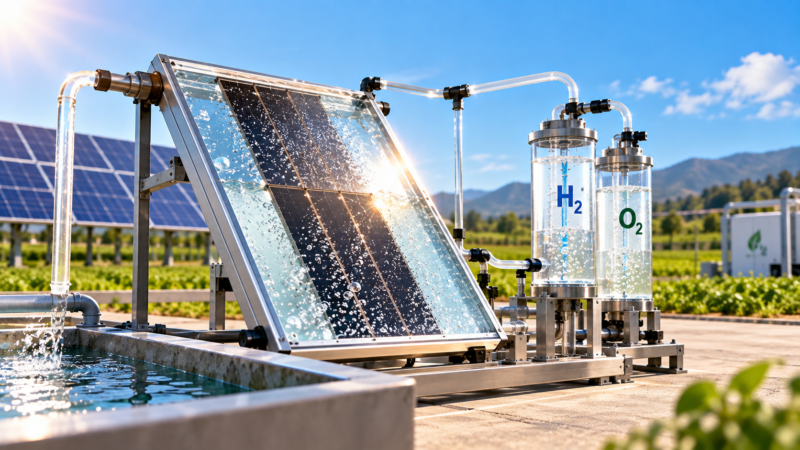
At its core, direct solar water splitting—often realized through photoelectrochemical cells (PEC)—is artificial photosynthesis. Instead of generating electricity to drive a separate water electrolysis unit, semiconductor materials inside a submerged cell absorb solar photons and instantly use that energy to split H_2O molecules into hydrogen (H_2) and oxygen (O_2).
Prompt to generate: Conceptual 3D scientific visualization showing the interior structure of a photoelectrochemical cell. Sunlight hitting a submerged semiconductor layer, generating electron-hole pairs, causing hydrogen bubbles (H_2) to form at the cathode and oxygen bubbles (O_2) at the anode in clean water. Clean interface graphics, high-tech laboratory background.
Unlike standard photovoltaic panels that output electric current, these specialized devices utilize light-sensitive semiconductor photoelectrodes immersed directly in an aqueous electrolyte. When illuminated, the semiconductors generate the thermodynamic potential required to break water bonds without relying on external power supplies.
The Chemical Blueprint: How Semiconductor Photoelectrodes Work
The entire process relies on tailored semiconductor photoelectrodes capable of capturing visible light while enduring harsh aqueous environments. The system typically pairs a p-type photocathode (where hydrogen is evolved) with an n-type photoanode (where oxygen is evolved).
Photoanode Materials: Oxides like bismuth vanadate (BiVO_4), iron oxide (Fe_2O_3), or titanium dioxide (TiO_2) absorb blue and ultraviolet photons to drive oxygen evolution.
Photocathode Materials: Silicon ($Si$), copper oxide (Cu_2O), or metal phosphides absorb longer wavelengths to drive green hydrogen production.
Co-catalysts: Nanoparticle coatings such as nickel-iron (NiFe) or platinum (Pt) lower reaction activation energies on electrode surfaces.
Tandem Configurations: Stacking narrow and wide bandgap semiconductors allows devices to capture a broader portion of the solar spectrum.
By combining these advanced materials, direct solar water splitting maximizes light capture while ensuring chemical stability against corrosion.
The Physics of Light-Driven Water Separation
To achieve efficient solar-to-hydrogen efficiency, a photoelectrochemical system must navigate a multi-step quantum process:
Prompt to generate: A visual scientific graphic illustrating quantum energy bandgaps in a semiconductor photoelectrode. Photons exciting electrons from valence to conduction bands, creating charge carriers that drive oxidation and reduction reactions at the water interface. Modern blue and neon-accented scientific styling.
Photon Absorption: Photons with energy greater than the semiconductor bandgap excite electrons from the valence band to the conduction band, generating electron-hole pairs.
Charge Separation: Internal electric fields drive electrons toward the photocathode and positive holes toward the photoanode.
Water Oxidation: Positive holes at the photoanode oxidize water to produce oxygen gas and hydrogen ions (H^+):
Hydrogen Reduction: Migrating H^+ ions combine with photoexcited electrons at the photocathode to yield pure hydrogen gas:
This direct mechanism streamlines green hydrogen production by eliminating the electrical transport losses typical of conventional PV-electrolyzer setups
Overcoming Efficiency Barriers: Elevating Solar-to-Hydrogen Yields
Historically, low solar-to-hydrogen efficiency hindered the widespread adoption of photoelectrochemical cells. Standard metal oxides absorb only a small fraction of visible light, while narrow-bandgap materials often suffer from rapid photocorrosion under intense sunlight.
However, recent innovations in bandgap engineering, protective atomic layer deposition (ALD), and concentrated light optics are dramatically raising performance benchmarks.
Prompt to generate: A microscopic 3D render of atomic-layer deposition (ALD) protective nanocoatings on a semiconductor crystal surface. Photons passing through a protective oxide shield while charges tunnel across to drive chemical reactions in liquid solution. Ultra-detailed materials science visualization.
By integrating multi-junction tandem structures and surface passivation layers, laboratory-scale systems for direct solar water splitting have achieved solar-to-hydrogen efficiency rates exceeding 10% to 19%. These milestones bring artificial photosynthesis closer to industrial viability.
Durability and Environmental Resilience
Industrial deployment requires semiconductor photoelectrodes that maintain high reactivity without degrading in highly acidic or alkaline water.
Unlike organic photovoltaics, modern PEC devices utilize protective oxide coatings (such as titanium dioxide or aluminum oxide) applied at the atomic level. These protective shields prevent corrosion while allowing photo-generated charges to tunnel through smoothly.
Prompt to generate: An environmental testing chamber in a materials science lab. A photoelectrochemical panel immersed in electrolyte solution undergoing high-temperature durability testing under intense solar simulators, maintaining steady bubble generation without physical degradation.
Such structural enhancements enable photoelectrochemical cells to operate continuously under concentrated sunlight and varying water conditions, unlocking long-term reliability for regional clean fuel generation.
Real-World Applications: Where Will Direct Hydrogen Generation Excel?
The single-step design of direct solar water splitting enables decentralized deployment scenarios that complement conventional energy grids:
Off-Grid Hydrogen Refueling Stations: Remote fueling sites for heavy-duty trucks and buses can generate clean fuel directly on-site from sunlight and water.
Industrial Decarbonization: Steelworks, chemical plants, and fertilizer facilities can source localized hydrogen without placing heavy demands on local electricity grids.
Seawater Hydrogen Production: Advanced PEC designs using specialized catalysts can perform direct water splitting using saline or wastewater feeds, conserving freshwater resources.
Prompt to generate: A futuristic solar-hydrogen production facility located near an industrial port or coastline. Arrays of direct solar water splitting collection panels feeding hydrogen directly into storage tanks and a heavy-duty fuel-cell transport truck. Clean, sustainable architecture under clear sunlight.
These versatile applications highlight the central role direct solar water splitting can play in global decarbonization.
Sustainable Manufacturing and Environmental Footprint
Evaluating sustainable technologies requires examining their lifetime environmental impact. Conventional green hydrogen production involves complex supply chains for separate silicon solar panels and proton exchange membrane (PEM) electrolyzers containing expensive noble metals.
In contrast, systems engineered for direct solar water splitting can utilize Earth-abundant materials like iron, bismuth, and titanium oxides. Low-temperature solution processing and scalable roll-to-roll deposition techniques significantly lower the manufacturing carbon footprint compared to standard high-temperature silicon production.
Prompt to generate: An automated industrial roll-to-roll manufacturing line printing thin-film photoelectrode sheets for direct solar water splitting. High-tech robotic machinery operating in a spotless cleanroom factory setting with subtle green-tech HUD overlays.
This direct approach simplifies recycling, reduces raw material dependency, and offers a low-cost, zero-emission path for green hydrogen production.
Scaling Up: The Future of Commercial Artificial Photosynthesis
To advance from laboratory testing to commercial scale, researchers are developing large-area panel arrays that integrate light harvesting, gas separation, and fluid transport into modular designs.
Because PEC systems operate as self-contained chemical reactors, they require fewer electrical balances of plant (BOP), dramatically reducing balance-of-system costs. As solar-to-hydrogen efficiency continues to rise and manufacturing costs drop, direct solar water splitting is positioned to become a pillar of next-generation clean fuel production.
Frequently Asked Questions (FAQ)
Direct solar water splitting is a process that uses light-absorbing semiconductor photoelectrodes in photoelectrochemical cells to split water directly into hydrogen and oxygen gas using sunlight, bypassing intermediate electricity generation.
How does direct water splitting differ from conventional green hydrogen production?
Conventional green hydrogen production uses standard solar panels to generate electricity, which is then sent to a separate electrolyzer. Direct water splitting combines solar absorption and water electrolysis into a single integrated device, reducing hardware complexity and energy conversion losses.
What is a competitive solar-to-hydrogen efficiency for commercial use?
A solar-to-hydrogen efficiency of 10% to 15% is generally considered the threshold for commercial viability, with advanced multi-junction laboratory devices already achieving numbers within and above this range.
Can direct solar water splitting work with seawater?
Yes. Advanced research focuses on developing corrosion-resistant catalyst coatings that allow photoelectrochemical cells to produce hydrogen directly from seawater without requiring expensive pre-desalination steps.


Trusted by 50000+ Customers
Anya Green Energy is a leading solar company and Solar Energy service provider established in 2013. We are recognized by startup India and customer best choice award 2022.
Our Achievements :
Recognized by Startup India.
Purvanchal’s first solar company to operate exclusively with solar products.
Certified by well-known institutions such as MSME, IndiaMart, and Just Dial and many more.
Winner of the Best Customer Choice Award 2022.
Over 50,000 happy customers across India.