
The Silent Revolution in Clean Tech: How Photoelectrochemical Redox Flow Cells Are Rewriting the Energy Playbook

Imagine capturing sunlight and turning it into dispatchable electrical power without using a silicon solar panel or plugging into a conventional wall charger. What if the very device harvesting photons was simultaneously charging a massive reservoir of liquid electricity?
For decades, clean energy researchers faced a persistent bottleneck: solar panels can only generate power when the sun shines, while stationary batteries simply store power generated elsewhere. The conversion steps between capture and storage introduce real thermodynamic losses. Combining these two functions into a single system has long been an ambitious goal in materials science.
Enter photoelectrochemical redox flow cells, an elegant hybrid technology bridging the gap between solar harvesting and chemical energy storage. By merging photoelectrochemistry directly with liquid flow chemistry, these systems convert sunlight directly into energetic chemical bonds stored within liquid tanks.
What Are Photoelectrochemical Redox Flow Cells?
To understand photoelectrochemical redox flow cells, it helps to dissect both parent technologies. Conventional flow batteries rely on liquid electrolytes pumped from external tanks through a central electrochemical stack. Electrical energy drives reduction and oxidation (redox) reactions in these liquids, storing energy in chemical form.
Conversely, photoelectrochemical devices use semiconductor materials to absorb light, creating electron-hole pairs that drive chemical reactions at an electrode interface. Photoelectrochemical redox flow cells merge these concepts by inserting light-active semiconductor electrodes directly into a flowing electrolyte environment.
Instead of using external solar panels to charge a battery, photoelectrochemical redox flow cells absorb sunlight directly across their illuminated surfaces. The photogenerated charges immediately drive redox reactions in the flowing liquid electrolytes, charging the fluid as it passes through the cell stack.
This integrated architecture creates a true all-in-one system often referred to in literature as solar flow batteries. By bypassing external wires, power converters, and multiple hardware interfaces, these systems streamline the entire capture-to-storage pipeline.
How Do These Integrated Systems Work Under the Hood?
At the heart of photoelectrochemical redox flow cells lies a straightforward yet precise sequence of physics and chemistry:
Light Absorption: Sunlight hits a photoactive semiconductor electrode (the photoanode or photocathode).
Charge Separation: Photons with energy greater than the material’s bandgap excite electrons, generating electron-hole pairs.
Interfacial Redox Reaction: Rather than producing an external electric current, these charges transfer to active species dissolved in the electrolyte.
Fluid Transport: Mechanical pumps transport the newly charged liquid away from the illuminated stack and into external storage tanks.
┌────────────────────────────────────────────────────────────────────────┐
│                   DIRECT CONVERSION & STORAGE PIPELINE                 │
├────────────────────────────────────────────────────────────────────────┤
│  [Sunlight] --> [Semiconductor Absorption] --> [Charge Separation]     │
│                         │                                              │
│                         ▼                                              │
│  [Stored Liquid] <-- [Flowing Electrolyte Redox] <-- [Surface Transfer]│
└────────────────────────────────────────────────────────────────────────┘
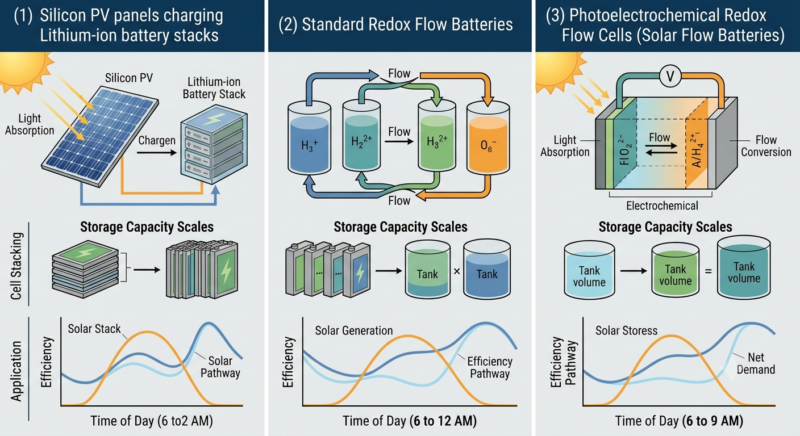
This fluid design provides a core advantage of flow architectures: decoupled power and energy capacities. Power capacity depends on the surface area of the illumination stack, while energy capacity depends purely on the volume of electrolyte stored in the tanks.
This decoupling makes photoelectrochemical redox flow cells exceptionally adaptable for long-duration applications. Scaling the storage capacity doesn’t require rebuilding the expensive light-harvesting stack—it simply requires larger liquid tanks.
The Efficiency Edge: Bypassing the "PV-to-Battery" Losses
In traditional solar storage setups, electricity follows a multi-step path from photon to stored energy:
[Sunlight] --> [PV Panel] --> [Inverter / Controller] --> [Battery] --> [Chemical Storage]
Every conversion step incurs thermal and electrical losses. Resistance along wiring, conversion losses in charge controllers, and electrochemical polarization at battery interfaces reduce the overall round-trip efficiency.
By contrast, photoelectrochemical redox flow cells combine light absorption and electrochemical storage into a single monolithic device:
[Sunlight] --> [Photoelectrochemical Flow Stack] --> [Chemical Storage Tank]
Eliminating intermediate electronics reduces balance-of-system (BOS) complexity, lowers capital costs, and removes major electronic failure points. This streamlined pathway is why researchers consider solar flow batteries a promising candidate for zero-carbon energy infrastructure.
Key Materials: The Search for the Perfect Photoelectrode
The real-world performance of photoelectrochemical redox flow cells depends directly on material selection. Developing durable, highly efficient photoelectrode materials remains one of the primary focal points of active research.
A ideal photoelectrode must fulfill several demanding requirements simultaneously:
Optimal Bandgap: It must absorb a broad spectrum of visible light to maximize photon utilization.
Favorable Energetics: Its conduction and valence band edges must line up with the redox potentials of the target electrolytes.
Chemical Stability: It must resist corrosion and degradation when exposed to acidic or alkaline liquid electrolytes under continuous sunlight.
Rapid Charge Transfer: Photogenerated carriers must move to the surface quickly before recombining internally.
Electrolyte Chemistry: Tailoring the Flow for Sunlight
While photoelectrodes capture incoming photons, liquid electrolytes are responsible for storing that harvested energy long-term. Electrolytes used in photoelectrochemical redox flow cells require unique chemical properties compared to standard battery solutions.
Beyond high solubility and low toxicity, these electrolytes must display high optical clarity when flowing across the illuminated photoelectrode face. Parasitic light absorption by the liquid itself can prevent photons from reaching the active semiconductor layer underneath.
Aqueous inorganic systems using iron complexes provide excellent safety, low toxicity, and environmental stability. Meanwhile, organic redox couples allow scientists to precisely tune molecular energy levels to match specific photoelectrode materials, opening new pathways for higher voltage outputs.
Solving the Grid-Scale Energy Storage Puzzle
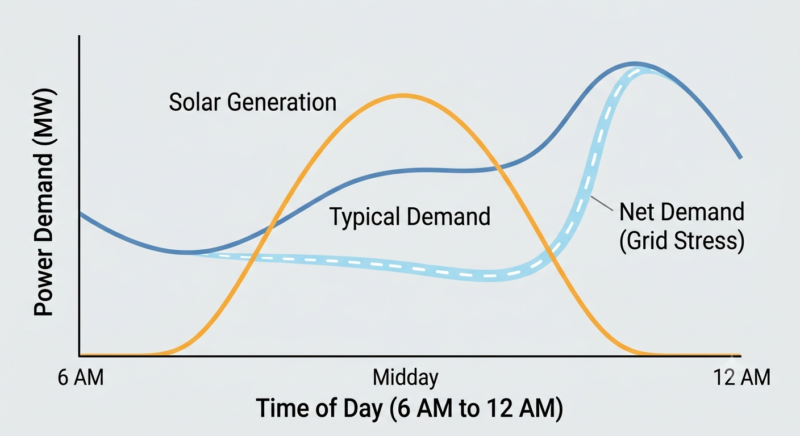
As modern power networks incorporate higher percentages of wind and solar power, managing grid instability becomes a central challenge. Intermittent generation creates mismatch between peak production hours and peak consumer demand.
Addressing this imbalance requires long-duration grid-scale energy storage systems capable of holding energy for days or weeks, rather than just a few hours.
Standard lithium-ion battery installations excel at short-duration frequency regulation, but their high cost per kilowatt-hour makes scaling them to multi-day capacities expensive. Photoelectrochemical redox flow cells offer a compelling alternative for grid-scale energy storage by combining primary solar generation directly with low-cost bulk liquid storage tanks.
By siting these dual-purpose solar flow facilities in land-rich, high-irradiance regions, energy planners could build integrated generation and storage plants that supply steady power long after dark.
The Road Ahead: Engineering Challenges and Commercialization
Addressing these challenges requires multidisciplinary collaboration among chemical engineers, optical physicists, and materials scientists. Recent advances in protective atomic layer deposition (ALD) coatings and high-throughput organic molecule synthesis are rapidly resolving these long-standing bottlenecks.
This comparison highlights why researchers view photoelectrochemical redox flow cells not as a replacement for rooftop solar panels, but as a distinct tool designed specifically for large-scale energy management.
The Future Landscape of Solar Energy Conversion
The ultimate goal of sustainable energy research is to build continuous, reliable power systems out of renewable resources. Direct solar energy conversion into liquid fuels or charged chemical species provides a clear route toward that goal.
As manufacturing techniques improve, scalable photoelectrochemical redox flow cells could power off-grid industrial plants, rural electrification projects, and grid-tied solar farms. By capturing light and storing chemical power inside a single integrated device, this technology offers an efficient path toward a resilient, zero-carbon grid.
Solving the Grid-Scale Energy Storage Puzzle
As modern power networks incorporate higher percentages of wind and solar power, managing grid instability becomes a central challenge. Intermittent generation creates mismatch between peak production hours and peak consumer demand.
Addressing this imbalance requires long-duration grid-scale energy storage systems capable of holding energy for days or weeks, rather than just a few hours.
Standard lithium-ion battery installations excel at short-duration frequency regulation, but their high cost per kilowatt-hour makes scaling them to multi-day capacities expensive. Photoelectrochemical redox flow cells offer a compelling alternative for grid-scale energy storage by combining primary solar generation directly with low-cost bulk liquid storage tanks.
By siting these dual-purpose solar flow facilities in land-rich, high-irradiance regions, energy planners could build integrated generation and storage plants that supply steady power long after dark.
Beyond stabilizing urban transmission grids, this dual capability unlocks fascinating possibilities for remote, climate-vulnerable communities. Imagine isolated island grids or agricultural centers running entirely on self-contained fluid energy loops that charge during intense midday heat and release steady baseline power during extended storms or overcast weeks, all without relying on fragile fuel supply chains or expensive grid extensions.
Frequently Asked Questions (FAQ)
What are photoelectrochemical redox flow cells?
Photoelectrochemical redox flow cells are hybrid energy devices that combine light absorption and liquid chemical storage into a single monolithic system. Instead of generating electricity via traditional solar panels and routing it to a separate battery, these cells absorb sunlight directly across illuminated semiconductor electrodes to charge flowing liquid electrolytes stored in external tanks.
How do solar flow batteries differ from conventional solar panel and battery systems?
Traditional setups convert sunlight into electricity via photovoltaic panels, route it through charge controllers and inverters, and then store it in solid batteries, losing energy at each step. Integrated solar flow batteries eliminate these intermediate conversion steps by using photogenerated charges to directly drive reduction and oxidation reactions within the liquid electrolytes, significantly reducing balance-of-system complexity and energy losses.
Why are photoelectrochemical redox flow cells ideal for grid-scale energy storage?
Like traditional flow batteries, these cells feature decoupled power and energy capacities. The power output depends on the surface area of the photoelectrode stack, while the total energy storage capacity depends simply on the volume of the electrolyte tanks. This scalability makes them an economical solution for long-duration grid-scale energy storage needed to balance seasonal and daily generation gaps.
What are the main challenges facing photoelectrode materials in these cells?
The primary hurdle for photoelectrode materials is balancing broad visible light absorption with long-term chemical durability. Because these semiconductors operate directly inside liquid electrolyte solutions under continuous sunlight, researchers are actively developing protective ultrathin coatings to prevent photocorrosion without hindering photogenerated electron transfer.

Trusted by 50000+ Customers
Anya Green Energy is a leading solar company and Solar Energy service provider established in 2013. We are recognized by startup India and customer best choice award 2022.
Our Achievements :
Recognized by Startup India.
Purvanchal’s first solar company to operate exclusively with solar products.
Certified by well-known institutions such as MSME, IndiaMart, and Just Dial and many more.
Winner of the Best Customer Choice Award 2022.
Over 50,000 happy customers across India.