
The Critical Minerals Supply War: India vs China in 2026
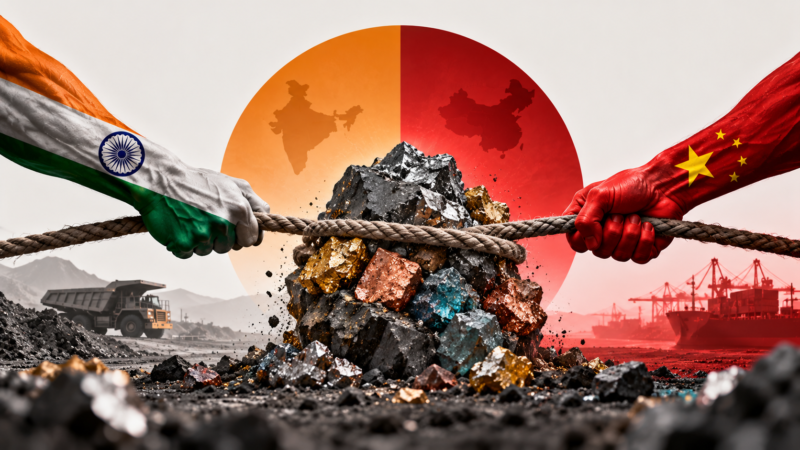
Beneath nearly every clean energy technology — solar panels, wind turbines, EV batteries, electronics — sits a layer most consumers never think about: the critical minerals that make the hardware possible. The critical minerals supply war India vs China has quietly become one of the most consequential economic and strategic contests of this decade, shaping everything from manufacturing costs to national energy security.
This blog examines the critical minerals supply war India vs China as it stands heading into 2026 — covering the broader critical minerals supply chain dynamics at play, the imbalance in rare earth elements India China access and processing capacity, the real impact of China rare earth export restrictions on global industry, and how India’s critical minerals strategy is attempting to close the gap.
A note on framing: this is presented as scenario analysis based on observable trends, not a confirmed real-time account of 2026 policy — readers should verify current developments against up-to-date trade and government sources.
Why Critical Minerals Have Become a Geopolitical Flashpoint
Critical minerals — including rare earth elements, lithium, cobalt, graphite, and nickel — are essential inputs for solar panels, wind turbine magnets, EV batteries, and a wide range of electronics and defense applications. What makes this a strategic issue rather than just a commodities story is concentration: a small number of countries, led overwhelmingly by China, control the vast majority of global processing and refining capacity for many of these materials, even when the raw ore is mined elsewhere.
This concentration is the root of the critical minerals supply war India vs China narrative. China’s multi-decade investment in refining infrastructure means that even minerals mined in other countries often still need to pass through Chinese processing facilities before becoming usable industrial inputs — a chokepoint that gives China significant leverage over global clean energy and technology supply chains.
Understanding the Critical Minerals Supply Chain
The critical minerals supply chain involves several distinct stages: extraction (mining raw ore), processing and refining (converting ore into usable material), and manufacturing (incorporating refined minerals into finished products like batteries or magnets). China’s dominance is most pronounced at the refining stage — estimates place China’s share of global rare earth processing capacity and battery-grade material refining at a level far exceeding its share of raw mineral reserves.
This structural imbalance in the critical minerals supply chain means that simply having domestic mineral deposits — which India has in some categories — isn’t sufficient to reduce dependence on China. Without comparable refining and processing capacity, raw materials often still need to be exported for processing, undermining the strategic value of domestic reserves alone.
Ready to switch to Solar?
Solar solutions with Anya Green Energy and discover how you can reduce your electricity bills.
Contact UsRare Earth Elements India China: The Core Imbalance
The rare earth elements India China relationship is particularly stark. Rare earth elements are essential for permanent magnets used in wind turbines, EV motors, and a range of defense and electronics applications. China controls a dominant share of global rare earth processing, built over decades of sustained industrial policy, environmental tolerance for the pollution-intensive refining process, and significant government investment.
India holds meaningful rare earth reserves, particularly along its coastal mineral sand deposits, but processing capacity remains comparatively limited. This gap in the rare earth elements India China balance means India, like most countries, remains structurally dependent on Chinese processing even where it has domestic raw material access — a dependency that becomes strategically uncomfortable during periods of diplomatic tension.
| Factor | China | India |
|---|---|---|
| Rare Earth Reserves | Large | Meaningful but smaller |
| Processing Capacity | Dominant globally | Limited, developing |
| Battery Mineral Refining | Dominant globally | Early-stage |
| Strategic Approach | Decades of sustained investment | Emerging national strategy |
| Export Policy Leverage | Significant | Minimal currently |
China Rare Earth Export Restrictions: Why They Matter
China rare earth export restrictions have periodically emerged as a tool of economic and diplomatic leverage, with export licensing requirements, quotas, or restrictions on specific processed materials affecting downstream industries globally. Even the possibility of China rare earth export restrictions tightening has historically triggered price volatility and prompted countries to accelerate domestic alternative sourcing and recycling initiatives.
For industries reliant on rare earth magnets — including wind turbine manufacturers and EV producers — the recurring threat of China rare earth export restrictions has become a standing risk factor in long-term planning, pushing many companies and governments toward diversification strategies that reduce single-country dependency, even when those alternatives remain more expensive in the near term.
India's Critical Minerals Strategy: Closing the Gap
In response to this imbalance, India’s critical minerals strategy has gained significant momentum, centered on several parallel efforts: identifying and auctioning domestic mineral blocks, forming international partnerships (including mineral security initiatives with allied nations), incentivizing domestic processing and refining capacity, and building strategic mineral reserves for critical inputs.
India’s critical minerals strategy also includes diplomatic and trade dimensions — pursuing supply agreements with resource-rich countries in Africa, Australia, and Latin America to secure raw material access independent of Chinese-controlled supply chains. While still in earlier stages compared to China’s established infrastructure, this strategy represents a genuine structural attempt to reduce dependency rather than simply reacting to periodic supply disruptions.
The 2026 Scenario: What's Likely at Stake
Looking at the critical minerals supply war India vs China through a 2026 lens, several dynamics are worth tracking (again, as scenario analysis requiring current verification): continued Chinese dominance in refining capacity in the near term, since building comparable infrastructure elsewhere takes years of investment and regulatory approval; gradual but meaningful progress in India’s critical minerals strategy as mineral block auctions and processing incentives begin yielding results; and continued volatility risk tied to China rare earth export restrictions, particularly during periods of broader geopolitical or trade tension.
The broader critical minerals supply chain is unlikely to fundamentally rebalance within a single year, but 2026 likely represents a meaningful midpoint in a longer multi-year diversification effort — with India positioned as one of several countries (alongside Australia, the US, and partners in the EU) working to build parallel supply chains outside Chinese-dominated infrastructure.
Implications for India's Clean Energy Sector
The critical minerals supply war India vs China has direct relevance to India’s own renewable energy ambitions. Wind turbine manufacturing depends heavily on rare earth magnets, and EV and battery storage manufacturing depends on lithium, cobalt, and graphite — all areas where the broader critical minerals supply chain currently favors China. As India scales its own clean energy manufacturing under various production-linked incentive schemes, reducing exposure to this dependency through India’s critical minerals strategy becomes directly relevant to the pace and resilience of the country’s own energy transition, not just an abstract geopolitical concern.
Challenges and Realistic Expectations
It’s worth being honest about the scale of this challenge. Building refining and processing capacity comparable to China’s decades-long head start requires sustained capital investment, environmental permitting (refining processes are pollution-intensive), and technical expertise that takes years to develop. India’s critical minerals strategy, however well-designed, cannot fully offset this structural gap within a short timeframe.
Similarly, while diversification away from China is a shared goal among many countries, it’s an incremental, multi-decade process rather than a sudden decoupling — meaning the critical minerals supply war India vs China will likely remain a slow-moving, strategically significant story for years to come rather than resolving sharply in any single year.
Expert Perspective
As one trade and resource security analyst put it in a recent industry discussion, paraphrased here: the real contest in critical minerals isn’t about who has the most reserves in the ground — it’s about who controls the refining step in between, and that single chokepoint is why countries like India are investing so heavily in processing capacity now, even though the payoff is likely a decade away rather than immediate.
Conclusion
The critical minerals supply war India vs China reflects a broader global reality: clean energy security depends as much on refining and processing capacity as it does on raw material access. While China’s dominant position in the critical minerals supply chain isn’t likely to change dramatically by 2026, India’s critical minerals strategy represents a genuine, structural effort to reduce dependency over the coming decade. Understanding the imbalance in rare earth elements India China access, the real risk posed by periodic China rare earth export restrictions, and the long-term nature of India’s response gives a clearer, more realistic picture of where this strategic competition is actually headed — one shaped by patient industrial policy rather than rapid disruption.
FAQs
Q1: Why is China so dominant in critical minerals?
A: China’s dominance comes primarily from decades of investment in refining and processing infrastructure, not just raw mineral reserves — a chokepoint that applies even to minerals mined outside China.
Q2: Does India have its own critical mineral reserves?
A: Yes, India holds meaningful reserves in certain categories, particularly coastal rare earth mineral sands, but currently lacks comparable processing and refining capacity to fully leverage them.
Q3: What are China’s rare earth export restrictions, and why do they matter?
A: These are periodic licensing requirements, quotas, or restrictions on exporting processed rare earth materials, which can disrupt global supply chains for industries like wind turbines and EVs that depend on rare earth magnets.
Q4: What is India doing to reduce dependency on China for critical minerals?
A: India’s critical minerals strategy includes domestic mineral block auctions, processing capacity incentives, strategic reserves, and international mineral partnerships with resource-rich countries.
Q5: How does this issue affect India’s clean energy sector specifically?
A: Wind turbine and battery manufacturing depend heavily on critical minerals currently dominated by Chinese supply chains, making this geopolitical issue directly relevant to the pace and resilience of India’s own renewable energy manufacturing ambitions.
Trusted by 50000+ Customers
Anya Green Energy is a leading solar company and Solar Energy service provider established in 2013. We are recognized by startup India and customer best choice award 2022.
Our Achievements :
Recognized by Startup India.
Purvanchal’s first solar company to operate exclusively with solar products.
Certified by well-known institutions such as MSME, IndiaMart, and Just Dial and many more.
Winner of the Best Customer Choice Award 2022.
Over 50,000 happy customers across India.