HJT Panels: What you should actually know in 2026
Most articles about This technology read like a datasheet. Efficiency numbers, temperature coefficients, charts. Useful, but not what a homeowner standing on their roof actually wants to know.
Real customers ask different questions. Will this actually survive a Delhi summer? Is the 30-year warranty real or just marketing? Why does one installer quote ₹26 a watt and another ₹32 for something both call “HJT”?
This guide answers These panels the way customers actually ask about them, not the way spec sheets present them.
How Do HJT Panels Work, in Plain Language?
Most people don’t want a materials-science lecture. Here’s the short version.
A regular solar cell is one layer of treated silicon. An HJT cell is three layers stacked together: crystalline silicon in the middle, with two very thin layers of a different kind of silicon on either side.
Those outer layers act like a protective coating that stops electricity from leaking out as heat before it reaches your inverter. That’s the entire trick behind how do HJT panels work better than older designs, and it’s worth remembering the next time a brochure throws efficiency numbers at you without explaining why.
Because both sides are coated the same way, the cell can also capture light that bounces off your roof or the ground. That’s why most The heterojunction option are bifacial by default, not as an upgrade.
Customers often ask whether this makes the panel fragile. It doesn’t. The layers are microscopically thin and sealed inside standard tempered glass, same as any premium panel — a detail worth knowing if you’re still working out how do HJT panels work well enough to explain it to a sceptical family member.
Are HJT Panels Worth It?
This is the real question behind every other question. Here’s the honest, non-salesy answer.
Are This panel type worth it depends entirely on three things: your climate, your roof space, and how long you plan to own the system.
If you live somewhere genuinely hot, your roof gets expensive real estate, and you’re not chasing a subsidy, the case is strong. The panel loses less power to heat, needs fewer units for the same output, and keeps producing closer to its original rating for longer.
If you live somewhere mild, have plenty of roof space, and you’re applying for PM Surya Ghar, the honest answer to are HJT panels worth it is usually no. You’d be paying a real premium for advantages your situation won’t fully use.
Customers sometimes assume “more expensive” automatically means “better value.” It doesn’t. Whether These modules are worth it is a math problem specific to your roof, not a universal yes.
HJT Panels Pros and Cons
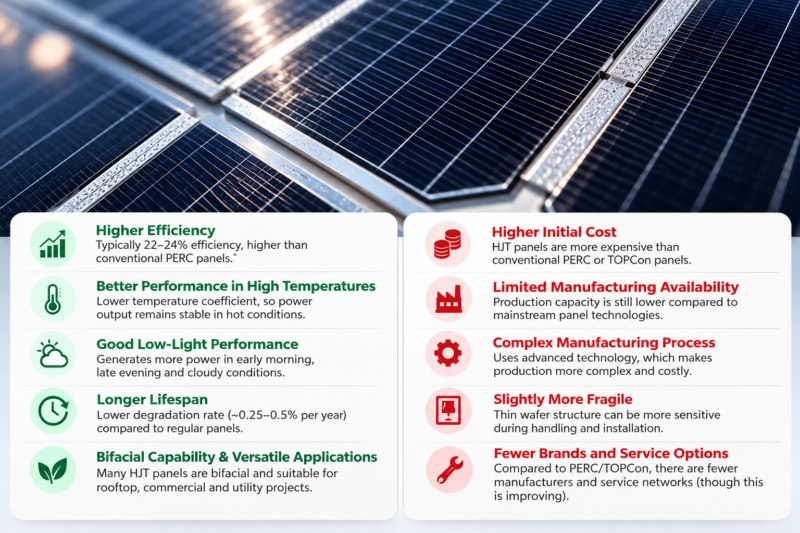
Pros
- Higher efficiency per panel, meaning fewer panels for the same output
- The lowest temperature coefficient of any mainstream silicon technology
- Slower degradation, often 0.25% to 0.35% a year against 0.4%+ for older panels
- Naturally bifacial, capturing reflected light without extra cost
- Longer standard warranties, commonly 30 years against 25
- Strong resistance to potential-induced degradation, a known failure mode in humid coastal areas
Cons
- A real price premium, typically 12% to 18% over TOPCon
- Heavier glass-glass construction, which some older roofs may need checked before installation
- Limited Indian manufacturing, so most supply is still imported
- Rarely eligible for subsidy-linked residential schemes like PM Surya Ghar in 2026
- Harder to verify quality, since not every product marketed as “HJT” is genuinely built to the same standard
- Weighing HJT panels pros and cons honestly usually comes down to this: the pros are real and measurable, but so is the price tag, and the cons aren’t dealbreakers so much as things to budget around, especially once you’ve seen the full HJT panels pros and cons list laid out plainly.
Is This Actually HJT, or Just Marketed That Way?
This is a question more customers should ask, and most don’t.
Some installers market panels as “HJT” when they’re really TOPCon modules with extra rear-surface passivation dressed up in similar language. The performance numbers don’t match, even though the marketing sounds identical.
A genuine HJT panel’s datasheet should clearly state amorphous silicon layers, a symmetrical glass-glass or glass-backsheet bifacial structure, and a temperature coefficient close to −0.24%/°C. If an installer can’t show you that specific number, or hedges when asked, treat the claim with real skepticism.
This single question, asked before signing anything, is one of the best ways to avoid overpaying for a technology you aren’t actually getting.
HJT Panels Warranty: What the Fine Print Actually Says
Customers hear “30-year warranty” and assume it means the panel is guaranteed for 30 years, full stop. It doesn’t quite work that way.
A typical HJT panels warranty is actually two separate promises. A product warranty, usually 15 to 25 years, covers manufacturing defects. A performance warranty, often extending to 30 years, guarantees a minimum output level, commonly 87% to 90% of original rated power at year thirty.
These are different documents, sometimes from different entities, with different claim processes. A cracked panel is a product warranty issue. A panel quietly producing less power than guaranteed is a performance warranty issue, and proving that is harder than it sounds.
Here’s the number that should temper expectations: across the industry, only about 2% to 3% of installed panels of any technology ever go through a successful warranty claim. Most successful claims require infrared camera evidence, continuous generation-curve data, and serial-number-traceable commissioning records, processed over 60 to 90 days.
The practical takeaway for the HJT panels warranty question: the paper warranty matters less than whether your installer sets up proper monitoring from day one, since monitoring data is what actually makes a claim provable
Will It Survive My Climate?
This question comes up constantly, and the answer genuinely varies by region.
In hot, dry climates, The technology perform close to their best-case scenario. The low temperature coefficient does real work when cell temperatures regularly exceed 60°C.
In humid coastal regions, a different advantage kicks in. HJT’s transparent conductive oxide layer makes it highly resistant to potential-induced degradation, a slow performance loss triggered by humidity and voltage stress that affects some older panel designs. For coastal Gujarat, Maharashtra, or Odisha installations, this resistance is a genuine, separate reason to consider HJT beyond raw efficiency.
In cooler hill-station climates, the honest answer is that the advantage shrinks considerably. A panel’s temperature coefficient only matters when temperatures actually rise above standard test conditions, and in Bengaluru, Pune, or Shillong, that happens far less often than in Jodhpur or Nagpur.
Does It Affect My Home's Resale Value?
An increasingly common question, and a fair one.
Appraisers evaluating a solar-equipped home in 2026 increasingly look at remaining warranty years as part of the asset’s value, not just installed capacity. A system with twenty years of HJT performance warranty remaining genuinely reads differently to a buyer than a generic, undocumented setup.
That said, this effect is still modest in most Indian markets compared to more mature solar economies. It’s a genuine factor, not yet a dominant one, in most resale conversations.
Is It High-Maintenance?
No, and this concern usually comes from general solar myths rather than anything HJT-specific.
Like any panel, periodic cleaning, a rinse every few months in dusty regions, keeps output close to rated levels. There are no moving parts and nothing to service in the way a generator or inverter sometimes needs attention.
The one practical maintenance-adjacent question worth asking before installation is structural, not operational: because This option use heavier glass-glass construction, it’s worth having your roof’s load capacity checked, particularly on older structures, before committing to a full array.
The Honest List of Buyer Mistakes
A few mistakes show up repeatedly in how customers approach These cells.
Paying the premium in a cool climate. If your region rarely gets hot, the temperature-coefficient advantage that justifies the price gap barely gets used.
Assuming subsidy eligibility. As of 2026, almost no PM Surya Ghar empanelled vendor catalogues include HJT as standard, so budgeting assuming a subsidy will apply is a common, costly error.
Not checking the actual datasheet. As covered above, not every panel marketed as HJT is built to genuine heterojunction specifications.
Ignoring installer service history. A 25 or 30-year warranty is only as good as a manufacturer’s ability to still honour it decades later. A long warranty from a company with no established Indian service presence is a weaker promise than it looks on paper.
Skipping monitoring setup. Given how rarely performance warranty claims succeed without proper data, skipping a monitoring system at installation quietly undermines the very warranty you paid extra for.
Quick-Fire Customer Questions
Can I mix HJT with TOPCon panels on the same roof?” Technically yes, if the inverter and stringing are designed for it, though most installers recommend against mixing technologies on the same string for simplicity and performance-matching reasons.
“Do HJT panels look different?” Mostly similar to premium TOPCon panels: typically all-black, glass-glass construction, slightly heavier in hand, with no visible difference that would stand out from the street.
“How long does installation take?” No different from any other panel technology. Installation time depends on system size and roof complexity, not the specific cell architecture.
“Can I upgrade an existing TOPCon system to HJT later?” Not as a simple add-on. Mixing technologies on an existing array usually means a separate system or inverter input, not a direct swap of a few panels.
What a Good Site Visit Should Actually Cover
Customers rarely know what a thorough HJT site assessment should include, which makes it easy for a rushed quote to skip steps that matter.
A proper visit should check your roof’s structural load capacity given the heavier glass-glass construction, measure actual shading patterns through the day, and confirm the available reflective surface below the array, since that’s what drives the bifacial bonus The panels are known for.
It should also include a clear, written answer to whether This product line are worth it specifically for your site, not a generic sales pitch. A good installer will show you the numbers for both HJT and TOPCon side by side and let the math speak for itself.
If an installer can’t explain how do HJT panels work in plain terms, or can’t produce a real datasheet when asked, that’s a reasonable signal to get a second opinion before signing anything.
A Simple Way to Weigh HJT Panels Pros and Cons for Your Own Roof
Rather than treating HJT panels pros and cons as a universal list, it helps to run through four questions specific to your situation.
First, how hot does your roof actually get in peak summer? If cell temperatures regularly exceed 55°C to 60°C, the temperature-coefficient advantage starts paying for itself faster.
Second, how much usable roof area do you have? A tightly constrained roof makes the efficiency advantage of The module type worth more per square metre than it would on a spacious one.
Third, are you eligible for, or planning to use, a subsidy scheme? If PM Surya Ghar eligibility matters to your budget, that alone may settle the decision regardless of climate.
Fourth, how long do you plan to own the property? A 30-year performance warranty matters far more to someone staying put for two decades than to someone planning to sell within five years.
Answering these four questions honestly turns “are HJT panels worth it” from a marketing slogan into a specific, personal calculation.
What's Changing That Buyers Should Watch
A few developments are likely to shift these answers over the next few years.
Domestic HJT manufacturing is expanding, led by Reliance’s Jamnagar facility and announced plans from Waaree and Premier Energies. As local supply grows, expect the price premium to narrow gradually.
Subsidy eligibility is the biggest wildcard. If These systems eventually get added to mainstream PM Surya Ghar empanelled vendor lists, the “is it worth it” math changes meaningfully for average homeowners, not just premium or commercial buyers.
Tandem perovskite-HJT cells are also on the horizon, expected around 2029 to 2030, which will eventually make today’s This cell type look like an entry-level version of what’s coming next.
Final Thoughts: Answering Curiosity, Not Just Specs
The technical case for The heterojunction design is genuinely strong: better efficiency, better heat tolerance, slower degradation, longer warranties. But the questions customers actually have, whether it’s genuinely HJT, whether the warranty will actually pay out, whether their specific climate and roof justify the cost, matter more to a real buying decision than any single number on a spec sheet.
Answering those questions honestly, including the uncomfortable ones about marketing tricks and warranty claim rates, is what actually helps someone decide whether These units belong on their roof.
FAQs
How do HJT panels work compared to regular solar panels? This build sandwich crystalline silicon between two thin amorphous silicon layers, which reduces energy loss at the cell surface and gives the panel a naturally bifacial, heat-tolerant design that standard single-layer cells don’t have.
Are HJT panels worth it for an average home? It depends on climate, roof space, and subsidy eligibility — This technology are worth it most clearly in hot regions with constrained roof space, while mild climates with ample roof area often get better value from standard TOPCon panels.
What does the HJT panels warranty actually cover? Most HJT panels warranty terms include a separate product warranty, typically 15 to 25 years, and a performance warranty extending to 30 years guaranteeing roughly 87% to 90% of original output, though successful claims require strong monitoring data.
What are the biggest pros and cons of HJT panels? The main pros are higher efficiency, better heat tolerance, and slower degradation; the main cons are a 12% to 18% price premium, limited Indian manufacturing, and reduced eligibility for subsidy-linked schemes in 2026.


Trusted by 50000+ Customers
Anya Green Energy is a leading solar company and Solar Energy service provider established in 2013. We are recognized by startup India and customer best choice award 2022.
Our Achievements :
Recognized by Startup India.
Purvanchal’s first solar company to operate exclusively with solar products.
Certified by well-known institutions such as MSME, IndiaMart, and Just Dial and many more.
Winner of the Best Customer Choice Award 2022.
Over 50,000 happy customers across India.