Lithium Ion Battery vs Lead Acid Battery: Which Is Better for Your Solar Power System? (2026)
Introduction
Choosing the right storage technology is one of the biggest decisions you’ll make when building a solar power system, and the debate almost always comes down to two options: a lithium ion battery or a lead acid battery. Both have powered homes and businesses for decades, but they are not remotely equal when it comes to performance, safety, and long-term value.
In this guide, we’ll break down the lithium ion battery vs lead acid battery comparison for the solar sector, look at the dimensions that matter most for buyers, and share how a company like Anya Green Energy Pvt Ltd helps homeowners install the right battery backup solution.
Lithium Ion Battery vs Lead Acid Battery: The Basics
What Is a Lithium Ion Battery?
A lithium ion battery stores energy by moving lithium ions between a positive and negative electrode during charging and discharging. In solar applications, the most widely used variant is LiFePO4 (lithium iron phosphate), valued for its thermal stability, safety, and long cycle life. A lithium ion battery is compact, lightweight, and requires little to no maintenance — qualities that have made it the default choice for modern solar battery storage.
What Is a Lead Acid Unit?
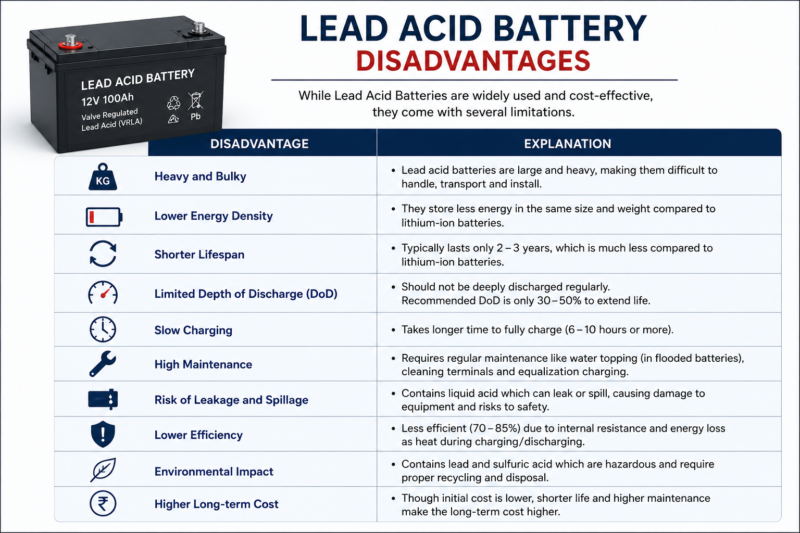
A traditional lead acid option is an older, more established technology that uses lead plates submerged in a sulfuric acid electrolyte. It was the standard choice for off-grid and backup power for decades because of its lower upfront cost. However, this older battery type is heavier, bulkier, and requires regular maintenance such as checking water levels and ensuring proper ventilation.
Why This Comparison Matters in the Solar Sector
A solar power system only generates electricity while the sun is out. Without efficient storage, excess daytime energy either gets exported to the grid or wasted entirely. The battery you choose determines how much of that energy you can actually use — which is why the lithium ion battery vs flooded lead acid cell decision has such a big impact on your system’s overall performance and payback period.
Here’s why it matters so much for solar buyers specifically:
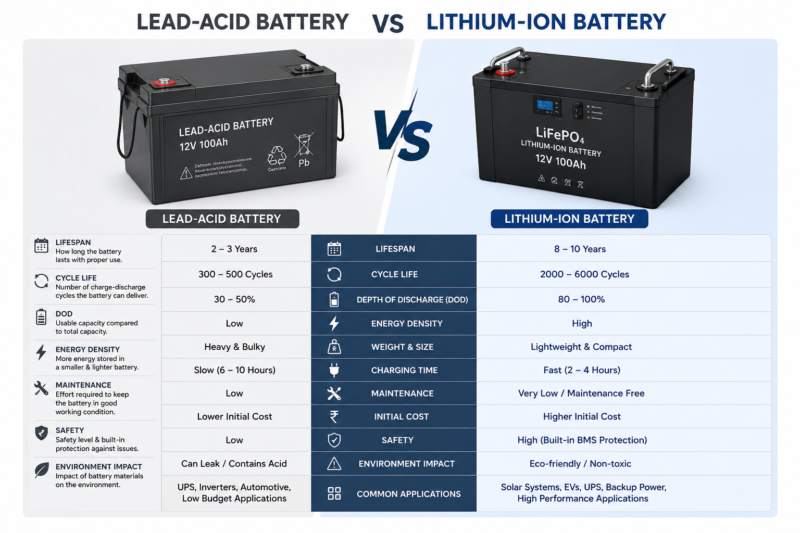
- Usable capacity: A lithium ion battery can be discharged to 80–100% of its capacity, while a lead acid bank is typically limited to 50% to preserve its lifespan — meaning you need a larger, more expensive setup to store the same usable energy.
- System efficiency: Higher round-trip efficiency in a lithium ion battery means less energy is lost during charging and discharging.
- Reliability during outages: For dependable battery backup, faster response times and deeper discharge capability matter — both are strengths of lithium technology.
- Total cost of ownership: While a this older battery type is cheaper upfront, its shorter lifespan often makes it more expensive over a 10–15 year solar power system lifetime.
Detailed Comparison Table
| Feature | Lithium Ion Battery | Lead Acid Unit |
|---|---|---|
| Average lifespan | 10–15+ years | 3–5 years |
| Depth of discharge | 80–100% | 50% (up to 80% for AGM) |
| Round-trip efficiency | 95%+ | 80–85% |
| Weight | Lightweight, compact | Heavy, bulky |
| Maintenance | Minimal to none | Regular (water levels, ventilation) |
| Charging speed | Fast | Slower |
| Safety profile | High (especially LiFePO4) | Moderate (risk of gas venting) |
| Upfront cost | Higher | Lower |
| Long-term cost | Lower (fewer replacements) | Higher (frequent replacement) |
| Best suited for | Daily cycling, backup power, off-grid systems | Budget-limited or occasional backup use |
As the table shows, a traditional lead acid option may look attractive on price alone, but a lithium ion battery consistently outperforms it across almost every dimension that affects real-world solar performance.
Cost Analysis: Upfront vs Long-Term
One of the most common questions in this debate is simple: which one actually saves more money?
- Upfront cost: A lead acid unit typically costs 30–50% less than a comparable lithium battery at the point of purchase.
- Replacement frequency: Because lead acid technology lasts only 3–5 years compared to 10–15+ years for lithium, you may need to replace it two or three times over the life of your solar power system.
- Effective cost per cycle: When you divide total cost by usable cycles, a lithium cell is almost always cheaper in the long run, despite the higher sticker price.
- Installation and space costs: A flooded lead acid cell requires more physical space and ventilation infrastructure, which can add to installation costs.
For most homeowners planning to keep their solar setup for over a decade, the lithium storage unit is the more financially sound choice — even though the initial investment is larger.
Performance Dimensions to Evaluate
1. Depth of Discharge and Usable Capacity
This battery type allows you to use nearly all of its rated capacity without damaging the cells, while a traditional lead acid option must be kept above roughly 50% charge to avoid shortening its life. This means you’d need a much larger lead acid bank to match the usable capacity of a smaller lithium system.
2. Cycle Life
Lithium technology can typically handle 6,000–10,000 charge cycles, compared to just 500–1,200 for a traditional lead acid option. For solar households cycling their battery daily, this difference translates into years of additional service life.
3. Temperature Tolerance
Lithium technology generally performs more consistently across a wider temperature range, while a lead acid unit is more sensitive to extreme heat and cold, which can accelerate degradation.
4. Maintenance Requirements
Lead acid systems require routine maintenance, including topping up electrolyte fluid and monitoring for corrosion. A sealed lithium battery, by contrast, is largely maintenance-free — a key advantage for anyone who wants low-hassle solar battery storage.
5. Safety and Ventilation
Traditional flooded lead acid batteries can release hydrogen gas during charging, requiring proper ventilation. Modern LiFePO4-based lithium systems are considered safer and don’t have this requirement.
6. Footprint and Installation Flexibility
Because a LiFePO4 battery is smaller and lighter for the same capacity, it offers far more flexibility for indoor installation, wall-mounting, or space-constrained homes.
What Should People Choose?- If you want the best long-term value for a solar installation: Choose a lithium cell — it offers a longer lifespan, deeper discharge, and lower total cost of ownership.
- If your budget is extremely tight and usage is occasional: A flooded lead acid cell may still work for basic, infrequent battery backup needs, though it will likely need replacing sooner.
- If you’re building an off-grid or daily-cycling solar system: Lithium is strongly recommended due to its higher cycle life and efficiency.
- If space is limited: A lithium storage unit’s compact footprint makes it the practical choice for smaller homes or indoor installations.
- If safety and low maintenance are priorities: Lithium technology, particularly LiFePO4, is the safer and more convenient option.
For the vast majority of solar battery storage buyers in 2026, this battery type is the recommended choice — lead acid technology is now mostly relevant for legacy systems or extremely budget-constrained backup applications.
How Anya Green Energy Pvt Ltd Can Help
Choosing between lithium technology and a lead acid bank isn’t just about specs on a page — it depends on your household’s energy usage, budget, and long-term goals. This is where working with an experienced solar provider makes a real difference.
Anya Green Energy Pvt Ltd specializes in helping homeowners and businesses design, install, and maintain complete PV systems tailored to their specific needs. Their services typically include:
- Custom solar and battery backup consultations to assess household energy usage and recommend the right battery capacity and chemistry.
- Professional installation of both solar panels and lithium battery storage systems, ensuring proper inverter compatibility and safety compliance.
- System design and sizing support, helping customers avoid common mistakes like undersizing their battery bank or choosing incompatible components.
- After-installation maintenance and monitoring, so customers get the maximum lifespan and performance from their solar battery storage investment.
- Guidance on financing and long-term value, helping customers weigh the upfront cost of lithium technology against long-term savings.
Working with a specialist like Anya Green Energy Pvt Ltd can help take the guesswork out of the lithium ion battery vs lead acid technology decision, ensuring your solar setup is built for reliability and maximum return on investment.
Common Mistakes When Choosing a Solar Battery
- Focusing only on upfront price and ignoring long-term replacement costs.
- Undersizing a lead acid bank, which shortens its already limited lifespan.
- Skipping professional installation, which can compromise both performance and safety.
- Ignoring inverter and system compatibility when switching from lead acid to a lithium cell.
Frequently Asked Questions
Q: Is lithium technology really better than lead acid for solar? A: In almost every performance category — lifespan, efficiency, depth of discharge, and maintenance — lithium outperforms a lead acid unit, though it comes at a higher upfront cost.
Q: Can I replace an existing lead acid unit with lithium in my solar installation? A: Yes, in most cases, though you’ll need to confirm inverter and charge controller compatibility. A professional installer like Anya Green Energy Pvt Ltd can assess your existing setup.
Q: How much longer does lithium technology last compared to lead acid? A: A lithium battery typically lasts 10–15+ years, compared to just 3–5 years for a standard lead acid unit.
Q: Is backup power worth the investment for solar homeowners? A: Yes, especially in areas with frequent outages — reliable outage protection protects essential appliances and maximizes the value of your solar investment.
Final Thoughts
Lithium technology vs a lead acid bank isn’t close when it comes to overall solar performance — lithium wins on lifespan, efficiency, safety, and long-term cost, while lead acid remains relevant only for tight budgets or minimal backup needs. Whichever direction you lean, working with an experienced provider like Anya Green Energy Pvt Ltd ensures your solar battery storage is sized, installed, and maintained correctly, so your solar system delivers reliable emergency power for years to come.
Ready to upgrade your solar storage? Reach out to a trusted installer like Anya Green Energy Pvt Ltd to find the right battery solution for your home.