Monocrystalline Solar Panels: Why They're the Top Choice for High-Efficiency Solar Power
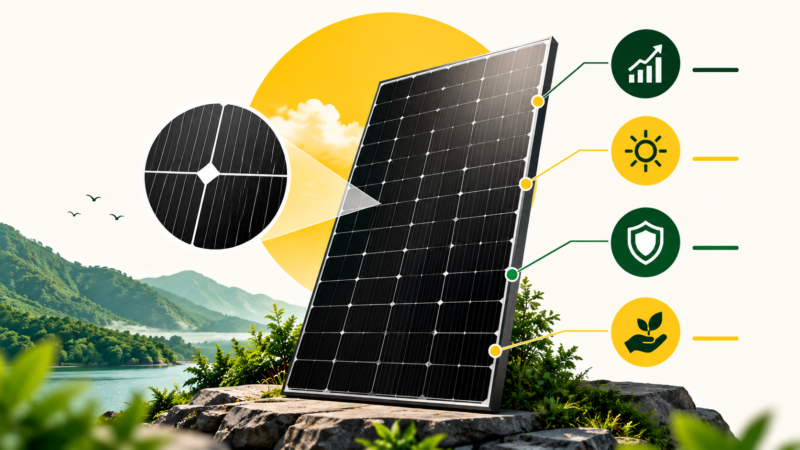
Among the many technology choices available today, monocrystalline solar panels consistently rank as the top-performing option on the market. Known for superior solar panel efficiency and a sleek, uniform black appearance, these panels are built from a single, continuous silicon crystal structure — a manufacturing approach that sets them apart in any monocrystalline vs polycrystalline comparison.
This guide covers everything you need to know about monocrystalline solar panels: how they’re made, how they stack up in the monocrystalline vs polycrystalline debate, what monocrystalline panel cost in India looks like heading into 2026, and which high efficiency monocrystalline panels are worth considering for your rooftop.
What Are Monocrystalline Solar Panels?
What Are Monocrystalline Solar Panels? is one of the most common questions homeowners ask when researching solar technology for the first time. In simple terms, they are solar panels made from a single, continuous crystal of silicon, grown using a process called the Czochralski method. This structure allows electrons to move more freely through the cell, which is the main reason behind their consistently higher efficiency ratings compared to other panel types.
Unlike polycrystalline cells — made by melting multiple silicon fragments together — a monocrystalline wafer is cut from one uniform silicon ingot, giving it a distinctive black colour and rounded-corner cell appearance. This single-crystal structure is also what allows monocrystalline cells to perform better in low-light and partial-shade conditions, a practical advantage for rooftops that aren’t perfectly sun-exposed all day.
Ready to switch to Solar?
solar solutions with Anya Green Energy and discover how you can reduce your electricity bills.
Contact UsHow Monocrystalline Solar Panels Are Made
The manufacturing process begins with highly purified silicon being melted and formed into a single crystal ingot. This cylindrical ingot is then sliced into thin wafers, polished, treated with anti-reflective coating, and assembled into finished solar cells. Because this process demands greater precision and more energy-intensive purification than polycrystalline manufacturing, production costs run higher — a factor that directly feeds into the monocrystalline panel cost in India that consumers eventually see on their installation quotes.
Manufacturers have steadily improved this process over the past decade, reducing silicon waste through wire-saw cutting techniques and improving ingot purity, which has helped bring prices down even as performance has improved — a rare combination in any manufacturing-driven industry.
Monocrystalline vs Polycrystalline: Key Differences
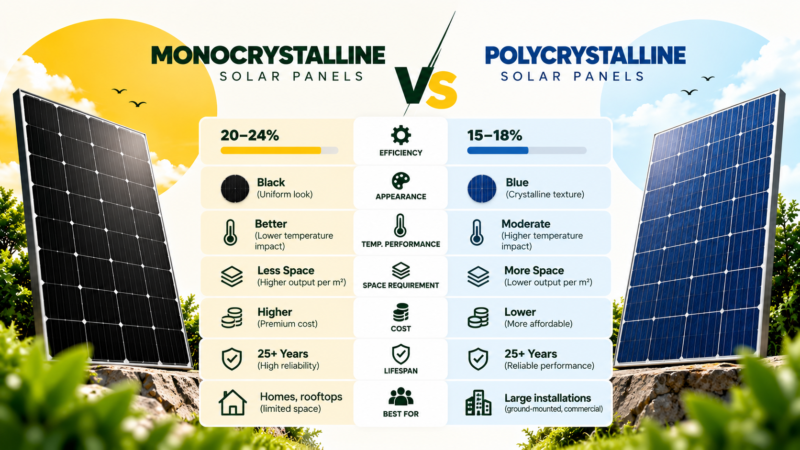
The monocrystalline vs polycrystalline debate comes down to a handful of core factors: efficiency, cost, lifespan, and aesthetics. Polycrystalline panels, made from multiple silicon fragments, are generally cheaper to produce but less efficient, with a characteristic bluish, speckled appearance. Monocrystalline panels, by contrast, deliver higher power output per square foot, making them the better fit for homeowners with limited roof space who still want to maximize generation capacity.
In terms of solar panel efficiency, monocrystalline cells typically range between 20-23%, while polycrystalline panels sit closer to 15-17%. This efficiency gap is one of the clearest differentiators in the monocrystalline vs polycrystalline comparison, and it’s a major reason monocrystalline technology now dominates premium residential and commercial installations.
| Factor | Monocrystalline | Polycrystalline |
|---|---|---|
| Efficiency | 20–23% | 15–17% |
| Appearance | Uniform black | Speckled blue |
| Space Required | Less (for same output) | More |
| Price per Watt | Higher | Lower |
| Lifespan | 25–30+ years | 20–25 years |
| Low-Light Performance | Better | Weaker |
Solar Panel Efficiency: Why Monocrystalline Leads the Pack
Solar panel efficiency is arguably the single biggest reason buyers choose monocrystalline technology over other options. Higher efficiency means more electricity generated from the same roof area — a crucial advantage for homes and businesses working with space constraints.
The uniform crystal structure reduces electron resistance within the cell, directly translating into better real-world performance even in partial shading, overcast skies, or early morning and late evening light conditions — scenarios where lower-efficiency panel types tend to underperform significantly.
Monocrystalline Panel Cost in India: What to Expect
Monocrystalline panel cost in India has fallen considerably over the past five years, driven by domestic manufacturing incentives under the government’s production-linked initiatives and broader economies of scale across the solar supply chain. While monocrystalline technology still carries a price premium over polycrystalline options — typically 10-15% higher per watt — that gap has narrowed substantially as local production has scaled up.
For most residential installations today, monocrystalline panel cost in India sits in a range that makes the technology accessible well beyond premium buyers alone. When factoring in higher efficiency and a smaller rooftop footprint, the total lifetime cost often favors monocrystalline panels over cheaper alternatives that require more panels — and more roof space — to generate the same output.
High Efficiency Monocrystalline Panels: What to Look For
Identifying genuinely high efficiency monocrystalline panels requires looking beyond price alone. Key factors include the cell efficiency rating, temperature coefficient (how much output drops in heat), warranty length, and manufacturer track record.
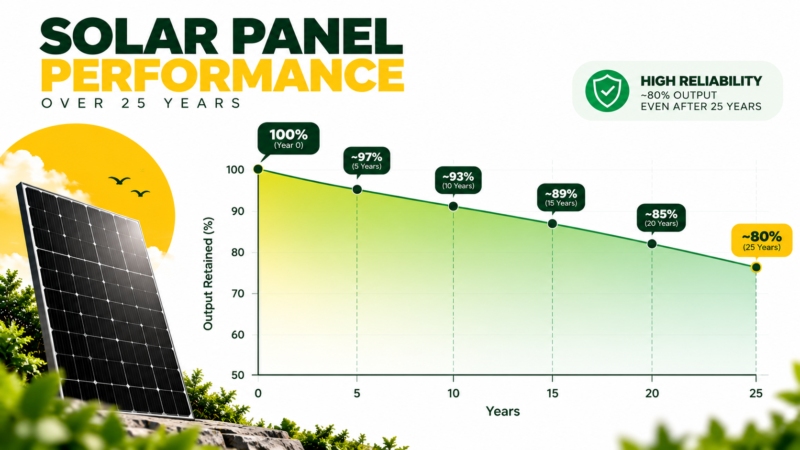
The best high efficiency monocrystalline panels on the market today typically offer 25-year performance warranties, efficiency ratings above 21%, and annual degradation rates under 0.5% — meaning the panel still produces close to its original output decades after installation. Comparing warranty terms and degradation data across brands is one of the most reliable ways to separate genuinely premium panels from merely adequately-marketed ones.
Advantages of Monocrystalline Solar Panels
Monocrystalline solar panels offer several standout advantages that explain their dominance in the premium solar segment:
- Higher efficiency ratings, meaning more power generated from less roof space
- Longer lifespan, often exceeding 25-30 years of productive use
- Better high-temperature performance, with a lower efficiency drop as panel temperature rises
- Sleek, uniform black aesthetic, widely preferred for residential rooftops
- Lower degradation rates over time, preserving output for decades
- Better low-light and partial-shade performance compared to other cell technologies
These combined advantages explain why this panel type remains the preferred choice for homeowners and businesses prioritizing long-term performance over the lowest possible upfront price.
Are There Any Downsides?
To give a balanced picture, monocrystalline technology isn’t without trade-offs. The higher manufacturing precision required means a higher purchase price compared to polycrystalline or thin-film alternatives. Manufacturing monocrystalline cells also generates slightly more silicon waste during the wafer-cutting process, though recycling and process improvements are steadily reducing this impact. For buyers on a tight budget with ample roof space to spare, polycrystalline panels may still make practical sense — efficiency isn’t the only variable that matters in every situation.
Who Should Choose Monocrystalline Solar Panels?
If you have limited roof space, a higher upfront budget, or want genuinely high efficiency monocrystalline panels for long-term reliability, this technology is likely your best fit. Homeowners evaluating monocrystalline panel cost in India against available roof area often find that monocrystalline panels deliver a better return over the system’s lifetime, simply because of superior space efficiency and lower long-term degradation — even though the initial investment is higher.
Expert Perspective
Choosing monocrystalline solar panels ultimately comes down to weighing a higher upfront investment against stronger long-term performance. For most homeowners and businesses comparing panel technologies, the decision increasingly favors monocrystalline as prices continue to fall and efficiency gains compound over a 25-30 year lifespan. If you’re searching for genuinely high efficiency monocrystalline panels for your rooftop, prioritize efficiency rating, warranty length, and manufacturer track record over price alone — the panel you choose today will be generating your electricity for the next three decades.
FAQs
Q1: What makes monocrystalline panels more efficient than other types?
A: Their single-crystal silicon structure allows electrons to move with less resistance, resulting in higher power output per square foot compared to polycrystalline or thin-film alternatives.
Q2: Are monocrystalline panels worth the extra cost in India?
A: For most homeowners with limited roof space or long-term ownership plans, yes — the higher efficiency and lower degradation typically offset the price premium over the system’s lifetime.
Q3: How long do monocrystalline solar panels last?
A: Quality panels typically carry 25-year performance warranties and can remain productive well beyond 25-30 years with proper maintenance.
Q4: Do monocrystalline panels perform better in cloudy or low-light conditions?
A: Yes, their uniform crystal structure generally handles partial shading and low-light conditions better than polycrystalline alternatives.
Q5: What should I check before buying a monocrystalline panel brand?
A: Compare efficiency rating, temperature coefficient, annual degradation rate, and warranty length — these factors matter more than price alone for long-term value.
Trusted by 50000+ Customers
Anya Green Energy is a leading solar company and Solar Energy service provider established in 2013. We are recognized by startup India and customer best choice award 2022.
Our Achievements :
Recognized by Startup India.
Purvanchal’s first solar company to operate exclusively with solar products.
Certified by well-known institutions such as MSME, IndiaMart, and Just Dial and many more.
Winner of the Best Customer Choice Award 2022.
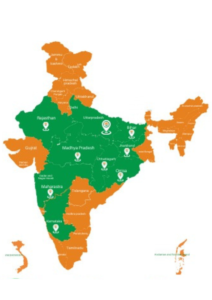
Over 50,000 happy customers across India.