On-Grid vs Off-Grid vs Hybrid Solar. Which Is Best For Your Home?
On-grid vs off-grid vs hybrid solar is one of the most important decisions a homeowner has to make before installing rooftop solar. Choosing the wrong system can mean paying for batteries you don’t need—or installing a system that leaves you without power when the grid goes down.
The good news? The decision becomes much easier when you look at three things: your electricity supply, your need for backup, and your budget.
Quick rule:
Want maximum bill savings? → On-grid
Want solar + backup? → Hybrid
Need complete independence from the grid? → Off-grid
On-Grid vs Of-Grid vs Hybrid Solar at a Glance
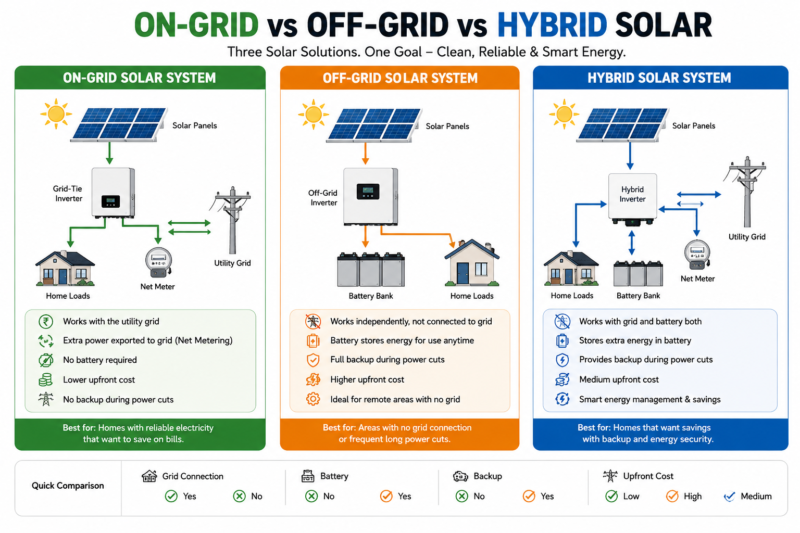
Before getting into technical details, this solar system comparison gives you the big picture.
| Feature | On-Grid | Off-Grid | Hybrid |
|---|---|---|---|
| Grid connection | Yes | No | Yes |
| Battery | No | Yes | Yes |
| Backup during grid outage | Generally no | Yes | Yes |
| Net metering | Where applicable | No | Depends on applicable rules |
| Upfront cost | Lowest | Highest | Medium–High |
| Energy independence | Low | Highest | High |
| Best suited for | Reliable grid | No/poor grid | Grid + frequent outages |
The fundamental difference is simple: the battery and the grid connection determine how the system behaves when sunlight or grid electricity isn’t available.
What is On-Grid Solar System ?
An on-grid solar system is connected to your home’s electricity connection and the utility grid.
During daylight, solar panels generate electricity. Your home uses the power it needs, while surplus electricity may be exported to the grid through the applicable metering arrangement.
At night, or when solar generation isn’t enough, electricity can be drawn from the grid.
Why choose on-grid solar?
The biggest attraction is simplicity.
Because there is normally no battery bank, an on-grid system can have a lower upfront cost than battery-based alternatives. It can be particularly attractive for homeowners whose main objective is reducing electricity bills.
But there is one major limitation.
What happens during a power cut?
A standard grid-connected system generally shuts down when the grid fails because of anti-islanding protection.
So:
Sunlight available + grid outage ≠ automatic backup
This is one of the most important things to understand before buying solar.

What Is an Off-Grid Solar System?
An off-grid solar system operates independently of the electricity grid.
Solar panels generate electricity, while batteries store energy for use when solar generation is unavailable.
The basic flow is:
Solar panels → inverter → home
↓
Battery storage
Because there is no dependable grid acting as backup, the system needs to be designed around your energy requirements and desired autonomy.
When does off-grid make sense?
An off-grid solar system can be appropriate for:
- Remote homes
- Farmhouses
- Properties without reliable grid access
- Locations where grid electricity is extremely limited
- Applications where energy independence is more important than minimum upfront cost
The trade-off is cost.
A system designed for greater autonomy can require more solar generation, larger battery storage and appropriate inverter capacity
What Is a Hybrid Solar System?
A hybrid solar system combines a grid connection with battery storage.
During the day, solar power can run household loads and charge the battery. Depending on the system configuration and applicable rules, surplus electricity may also interact with the grid.
During an outage, the battery can supply designated backup loads.
This gives hybrid solar a major advantage:
You can pursue solar savings without giving up battery backup.
For many homeowners who experience regular power cuts but still have a grid connection, this is the middle ground between on-grid simplicity and off-grid independence.
On-Grid vs Hybrid Solar: Which Should You Choose?
The biggest difference in on-grid vs hybrid solar is the battery.
On-grid
You primarily use solar and the grid.
Hybrid
You use solar, the grid and battery storage.
So, on-grid vs hybrid solar comes down to one key question:
Do you actually need backup power?
If your area has reliable electricity and outages are rare, paying extra for a battery may not provide enough additional value.
If your home experiences frequent outages and backup is important for fans, lights, refrigeration, Wi-Fi or other essential loads, hybrid can justify the additional investment.
On-grid vs hybrid solar: cost perspective
An on-grid system generally has fewer major components because it doesn’t require battery storage.
A hybrid system costs more because battery capacity becomes part of the system design.
Therefore, in the on-grid vs hybrid solar decision, don’t compare only the solar-panel capacity. Compare the complete system, including battery capacity and backup requirements.
Hybrid vs Off-Grid Solar: What’s the Difference?
The biggest difference in hybrid vs off-grid solar is the role of the electricity grid.
A hybrid system has a grid connection.
An off-grid system is designed to operate without depending on that grid.
In other words:
Hybrid = solar + battery + grid
Off-grid = solar + battery, without grid dependence
When does hybrid make more sense?
If your electricity connection is available but unreliable, a hybrid system may provide a practical balance.
When does off-grid make more sense?
If there is no dependable grid connection, an off-grid system may be necessary.
The hybrid vs off-grid solar decision therefore depends heavily on whether you can realistically rely on the grid as an additional energy source.
Hybrid vs off-grid solar: battery sizing
Both systems use batteries, but the design objective can be very different.
A hybrid battery can be sized around your expected outage and essential-load requirements.
An off-grid system needs much greater attention to autonomy because there may be no grid fallback.
That’s why the hybrid vs off-grid solar comparison should never be made simply by looking at battery capacity.
On-Grid vs Off-Grid Solar: Which Is Better?
he on-grid vs off-grid solar decision is essentially a choice between grid dependence and energy independence.
On-grid
Best when the grid is reliable and your main objective is bill reduction.
Off-grid
Best when grid electricity is unavailable or cannot be relied upon.
In the on-grid vs off-grid solar comparison, on-grid generally has the advantage on upfront simplicity because it doesn’t require a battery bank.
Off-grid has the advantage when independence is the priority.
Therefore, there is no universal winner in the on-grid vs off-grid solar debate.
The winner is the system that solves your actual electricity pro
On-Grid or Hybrid Solar: Which Is Right for Your Home?
Still confused about on-grid or hybrid solar?
Use this simple test.
Choose on-grid if:
- Power cuts are rare.
- Your main goal is lower electricity bills.
- You don’t need backup.
- You want to avoid battery storage.
Choose hybrid if:
- Power cuts happen regularly.
- You need essential appliances to continue running.
- You want solar savings plus backup.
- You are comfortable with the additional battery investment.
The on-grid or hybrid solar decision should therefore start with your outage pattern—not with the salesperson’s preferred package.
For a homeowner asking on-grid or hybrid solar, the most useful question is:
“How many hours of backup do I actually need?”
Hybrid or Off-Grid Solar: Which Makes More Sense?
he hybrid or off-grid solar decision becomes easier once you answer another question:
Do you have a usable grid connection?
Yes → Hybrid may be worth considering.
No → Off-grid may be more appropriate.
For someone asking hybrid or off-grid solar, battery capacity is important, but so is the availability of the grid.
If the grid works most of the time, a hybrid system can use it as an additional energy source.
If the grid is unavailable, an off-grid design has to carry much more of the energy burden.
How Much Does Each System Cost?
There is no universal price for any of these systems.
Your final quotation can depend on:
- System capacity
- Solar panel type
- Inverter specification
- Battery technology and capacity
- Roof structure
- Wiring
- Protection equipment
- Installation complexity
- Location
- Electrical connection
- Required backup duration
A useful way to think about the cost hierarchy is:
On-grid → generally lowest upfront cost
Hybrid → higher because of battery storage
Off-grid → potentially highest because of autonomy requirements
However, don’t use this as a substitute for an actual quotation.
A small hybrid battery and a large hybrid battery are completely different products from a homeowner’s perspective.
On-Grid or Hybrid Solar: Don’t Oversize the Battery
One of the biggest mistakes in the on-grid or hybrid solar decision is focusing on the maximum possible backup rather than the backup you actually need.
Imagine your essential outage loads are:
- 3 fans
- 4 lights
- Wi-Fi
- Refrigerator
You may not need your battery to power every appliance in the house.
Instead, identify your essential loads and the number of hours you want them running.
That gives your installer a much better basis for battery sizing.
Hybrid or Off-Grid Solar: Don’t Ignore Autonomy
The hybrid or off-grid solar comparison becomes particularly important when power cuts are long.
An off-grid system has to be designed for periods when solar generation is low and grid electricity isn’t available.
That means system planning can involve:
Load → Solar generation → Battery storage → Required autonomy
The longer you want the system to operate independently, the more carefully generation and storage need to be sized.
This is why an off-grid system shouldn’t simply be selected from a standard “package.”
What Happens During a Power Cut?
This is perhaps the simplest solar system comparison you can make.
On-grid
Grid outage → system disconnects for safety
Hybrid
Grid outage → battery supplies designated backup loads
Off-grid
Grid outage → system continues operating independently
This single difference can completely change which system is right for your home.
Which Solar System Is Best for Your Home?
Here’s the practical decision framework.
Choose ON-GRID when:
Your electricity supply is reliable and your priority is reducing your electricity bill.
Choose HYBRID when:
You have a grid connection but experience regular power cuts and need backup.
Choose OFF-GRID when:
You cannot depend on the electricity grid and require independent power.
So, when comparing on-grid vs off-grid vs hybrid solar, don’t ask:“Which system is best?”
Ask:“Which system matches my electricity problem?”
7 Mistakes to Avoid Before Buying Solar
1. Buying based only on the lowest quotation
Compare the complete scope, not just the headline price.
2. Assuming on-grid means backup
It generally doesn’t provide backup during a grid outage.
3. Buying excessive battery capacity
Size the battery around actual backup requirements.
4. Choosing a system only because of subsidy
Your energy requirement should come first.
5. Ignoring roof shading
Available roof area isn’t necessarily usable solar area.
6. Comparing different system configurations as if they’re identical
A 5 kW on-grid system and a 5 kW hybrid system aren’t equivalent products.
7. Not asking what happens during a grid outage
This should be one of your first questions to the installer.
A Simple Decision Tree
Do you have reliable grid electricity?
YES
Do you need backup during outages?
→ NO → On-grid
→ YES → Hybrid
NO
→ Off-grid
This is the simplest way to approach the on-grid vs off-grid vs hybrid solar decision.
Final Verdict
The best solar system isn’t necessarily the most expensive one—or the one with the largest battery.
For a homeowner focused primarily on electricity-bill savings, on-grid solar can be the logical choice.
For someone who wants savings plus backup, hybrid solar offers a different value proposition.
For a property without dependable grid electricity, off-grid solar can provide the independence that an on-grid system cannot.
The right solar system comparison therefore starts with your electricity consumption, grid reliability, backup requirement, roof conditions and budget.
Before signing a quotation, ask your installer to explain exactly what happens during a power cut, how much battery backup you are getting, what equipment is included and what the installation covers.
That one conversation can prevent an expensive mistake.
FAQs
Which is better: on-grid vs off-grid vs hybrid solar?
It depends on your requirement. On-grid is generally suited to reliable-grid locations focused on bill savings. Hybrid is useful when backup is important. Off-grid is designed for locations where the grid cannot be relied upon.
What is the main difference between on-grid vs hybrid solar?
The key difference is battery storage. An on-grid system generally operates without battery backup, while a hybrid system combines grid connectivity with battery storage.
Is on-grid or hybrid solar better for homes with power cuts?
If backup is important, hybrid may be more suitable. If outages are rare and savings are the priority, on-grid may be more economical.
What is better in the hybrid vs off-grid solar comparison?
Hybrid is generally more suitable when you have a usable grid connection but need backup. Off-grid is designed for greater independence where the grid is unavailable or unreliable.
Is on-grid or off-grid solar cheaper?
On-grid systems generally have a lower upfront cost because they don’t require battery storage. Off-grid systems can cost more because they need energy storage and must be designed for greater autonomy.
Can an on-grid solar system work during a power cut?
A standard grid-connected solar system generally shuts down during a grid outage because of anti-islanding protection. Backup requires an appropriate system configuration.
How should I choose between hybrid or off-grid solar?
Start by checking whether you have a dependable grid connection. If you do and need backup, hybrid may be appropriate. If you cannot depend on the grid, an off-grid system may be more suitable.
https://www.youtube.com/watch?v=953wlPj6JrM