Optimal Direction for Solar Panels: The Complete 2025 Guide to Maximum Output
If you’re planning a rooftop system, one question matters more than almost any other: what’s the optimal direction for solar panels on your specific roof? Get this wrong, and even the most expensive, high-efficiency panels will underperform for 25 years. Get it right, and you maximize every rupee of your investment from day one.
This guide breaks down everything you need to know about the optimal direction for solar panels — including orientation, tilt angle, and placement — so you can make a decision based on data, not guesswork.
Why Direction Matters More Than Most Homeowners Realize
Many people assume any sunny spot on the roof works fine for a solar installation. In reality, choosing the optimal direction for solar panels correctly can mean the difference between 15% and 25% more energy generation annually, depending on your location and roof layout.
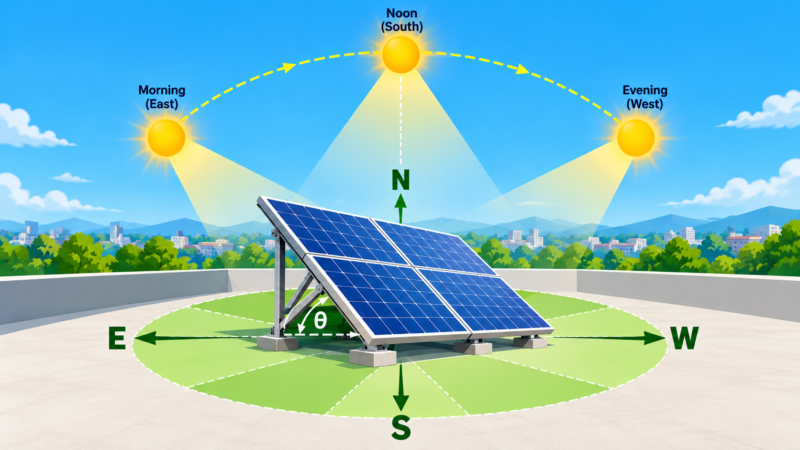
Solar panels generate the most electricity when they receive direct, uninterrupted sunlight for the longest part of the day. Since the sun’s path changes with hemisphere and season, this determines which way panels should face, how steeply they should be angled, and exactly where on the roof they should sit — the three variables that together define effective solar panel orientation.
Ready to switch to Solar?
solar solutions with Anya Green Energy and discover how you can reduce your electricity bills.
Contact UsUnderstanding Solar Panel Orientation Basics
Solar panel orientation refers to the compass direction your panels face — north, south, east, or west. Along with solar panel tilt angle (how steeply panels are angled relative to flat ground), orientation determines how much direct sunlight your system captures throughout the day and across seasons.
For homes in India and other Northern Hemisphere locations, the sun spends most of its time in the southern part of the sky. This is precisely why determining the optimal direction for solar panels almost always starts with facing south, before any site-specific adjustments come into play.
South-Facing Solar Panels: The Gold Standard in India
For most Indian homes, south-facing solar panels receive the most consistent sunlight exposure throughout the year. This orientation captures sunlight from sunrise to sunset with minimal interruption, which is why it’s the default recommendation from nearly every solar installer across the country.
South-facing solar panels typically generate 10-25% more energy annually compared to east- or west-facing installations, depending on your specific latitude and local shading conditions. This is why, when installers talk about the optimal direction for solar panels, south is almost always the starting recommendation before any fine-tuning happens.
That said, south-facing solar panels aren’t automatically available to every homeowner — roof shape, structural layout, and existing obstructions sometimes make a true south orientation impossible. In those cases, it’s important to understand your next-best options.
What About East- or West-Facing Roofs?
If true south isn’t available, east- and west-facing roofs are the next-best options for solar panel placement.
East-facing panels capture strong morning sunlight, which pairs well with households that consume more electricity earlier in the day. West-facing panels capture afternoon and evening sun, aligning well with peak evening usage — particularly relevant for homes running air conditioning or appliances in the evening hours.
While neither matches the output of true south-facing solar panels, a well-designed east- or west-facing system can still deliver strong returns — often within 5-15% of true south-facing performance when combined with correct tilt and minimal shading.
North-facing roofs are generally not recommended in the Northern Hemisphere, as they receive the least direct sunlight year-round. If north is your only available orientation, consult an installer about ground-mounted or pole-mounted alternatives instead.
Solar Panel Tilt Angle: The Other Half of the Equation
Direction alone doesn’t determine the optimal direction for solar panels — tilt angle plays an equally important role in overall performance.
As a general rule, solar panel tilt angle should roughly match your location’s latitude for the best annual performance. For most Indian cities, this means a tilt angle between 15-30 degrees, depending on exact geographic location.
A steeper solar panel tilt angle favors winter sun capture, since the sun sits lower in the sky during colder months, while a flatter angle favors summer performance, when the sun is more directly overhead. Most residential installations use a fixed, moderate angle that balances output across all seasons, though adjustable mounting systems exist for homeowners who want to fine-tune performance seasonally.
Getting the solar panel tilt angle wrong — even with perfect orientation — can reduce annual output by 5-10%, which is why professional installers calculate this based on exact geographic coordinates rather than a generic, one-size-fits-all estimate.
Solar Panel Placement: Beyond Direction and Tilt
Good solar panel placement goes beyond compass direction and tilt angle — it also accounts for shading, roof obstructions, and panel spacing.
Even a perfectly south-facing roof with ideal solar panel tilt angle can underperform if shading from a water tank, chimney, neighboring building, or tree falls across the panels for even a few hours a day. A proper site survey maps shadow patterns across all four seasons — not just the day of the site visit — to ensure truly optimal solar panel placement.
Spacing between panel rows matters too. If rows are installed too close together, one row can shade the row behind it during low-sun hours — early morning and late afternoon — reducing total system output. Professional installers calculate row spacing based on tilt angle and local sun path specifically to avoid this inter-row shading problem.
Regional Variations Across India
The optimal direction for solar panels isn’t identical across every Indian region. While true south remains the general recommendation nationwide, specific tilt angle adjustments vary meaningfully by latitude:
| Region | Recommended Tilt Angle | Notes |
|---|---|---|
| Northern states (Punjab, Haryana, Delhi) | 28-32 degrees | Higher latitude requires steeper angle |
| Central states (Madhya Pradesh, Maharashtra) | 18-24 degrees | Moderate tilt works well year-round |
| Southern states (Tamil Nadu, Kerala, Karnataka) | 10-16 degrees | Lower tilt sufficient near the equator |
This means the optimal direction for solar panels for a homeowner in Chandigarh will differ slightly in tilt specifics from one in Chennai, even though both installations should generally face south.
Common Mistakes in Solar Panel Orientation
Even experienced homeowners make avoidable errors when planning solar panel orientation. Here are the most common ones installers see:
- Ignoring seasonal shading — a roof that’s shadow-free in summer may be partially shaded in winter when the sun sits lower
- Prioritizing aesthetics over performance — placing panels to “look neat” rather than following true optimal direction for solar panels guidance
- Using a flat, zero-degree tilt to minimize visibility, which reduces rain runoff self-cleaning and overall output
- Confusing magnetic south with true south — a standard compass shows magnetic south, which can differ from true south by several degrees depending on location
- Skipping a professional site survey before finalizing solar panel placement, relying instead on rough visual estimates
Avoiding these mistakes is often the real difference between a system that meets its projected output and one that consistently underdelivers
How to Determine the Optimal Direction for Solar Panels for Your Home
Here’s a practical, step-by-step approach to finding the optimal direction for solar panels for your specific property:
- Identify true south using a solar positioning app or tool — not just a standard compass, which shows magnetic south
- Map shading patterns across all four seasons using satellite tools or a professional site survey
- Calculate the ideal tilt angle based on your exact latitude rather than a generic regional average
- Account for roof obstructions like water tanks, chimneys, and staircases when planning panel layout
- Get a professional site assessment to confirm theoretical calculations against real-world roof conditions
Following this process ensures your solar panel orientation decision is based on actual data from your roof — not assumptions that may not apply to your specific home.
Tools That Help You Find the Optimal Direction
Several free and paid tools can help homeowners and installers determine the optimal direction for solar panels before committing to a layout:
- Solar positioning apps (show sun path across seasons for your exact coordinates)
- Satellite shading analysis tools used by most professional installers during site surveys
- PVWatts-style calculators that estimate output based on orientation, tilt, and location
- Drone-based roof scans for larger or complex rooftop layouts
Using these tools alongside a professional site visit gives you the most accurate picture of how solar panel placement, orientation, and tilt will perform specifically on your roof — not just in theory.
Final Thoughts: Getting Direction Right From Day One
Choosing the optimal direction for solar panels isn’t a minor technical detail — it’s one of the biggest factors determining whether your system meets, exceeds, or falls short of its projected output over its 25-year lifespan. South-facing orientation remains the strongest default for most Indian homes, but the right solar panel tilt angle and shading-free solar panel placement matter just as much as direction alone.
If you’re unsure what the optimal direction for solar panels looks like for your specific roof, Anya Green Energy offers free site assessments that map shading, calculate ideal tilt angle, and confirm the best orientation for your home — before you commit to a system size or quote.
FAQ Section
Q1: What is the optimal direction for solar panels in India?
For most of India, the optimal direction for solar panels is true south, since this orientation captures the most consistent sunlight throughout the day and across all seasons.
Q2: Do south-facing solar panels always perform best?
In most cases, yes — south-facing solar panels generate 10-25% more energy annually than east- or west-facing systems, though local shading and roof layout can affect this.
Q3: What is the best solar panel tilt angle for my home?
Your ideal solar panel tilt angle should roughly match your location’s latitude — typically 10-16 degrees in southern India, 18-24 degrees in central India, and 28-32 degrees in northern India.
Q4: Can solar panel placement be adjusted if my roof doesn’t face south?
Yes — adjusting solar panel placement, tilt angle, and even considering east/west orientation can still deliver strong performance, often within 5-15% of true south-facing output.
Q5: How do I find the optimal direction for solar panels on my specific roof?
The best approach combines a solar positioning tool to identify true south with a professional site survey that maps shading patterns and confirms the ideal solar panel orientation and tilt for your exact roof.
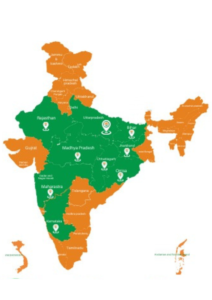
Trusted by 50000+ Customers
Anya Green Energy is a leading solar company and Solar Energy service provider established in 2013. We are recognized by startup India and customer best choice award 2022.
Our Achievements :
Recognized by Startup India.
Purvanchal’s first solar company to operate exclusively with solar products.
Certified by well-known institutions such as MSME, IndiaMart, and Just Dial and many more.
Winner of the Best Customer Choice Award 2022.
Over 50,000 happy customers across India.