Polycrystalline Solar Panels: A Budget-Friendly Guide to Cost, Efficiency, and Performance
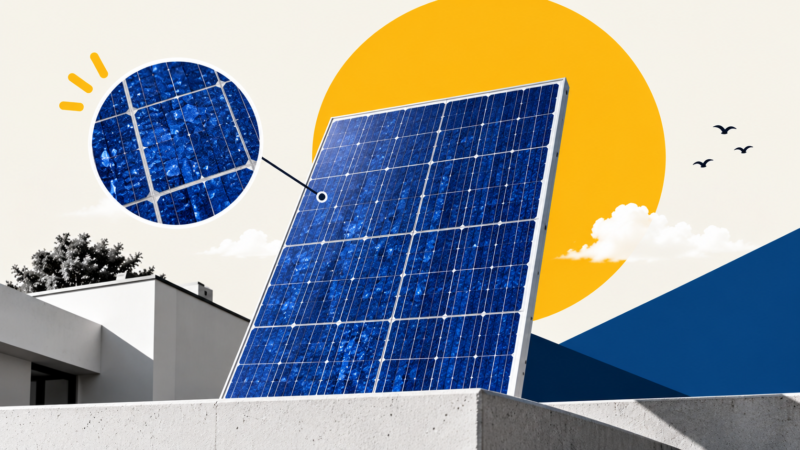
For homeowners looking to go solar without stretching their budget, polycrystalline solar panels remain one of the most practical entry points into renewable energy. Recognizable by their distinctive bluish, speckled appearance, these panels are made from multiple silicon fragments melted together — a manufacturing approach that makes them more affordable, though it does come with some trade-offs worth understanding before you buy.
This guide covers everything you need to know about polycrystalline solar panels: how they stack up in the polycrystalline vs monocrystalline debate, what real-world polycrystalline panel efficiency looks like, current polycrystalline solar panel price trends, and what to expect from polycrystalline solar panel cost in India as you plan your installation.
What Are Polycrystalline Solar Panels?
Polycrystalline solar panels are made by melting multiple fragments of silicon together and casting them into a mould, rather than growing a single continuous crystal as with monocrystalline technology. This manufacturing process is simpler and generates less silicon waste, which directly translates into a lower cost per panel — one of the main reasons polycrystalline solar panels have remained popular among budget-conscious buyers for decades.
Visually, polycrystalline solar panels have a characteristic blue, speckled appearance with square-cut cells, a straightforward way to distinguish them from the uniform black, rounded-corner cells typical of monocrystalline panels.
How Polycrystalline Solar Panels Are Manufactured
The manufacturing process for polycrystalline solar panels begins with raw silicon fragments being melted together in a mould, rather than grown as a single crystal ingot. This molten silicon cools and solidifies into blocks, which are then sliced into wafers and processed into finished cells. Because this method requires less precision and energy than growing a single-crystal ingot, production costs are considerably lower — a saving that’s passed on to buyers through more affordable polycrystalline solar panel price points.
This simpler process is also faster to scale, which is part of why polycrystalline solar panels were historically the dominant panel type globally before monocrystalline technology became more cost-competitive in recent years.
Polycrystalline vs Monocrystalline: Key Differences
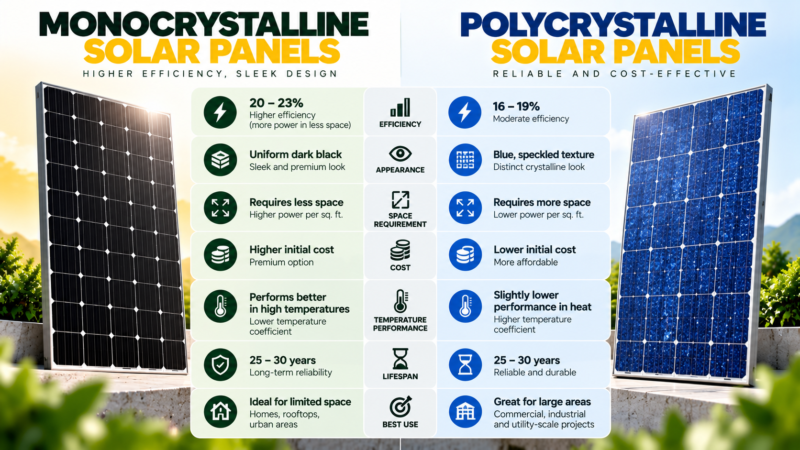
The polycrystalline vs monocrystalline comparison usually comes down to a trade-off between cost and efficiency. Polycrystalline panels are cheaper to manufacture and purchase, but they typically deliver lower efficiency and require more roof space to generate the same output as monocrystalline alternatives.
In terms of polycrystalline panel efficiency, these panels generally range between 15-17%, compared to 20-23% for monocrystalline cells. This gap is the central factor in most polycrystalline vs monocrystalline decisions — buyers with ample roof space often find polycrystalline’s lower price outweighs the efficiency disadvantage, while those with limited space tend to lean monocrystalline instead.
| Factor | Polycrystalline | Monocrystalline |
|---|---|---|
| Efficiency | 15–17% | 20–23% |
| Appearance | Speckled blue | Uniform black |
| Price per Watt | Lower | Higher |
| Space Required | More (for same output) | Less |
| Lifespan | 20–25 years | 25–30+ years |
| Heat Tolerance | Slightly lower | Slightly higher |
Ready to switch to Solar?
solar solutions with Anya Green Energy and discover how you can reduce your electricity bills.
Contact UsPolycrystalline Panel Efficiency: What to Realistically Expect
Understanding real polycrystalline panel efficiency matters for planning your system size accurately. While 15-17% efficiency is lower than premium monocrystalline options, it’s still perfectly workable for households with sufficient roof area — the lower polycrystalline panel efficiency simply means you’ll need a slightly larger array to hit the same total output.
It’s also worth noting that polycrystalline panel efficiency tends to drop a bit more in high-temperature conditions compared to monocrystalline cells, a factor worth considering for installations in particularly hot climates where rooftop temperatures can climb significantly during peak summer months.
Polycrystalline Solar Panel Price: What Drives the Cost
Polycrystalline solar panel price remains consistently lower than monocrystalline alternatives, typically by 10-15% per watt, largely due to the simpler, less energy-intensive manufacturing process. For buyers prioritizing upfront affordability over maximum space efficiency, this price gap makes polycrystalline solar panel price an attractive starting point for first-time solar adopters.
That said, it’s worth calculating total system cost rather than comparing panel price alone — because polycrystalline’s lower polycrystalline panel efficiency may require additional panels to reach a target output, sometimes narrowing the overall savings once mounting hardware and installation labor are factored in
Polycrystalline Solar Panel Cost in India: Current Trends
Polycrystalline solar panel cost in India has fallen steadily as domestic manufacturing capacity has expanded under government production incentives. For many residential buyers, polycrystalline solar panel cost in India remains one of the most accessible entry points into rooftop solar, particularly for homes with generous roof space where the lower efficiency trade-off matters less.
As monocrystalline prices continue to converge with polycrystalline over time, some analysts expect polycrystalline solar panel cost in India advantages to narrow further in coming years — making it worth comparing both options carefully rather than assuming polycrystalline will always be the cheaper long-term choice.
Advantages of Polycrystalline Solar Panels
Polycrystalline solar panels offer several genuine advantages worth considering:
- Lower upfront cost, making solar more accessible to budget-conscious buyers
- Simpler, more established manufacturing process, often meaning stable long-term supply
- Solid performance for homes with ample, unconstrained roof space
- Lower silicon waste during manufacturing compared to monocrystalline production
- Proven long-term track record, having been a dominant panel type for decades
These advantages make polycrystalline solar panels a sensible choice for a specific, common scenario: a household with enough roof area to accommodate a slightly larger array in exchange for meaningful upfront savings.
Limitations to Consider
To give a balanced view, polycrystalline solar panels do carry real trade-offs. Lower efficiency means more panels and more roof space are needed for the same output, which can be a dealbreaker for smaller or irregularly shaped rooftops. Slightly reduced heat tolerance can also mean a modest performance dip during peak summer conditions compared to monocrystalline alternatives. For buyers without space constraints, however, these limitations are often a reasonable trade for the lower price point.
Who Should Choose Polycrystalline Solar Panels?
If you have generous, unobstructed roof space and want to minimize upfront investment, polycrystalline solar panels are a practical and proven choice. Homeowners comparing polycrystalline solar panel cost in India against monocrystalline pricing often find that for larger properties, the lower price per watt outweighs the efficiency gap — especially when the goal is maximizing savings rather than squeezing output from a constrained footprint.
Expert Perspective
As one solar procurement consultant put it, paraphrased here: polycrystalline solar panels haven’t become obsolete just because monocrystalline technology improved — for large rural rooftops, farms, and ground-mounted installations where space isn’t the limiting factor, polycrystalline still offers one of the best cost-per-watt ratios on the market today.
Conclusion
Choosing polycrystalline solar panels comes down to a straightforward trade-off: lower upfront cost in exchange for slightly reduced efficiency and a larger space requirement. For homeowners and businesses with ample roof area who want to minimize initial investment, polycrystalline remains a reliable, well-proven technology with decades of real-world performance behind it. Before deciding, compare polycrystalline solar panel price and polycrystalline solar panel cost in India against your available roof space and long-term energy goals — the right choice depends less on which technology is “better” and more on which fits your specific property and budget.
FAQs
Q1: Are polycrystalline solar panels a good choice for homes in India?
A: Yes, especially for homes with ample roof space, where the lower polycrystalline solar panel cost in India makes it an accessible and cost-effective entry point into solar.
Q2: How much less efficient are polycrystalline panels compared to monocrystalline?
A: Polycrystalline panel efficiency typically ranges from 15-17%, compared to 20-23% for monocrystalline panels — a meaningful but manageable gap for larger roofs.
Q3: Do polycrystalline solar panels last as long as monocrystalline ones?
A: They generally have a slightly shorter lifespan, around 20-25 years compared to 25-30+ years for monocrystalline, though both remain long-term investments.
Q4: Is polycrystalline solar panel price always lower than monocrystalline?
A: Typically yes, by about 10-15% per watt, though the price gap has been narrowing as monocrystalline manufacturing scales and costs fall.
Q5: Do polycrystalline panels perform worse in hot climates?
A: They can experience a slightly larger efficiency drop in high heat compared to monocrystalline panels, which is worth considering in particularly hot regions.
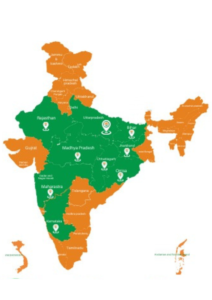
Trusted by 50000+ Customers
Anya Green Energy is a leading solar company and Solar Energy service provider established in 2013. We are recognized by startup India and customer best choice award 2022.
Our Achievements :
Recognized by Startup India.
Purvanchal’s first solar company to operate exclusively with solar products.
Certified by well-known institutions such as MSME, IndiaMart, and Just Dial and many more.
Winner of the Best Customer Choice Award 2022.
Over 50,000 happy customers across India.