Solar Energy Trends 2026: What's Changing & Why It Matters
Just a decade ago, solar panels were considered a luxury investment reserved for eco-conscious homeowners with deep pockets. Today, solar is the cheapest source of electricity in human history in most parts of the world — and it’s only accelerating. As one energy industry report recently stated, “solar isn’t competing with fossil fuels anymore; it’s competing with itself to get even cheaper and more efficient.” That’s exactly the story behind the solar energy trends 2026 is set to bring.
From next-generation panel materials to AI-optimized power grids, the solar industry is entering a transformative phase. In this blog, we’ll break down the data, the innovations, and the multiple dimensions — technological, economic, environmental, and policy-driven — shaping where solar power is headed next year and beyond.
Why 2026 Is a Pivotal Year for Solar
The solar industry added a record-breaking 452 GW of new capacity globally in 2024, and projections suggest 2025 will cross the 500 GW mark. Analysts tracking solar energy trends 2026 widely agree that next year will mark a turning point — not because solar is new, but because it’s finally reaching maturity across cost, storage, and grid integration simultaneously.
This convergence of factors is why understanding solar energy trends 2026 matters now more than ever, whether you’re a homeowner, business owner, investor, or simply someone curious about where the world’s energy is headed.
Technological Innovation Driving Solar Forward
Perovskite-Silicon Tandem Cells
One of the most exciting solar energy trends 2026 will highlight is the commercialization of perovskite-silicon tandem solar cells. Traditional silicon panels max out at around 22-24% efficiency, but tandem cells combining perovskite layers with silicon have already achieved laboratory efficiencies above 33%. Companies like Oxford PV and Qcells are racing to bring these to mass production, with commercial rollout expected to scale significantly through 2026.
Bifacial and Floating Solar Panels
Bifacial panels — which capture sunlight from both sides — are becoming the new industry standard, boosting energy yield by 11-23% compared to traditional monofacial panels. Meanwhile, floating solar installations on reservoirs and lakes are gaining massive traction, particularly in land-scarce countries like Japan, South Korea, and India, since they eliminate the need for valuable land while reducing water evaporation.
AI-Driven Solar Optimization
Artificial intelligence is now being integrated into solar panel technology to predict weather patterns, optimize panel angles in real-time, and preemptively identify maintenance issues before they cause downtime. This is dramatically improving the overall efficiency and reliability of solar power plants, large and small alike.
Solar Recycling Infrastructure
As panels installed during the 2010s solar boom begin reaching end-of-life, 2026 will see a major push toward solar panel recycling infrastructure, with the International Energy Agency estimating that solar panel waste could reach 78 million tonnes globally by 2050 if recycling systems aren’t scaled immediately.
Economic Shifts Shaping the Solar Industrye
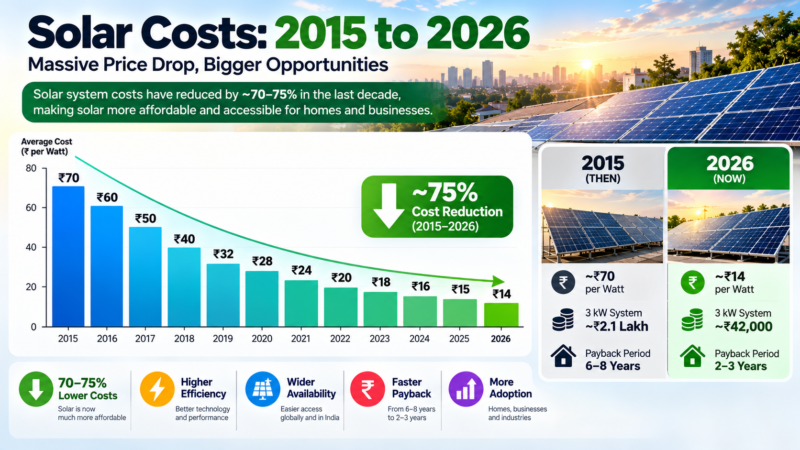
The cost of solar power has fallen nearly 90% over the past decade, and this downward trajectory shows no signs of slowing. Current utility-scale solar power costs range between $0.02 to $0.04 per kilowatt-hour in optimal regions — cheaper than coal, natural gas, or nuclear in most global markets.
Global Market Size:
The global solar energy market was valued at approximately $253 billion in 2024 and is projected to reach $373 billion by 2029, growing at a CAGR of roughly 8%. This growth reflects just how central solar has become to the global clean energy transition.
China’s Manufacturing Dominance:
China currently controls over 80% of global solar panel manufacturing capacity, from polysilicon production to finished modules. This dominance is prompting the US, EU, and India to heavily subsidize domestic manufacturing to reduce supply chain dependency — a trend that will intensify through 2026.
US Incentives:
Under the Inflation Reduction Act, American homeowners and businesses can claim a 30% federal tax credit on solar installations through 2032, while new domestic content bonuses are pushing manufacturers to build panels within the US itself.
India’s Rooftop Solar Push:
India’s PM Surya Ghar Muft Bijli Yojana aims to install rooftop solar on 1 crore (10 million) households by 2026-27, offering subsidies up to ₹78,000 per household. This scheme alone is expected to add over 30 GW of residential solar power capacity.
Environmental Impact and Climate Goals
Solar energy adoption is directly tied to global climate commitments. The International Energy Agency projects that solar alone needs to reach 7,000 GW of global installed capacity by 2030 to keep net-zero targets within reach — nearly five times today’s levels.
Every GW of solar capacity installed offsets approximately 1.5 million tonnes of CO2 emissions annually compared to coal-fired power generation. This makes solar one of the single most impactful levers available for reducing global carbon footprints, which is why renewable energy advocates view solar energy trends 2026 as a critical checkpoint toward long-term climate goals.
Agrivoltaics — Farming Under Solar Panels:
A fascinating emerging trend is agrivoltaics — installing solar panels above farmland, allowing crops to grow underneath while generating electricity simultaneously. Studies show this dual-use approach can increase land productivity by up to 60% compared to using land for either farming or solar alone. Countries like Germany, France, and the US are rapidly scaling pilot agrivoltaic projects into full commercial operations.
Policy and Grid Infrastructure Developments
Battery Storage Integration
Perhaps the single biggest shift among solar energy trends 2026 will showcase is the mainstream pairing of solar with battery storage. Global battery storage capacity paired with solar projects grew by 76% in 2024 alone, solving solar’s historic weakness — intermittency. Tesla, BYD, and Fluence are leading this charge with increasingly affordable lithium-ion and emerging sodium-ion storage solutions.
Virtual Power Plants (VPPs)
Utilities worldwide are beginning to aggregate thousands of residential solar-plus-battery systems into “virtual power plants” that can be dispatched collectively to stabilize the grid during peak demand. Australia already has over 300 MW of VPP capacity operational, with similar programs launching across California and parts of Europe.
Grid Modernization Investments
Governments are recognizing that solar’s growth is being bottlenecked not by panel costs, but by outdated grid infrastructure. The US alone plans to invest over $65 billion into grid modernization through 2026, specifically to accommodate distributed solar power generation at scale.
Real-World Examples Already Shaping the Narrative
Tesla’s Solar Roof 2.0: Tesla has refined its solar roof tiles to be more affordable and faster to install, targeting mainstream residential adoption rather than just luxury markets.
India’s Bhadla Solar Park: Spanning 14,000 acres in Rajasthan, this remains one of the largest solar installations globally, generating 2,245 MW and serving as a blueprint for utility-scale desert solar projects worldwide.
Singapore’s Floating Solar Farms: With limited land availability, Singapore has pioneered floating solar installations on reservoirs, a model now being replicated across Southeast Asia.
Dubai’s Mohammed bin Rashid Al Maktoum Solar Park: Targeting 5,000 MW capacity by 2030, this project exemplifies how oil-rich Gulf nations are diversifying aggressively into renewable energy.
Challenges That Could Slow Down Solar's Momentum
Despite the optimism surrounding solar energy trends 2026, several challenges remain:
Supply Chain Vulnerabilities: Heavy reliance on Chinese manufacturing creates geopolitical risk, especially amid ongoing trade tensions and tariff disputes between major economies.
Land Use Conflicts: Utility-scale solar farms require significant land, occasionally competing with agricultural or conservation interests, making agrivoltaics and floating solar increasingly important solutions.
Grid Interconnection Delays: In the US alone, over 2,000 GW of proposed solar and storage projects are currently stuck in interconnection queues, sometimes waiting 3-5 years for grid approval.
Raw Material Constraints: Silver, used in solar cell conductivity, and polysilicon production both face supply constraints that could impact manufacturing scale-up if not addressed through recycling and material innovation.
As one renewable energy analyst put it in a recent market report, “the sun isn’t the limiting factor for solar’s growth anymore — our grids, policies, and supply chains are.”
What Experts Predict for 2026 and Beyond
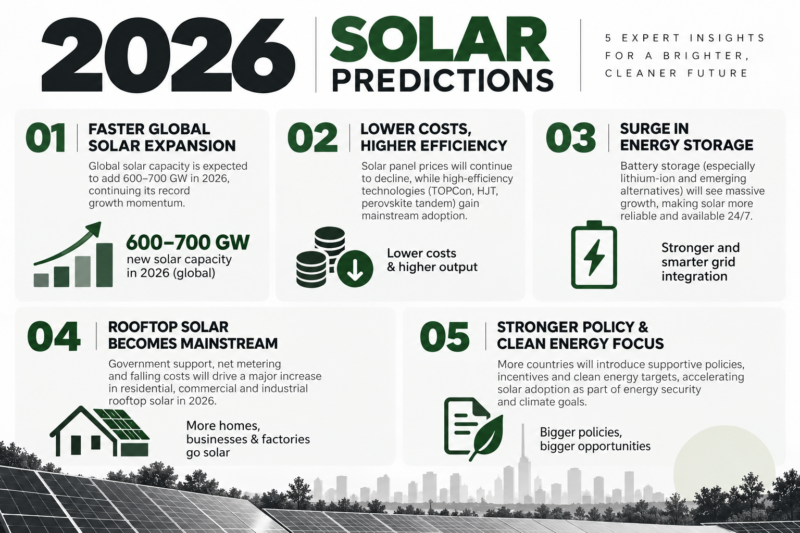
Analysts tracking solar energy trends 2026 broadly agree on several key predictions:
- Global solar capacity additions will likely exceed 600 GW for the first time in a single year
- Battery storage attachment rates with new solar installations will surpass 40% globally, up from roughly 25% in 2023
- Perovskite-tandem panels will begin appearing in commercial projects, though full market saturation remains years away
- Residential solar adoption in emerging markets like India, Brazil, and Southeast Asia will outpace growth in mature markets like the US and Europe
- AI-powered energy management systems will become standard features in new solar installations, both residential and commercial
The overarching theme across every solar energy trends 2026 forecast is clear: solar is no longer just an alternative energy source — it’s becoming the backbone of modern electricity generation worldwide.
Conclusion: Why You Should Pay Attention to Solar Energy Trends 2026
Whether you’re a homeowner considering rooftop panels, a business evaluating energy costs, or simply someone interested in climate solutions, the solar energy trends 2026 will bring are impossible to ignore. From breakthrough perovskite technology to AI-optimized grids, from agrivoltaic farms to massive floating solar installations, the solar industry is evolving across every dimension simultaneously.
The data is unambiguous — costs are falling, efficiency is rising, storage is solving solar’s biggest weakness, and governments worldwide are backing this transition with unprecedented policy support. As we move closer to 2026, solar power isn’t just participating in the global clean energy transition — it’s leading it.
The question is no longer whether solar will dominate the future of energy. It’s how quickly the rest of the world’s infrastructure, policy, and markets can catch up to match its pace.
FAQs About Solar Energy Trends 2026
Q: What is the biggest solar energy trend for 2026?
A: The mainstream integration of battery storage with solar installations is widely considered the most significant trend, solving solar’s historic intermittency problem.
Q: Will solar panels get cheaper in 2026?
A: Yes, costs are expected to continue declining due to manufacturing scale-up, improved solar panel technology, and increased competition among global manufacturers.
Q: Which countries are leading in solar energy adoption?
A: China, the United States, India, Germany, and Australia currently lead global solar capacity additions and are expected to remain frontrunners through 2026.
Q: What is agrivoltaics and why is it trending?
A: Agrivoltaics combines farming and solar power generation on the same land, increasing overall land productivity — a trend rapidly gaining popularity in land-scarce regions.
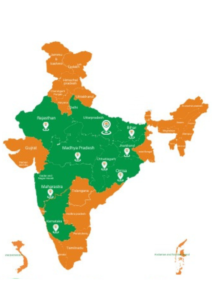
Trusted by 50000+ Customers
Anya Green Energy is a leading solar company and Solar Energy service provider established in 2013. We are recognized by startup India and customer best choice award 2022.
Our Achievements :
Recognized by Startup India.
Purvanchal’s first solar company to operate exclusively with solar products.
Certified by well-known institutions such as MSME, IndiaMart, and Just Dial and many more.
Winner of the Best Customer Choice Award 2022.
Over 50,000 happy customers across India.