Why Small Business Owners Should Opt for Solar in 2025
Every small business owner knows the feeling — the electricity bill arrives, and a chunk of hard-earned monthly profit disappears before it even reaches the bank account. For shop owners, manufacturers, restaurant operators, and office-based businesses alike, power costs are often the second or third largest recurring expense after rent and salaries. Yet most small business owners haven’t seriously considered the one solution sitting right above their heads — literally. As one commercial energy consultant put it, “the businesses that switch to solar early aren’t just saving money, they’re buying themselves a permanent competitive advantage.”
This is exactly why solar for small business has become one of the most important financial decisions available to entrepreneurs today. In this blog, we’ll explore the real data, the financial logic, and the multiple dimensions — cost, tax, branding, and long-term security — that make solar a smart move for small business owners right now.
The Real Cost Problem Small Businesses Face
Commercial electricity tariffs in India are typically 20-40% higher than residential rates, depending on the state and consumption slab. A small manufacturing unit, retail showroom, or office consuming even 1,000-2,000 units monthly can easily see electricity bills ranging from ₹15,000 to ₹40,000 or more. Over a year, that’s a substantial fixed cost eating directly into profit margins — money that could otherwise be reinvested into inventory, marketing, or staff.
Unlike large corporations that can absorb fluctuating energy costs, small businesses operate on thinner margins, making predictable and reduced power expenses far more critical to long-term survival and growth.
Why Solar Makes Sense: The Core Financial Logic
Solar for small business essentially converts an ongoing monthly expense into a one-time investment with long-term returns. Once a commercial solar system is installed, it can offset 70-90% of a business’s electricity consumption, depending on roof space, energy usage patterns, and system size.
Payback Period:
Most commercial solar installations in India pay back their initial investment within 3 to 5 years, while the system itself typically operates efficiently for 25 years or more. This means a business enjoys 20+ years of significantly reduced electricity costs after the initial payback period — essentially free or near-free power for the majority of the system’s lifespan.
Return on Investment (ROI):
Industry data suggests commercial solar installations often deliver an ROI of 18-24% annually once operational, a figure that outperforms many traditional business investment avenues, especially considering the low-risk, predictable nature of electricity savings compared to volatile markets.
Direct Financial Savings
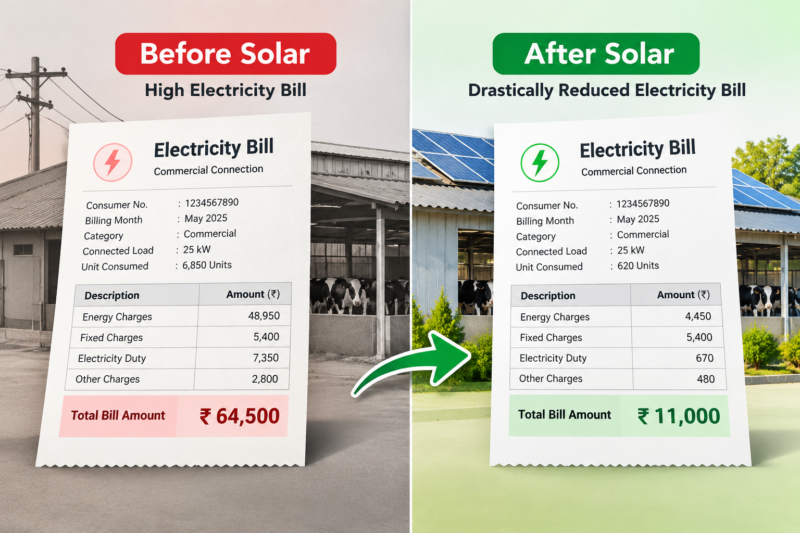
The most obvious reason small business owners should opt for solar is straightforward cost reduction. Commercial solar panels installed on rooftops or unused land can directly offset daytime electricity consumption — which aligns perfectly with typical business operating hours when solar generation is at its peak.
For businesses operating retail stores, restaurants, offices, or light manufacturing units during daylight hours, this alignment between solar generation and consumption makes the savings even more immediate and impactful compared to residential use, where evening consumption patterns reduce direct solar benefit.
Net Metering Benefits:
Through net metering policies available in most Indian states, businesses can export excess solar generation back to the grid during low-usage periods and draw credited power during high-usage periods, effectively using the grid as a virtual battery and maximizing savings even further.
Ready to switch to Solar?
solar solutions with Anya Green Energy and discover how you can reduce your electricity bills.
Contact UsTax Benefits and Government Incentives
Beyond direct electricity savings, solar subsidy for business programs and tax incentives make the investment even more attractive.
Accelerated Depreciation:
Under Indian tax law, businesses can claim accelerated depreciation of up to 40% annually on solar assets, significantly reducing taxable income in the initial years after installation. This tax shield alone can recover a substantial portion of the initial investment within the first two to three years.
State and Central Subsidies:
Many state governments offer additional capital subsidies or reduced GST rates on commercial solar installations, further lowering the effective upfront cost. Combined with central government incentives under various renewable energy promotion schemes, the net cost of commercial solar adoption has never been more affordable.
Priority Sector Lending:
Several banks and financial institutions now classify solar investments under priority sector lending, meaning small businesses can access loans for solar installation at more favorable interest rates compared to standard business loans.
Energy Security and Business Continuity
For small businesses, especially those in manufacturing or essential retail operations, unpredictable power cuts and grid instability can directly translate into lost revenue, damaged inventory, or missed deadlines. Solar for business owners paired with battery storage solutions provides a reliable backup, reducing dependency on an often inconsistent grid supply, particularly in semi-urban and rural business locations.
This energy security dimension is increasingly important as climate-related grid disruptions and peak-demand blackouts become more frequent across various Indian states, making solar not just a cost-saving measure but a genuine business continuity strategy.
Brand Image and Customer Perception
Modern consumers, particularly younger demographics, increasingly favor businesses that demonstrate environmental responsibility. Small businesses that visibly adopt solar — whether a retail showroom, restaurant, or manufacturing unit — can leverage this transition as a genuine marketing and branding asset.
Competitive Differentiation:
In competitive local markets, being known as an environmentally conscious business can meaningfully influence customer loyalty and word-of-mouth referrals, particularly among urban and semi-urban customer bases increasingly aware of sustainability issues.
B2B Advantage:
For businesses operating in supply chains serving larger corporations, many of which now have their own sustainability targets and vendor requirements, having solar-powered operations can become a genuine competitive advantage when bidding for contracts or partnerships with environmentally conscious larger clients.
Protection Against Rising Electricity Costs
Commercial electricity tariffs have historically risen at a rate of 5-7% annually across most Indian states, driven by fuel cost adjustments, infrastructure investments, and policy changes. For a small business locked into traditional grid dependency, this means power costs will almost certainly continue climbing year after year, directly squeezing already thin margins.
Solar for small business effectively locks in a predictable, significantly lower energy cost structure for decades, insulating the business from this ongoing tariff inflation. Over a 20-25 year system lifespan, the cumulative savings compared to continued grid dependency can be substantial, often running into several lakhs or even crores of rupees depending on business size and consumption levels.
Real-World Examples of Small Businesses Benefiting from Solar
Retail Showrooms: Many small and medium retail businesses across Gujarat and Maharashtra have reported 60-80% reductions in monthly electricity bills after installing rooftop solar, with payback periods often under 4 years due to favorable state subsidies.
Manufacturing Units: Small-scale manufacturing operations in industrial clusters like Ludhiana, Coimbatore, and Rajkot have increasingly adopted solar to offset high daytime machinery power consumption, directly improving profit margins in cost-sensitive manufacturing sectors.
Restaurants and Hospitality: Restaurants and small hotels, which often run heavy refrigeration and air conditioning loads during daytime hours, have found solar particularly effective in offsetting these predictable, high-consumption patterns.
Educational Institutions: Small private schools and coaching centers have adopted solar to manage daytime electricity loads from lighting, fans, and computer labs, while also using the installation as an educational and branding tool to demonstrate sustainability values to parents and students.
Common Concerns Small Business Owners Have (And Why They Shouldn't Hold You Back)
“The upfront cost is too high.”
While initial investment can seem significant, the combination of accelerated depreciation, subsidies, and financing options has dramatically reduced the effective cost burden, with many businesses recovering a substantial portion of costs within the first few years through tax benefits alone.
“My roof isn’t big enough.”
Modern commercial solar panels have significantly improved efficiency, meaning even moderate roof spaces can generate meaningful power offsets. Additionally, ground-mounted or carport-style installations are viable alternatives for businesses with limited rooftop space but available land.
“What if I move locations?”
While solar is a fixed asset tied to a property, many businesses structure installations as long-term investments tied to owned properties, and the increased property value from an installed solar system often benefits businesses even if they eventually relocate or sell.
“Maintenance will be a hassle.”
Commercial solar systems require minimal maintenance — typically periodic cleaning and occasional inspection — with most reputable installers offering maintenance packages and warranties covering 20-25 years, significantly reducing owner concern around upkeep.
The Cost of Waiting
Perhaps the most compelling reason for small business owners to act now rather than later is the combination of rising electricity costs and time-sensitive government incentives. Current subsidy structures and accelerated depreciation benefits may not remain at present levels indefinitely, while commercial electricity tariffs continue their steady upward climb regardless of policy changes.
Every year a small business delays adopting solar for business operations represents another year of elevated electricity bills, missed tax benefits, and foregone long-term savings that could otherwise be reinvested into business growth.
Conclusion: A Decision That Pays for Itself
For small business owners evaluating where to invest limited capital for maximum long-term impact, solar for small business adoption represents one of the rare decisions that simultaneously reduces costs, improves tax efficiency, strengthens energy security, and enhances brand reputation — all while paying for itself within just a few years of operation.
As commercial electricity costs continue rising and government incentives remain available, the financial logic for small businesses to transition to solar has never been more compelling. The businesses that act today will spend the next two decades enjoying the competitive advantage of dramatically lower operating costs — while those that wait will continue paying the price, quite literally, for delayed decisions.
FAQs About Solar for Small Business
Lorem ipsum dolor sit amet, consectetur
Q: How much can a small business save by switching to solar?
A: Most small businesses see a 60-90% reduction in electricity bills, depending on system size and consumption patterns, with savings continuing for 20-25 years after installation.
Q: What is the typical payback period for commercial solar?
A: Commercial solar installations typically pay back their initial investment within 3 to 5 years, factoring in tax benefits and subsidies.
Q: Are there tax benefits for businesses installing solar?
A: Yes, businesses can claim accelerated depreciation of up to 40% annually, significantly reducing taxable income in the years following installation.
Q: Is solar suitable for businesses with limited roof space?
A: Yes, modern high-efficiency panels and alternative installation methods like ground-mounted systems make solar viable even for businesses with limited rooftop space.
adipiscing elit. Ut elit tellus, luctus nec ullamcorper mattis, pulvinar dapibus leo.
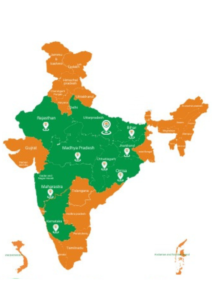
Trusted by 50000+ Customers
Anya Green Energy is a leading solar company and Solar Energy service provider established in 2013. We are recognized by startup India and customer best choice award 2022.
Our Achievements :
Recognized by Startup India.
Purvanchal’s first solar company to operate exclusively with solar products.
Certified by well-known institutions such as MSME, IndiaMart, and Just Dial and many more.
Winner of the Best Customer Choice Award 2022.
Over 50,000 happy customers across India.