
Solar Panel Recycling: What Happens to Panels After 25 Years?
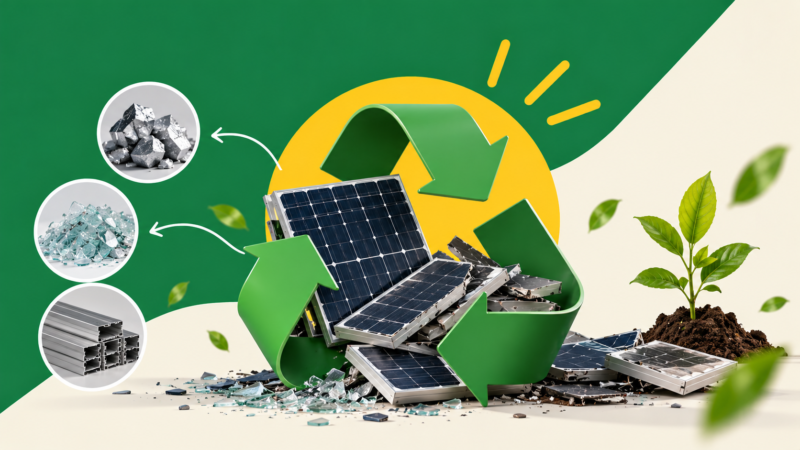
Solar panels are often marketed around their 25-year performance warranty, but a question quietly follows that promise: what actually happens once those panels reach the end of their working life? It’s a fair question, and increasingly a common one, as the first large wave of residential installations from over a decade ago begins approaching retirement age.
This guide covers everything currently known about what happens to panels after installation ends, how the recycling process actually works, what it costs, and why this matters for the long-term sustainability of the technology as a whole — written for both current solar owners and prospective buyers thinking ahead.
Ready to switch to Solar?
solar solutions with Anya Green Energy and discover how you can reduce your electricity bills.
Contact UsWhy This Topic Is Becoming More Urgent
For years, discussions around panel retirement felt distant and theoretical, since most installed systems were still well within their productive lifespan. That’s changing. Early adopters from roughly fifteen to twenty years ago are now watching their systems approach the point where panel degradation becomes significant enough to consider replacement, and that shift is driving genuine, practical interest in a question that used to be purely hypothetical.
At the same time, the sheer scale of global solar deployment over the past decade means the volume of panels eventually reaching retirement is set to grow dramatically over the coming years. Industry projections suggest the cumulative weight of retired panels worldwide will increase many times over by the mid-2030s compared to current volumes — a trajectory that makes proper end-of-life management a genuinely important infrastructure question, not a niche environmental concern
What Are Panels Actually Made Of?
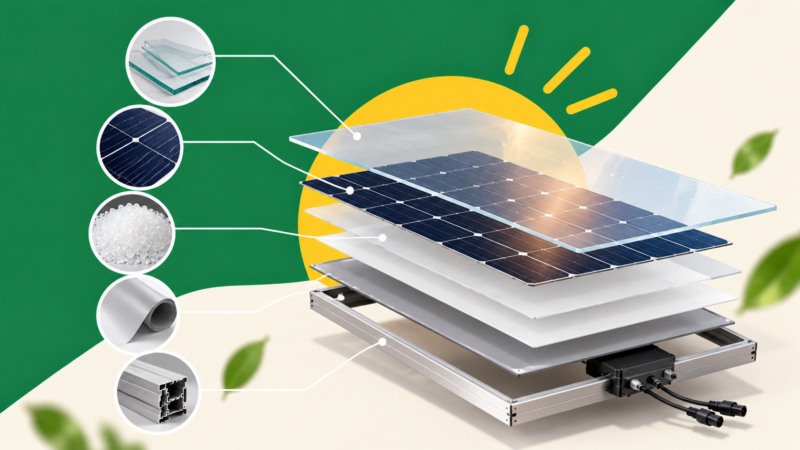
Understanding why proper end of life solar panels management matters requires knowing what’s actually inside a typical module. A standard panel consists of a glass front sheet (roughly 65-75% of total weight), an aluminum frame, a polymer back sheet, encapsulant material holding the cells in place, copper wiring, and the silicon solar cells themselves, along with small amounts of silver and other metals used in cell manufacturing.
Most of this composition — particularly the glass and aluminum — is genuinely recyclable using fairly conventional industrial processes. The more complex part involves separating and recovering the silicon cells and trace metals, which requires more specialized processing than simply crushing the panel and sorting materials.
What Happens Without Proper Recycling?
Before diving into how recycling works, it’s worth understanding what happens when panels aren’t recycled properly. Without a structured recycling pathway, retired panels typically end up in general landfills, where the glass and aluminum content simply goes to waste rather than being recovered, and the long-term breakdown of polymer backing materials raises some environmental concerns, though panels are not considered hazardous waste in most regulatory frameworks.
This isn’t a crisis today, given how few panels have actually reached end-of-life relative to total installations, but it’s exactly why building proper infrastructure now — before volumes scale up dramatically — matters so much for the industry’s long-term credibility as a genuinely sustainable technology.
How the Recycling Process Actually Works
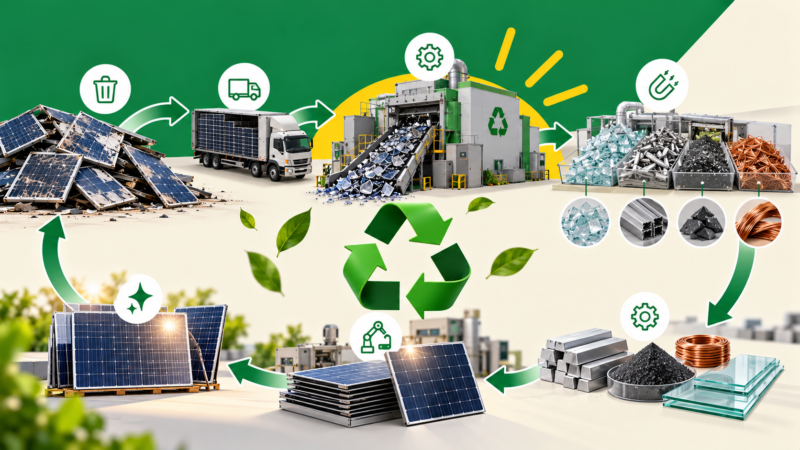
The recycling process generally happens in stages, each targeting different materials within the panel.
Stage One: Disassembly and Frame Removal
The aluminum frame is mechanically removed first, since it’s the easiest component to separate and has well-established recycling markets already in place, similar to aluminum recycling in other industries.
Stage Two: Glass Separation
The front glass sheet, making up the majority of a panel’s weight, is separated next. This can be done through mechanical crushing and sorting or, in more advanced facilities, through thermal or chemical processes designed to preserve glass quality for higher-value reuse rather than downcycling into lower-grade applications.
Stage Three: Cell and Material Recovery
This is the most technically complex stage, involving separating the silicon cells from the encapsulant material and recovering valuable materials like silver, copper, and silicon itself. Advanced facilities use a combination of thermal treatment (to break down the polymer encapsulant) and chemical or mechanical processes to recover these materials at increasingly high purity levels.
Stage Four: Material Reuse
Recovered glass typically goes into new glass manufacturing or construction materials. Aluminum frames feed back into standard aluminum recycling supply chains. Recovered silicon, silver, and copper can, in more advanced facilities, be reintroduced into new panel manufacturing or other electronics applications, closing the loop on the original materials.
Overall recovery rates vary significantly depending on facility sophistication, ranging from around 80% material recovery in basic facilities to over 95% in advanced ones specifically designed for this purpose.
The Current State of Infrastructure
Dedicated recycling infrastructure remains in a relatively early stage of development globally, including in India, where the volume of retired panels hasn’t yet reached the scale that justifies widespread dedicated facilities in every region. Most current solar waste management today happens through a combination of general e-waste recyclers (who can recover glass and metal but may not have specialized processes for cell-level material recovery) and a smaller number of dedicated facilities specifically built for this purpose.
This is expected to change significantly over the next decade as volumes increase and regulatory frameworks mature, following a pattern similar to how electronics and battery recycling infrastructure developed in response to growing waste volumes in those sectors.
Policy and Regulatory Landscape
Several governments globally have begun introducing specific regulations addressing solar panel disposal and recycling obligations, often modeled on existing e-waste management frameworks. In India, panels generally fall under broader e-waste management rules, though dedicated solar-specific regulations are still developing as the issue gains more policy attention.
Manufacturer responsibility is an increasingly common regulatory approach being discussed and implemented in various markets — requiring panel manufacturers to take some responsibility for end-of-life management of the products they sell, similar to extended producer responsibility frameworks already common in electronics and packaging industries. This kind of policy shift would meaningfully accelerate the development of dedicated recycling infrastructure by creating clearer financial incentives and obligations.
How Much Does Recycling Cost?
Cost remains one of the biggest practical barriers to widespread adoption of proper recycling practices. Processing a single panel through a dedicated solar panel recycling facility currently costs more than simply sending it to a general landfill, which creates an economic disincentive without supportive policy or regulation in place.
However, as solar panel recycling facility scale increases and material recovery technology improves, per-panel processing costs are expected to decrease substantially, following the same cost-reduction trajectory seen in other recycling industries as they matured from niche operations into established infrastructure. Additionally, as recovered silver, copper, and silicon become more valuable inputs for new panel manufacturing, the economics of recycling are likely to improve independently of regulatory pressure, since manufacturers increasingly see recovered materials as a genuine supply chain opportunity rather than just an environmental obligation.
What This Means for Current and Future Solar Buyers
For homeowners currently considering installation, panel retirement remains a distant concern given the 25-year warranty period most systems carry — but understanding the full lifecycle picture matters for making a genuinely informed, sustainability-conscious decision. A few practical points worth knowing:
First, panels rarely fail suddenly or completely at the 25-year mark; performance gradually degrades over time, solar panel recycling meaning most systems continue producing meaningful (if reduced) output well beyond their warranty period, pushing actual retirement further into the future than many assume.
Second, choosing an installer and manufacturer with documented plans or participation in recycling programs, even if not currently mandatory, reflects a stronger long-term sustainability commitment than one with no end-of-life consideration at all.
Third, the environmental footprint of manufacturing new panels is already offset many times over by the clean electricity generated during a panel’s operational lifespan, solar panel recycling meaning concerns about eventual disposal shouldn’t discourage adoption — proper end-of-life management is an important refinement to an already strongly positive environmental equation, not a reason to question the technology’s overall value.
Comparing Disposal Pathways
| Pathway | Material Recovery | Environmental Impact | Current Availability |
|---|---|---|---|
| General landfill | Minimal to none | Highest negative impact | Widely available, not recommended |
| General e-waste recycler | Partial (glass, aluminum, some metals) | Moderate improvement | Increasingly available |
| Dedicated solar recycling facility | High (80-95%+) | Lowest negative impact | Limited but growing |
| Manufacturer take-back programs | Varies by program | Depends on downstream processing | Emerging, not yet widespread |
This comparison highlights why the current conversation around solar waste management centers so heavily on building out dedicated facility capacity and manufacturer accountability programs, rather than relying on general e-waste infrastructure alone.
The Economic Opportunity in Recycling
Beyond the environmental argument, there’s a growing economic case for investing in better recycling infrastructure. The materials recovered through a well-executed recycling process — particularly silver, copper, and high-purity silicon — represent genuinely valuable inputs for manufacturing, not just waste byproducts. As global panel installation volumes have grown dramatically, the long-term value locked inside eventually-retired panels represents a substantial potential resource stream, reducing dependence on newly mined raw materials for future panel production.
This circular economy framing is increasingly how industry analysts discuss the opportunity, rather than treating it purely as a cost center or regulatory burden. As one renewable energy sustainability researcher put it in a recent industry panel discussion: “We spent the first two decades of the solar industry focused entirely on getting panels installed. The next decade has to be about building the infrastructure to handle them responsibly when they come down — and increasingly, that’s starting to look like a genuine business opportunity, not just an obligation.”
What Buyers and Installers Can Do Today
While comprehensive infrastructure is still developing, there are practical steps available right now:
First, ask installers and manufacturers directly about their end-of-life policies or any recycling partnerships they participate in, even informally. Second, support policy development by staying informed about regulatory proposals addressing solar waste management, since consumer and industry demand often accelerates regulatory attention. Third, for anyone replacing an older system, actively seek out e-waste recyclers or emerging dedicated facilities rather than defaulting to general disposal, even if it requires slightly more effort or cost in the near term.
Fourth, and perhaps most importantly, don’t let end-of-life concerns become a reason to delay adopting solar now — the technology’s climate benefit during its operational decades vastly outweighs the current gaps in disposal infrastructure, and those solar panel recycling gaps are actively closing as the industry matures.
Looking Ahead: The Future of Panel Retirement
The trajectory for solar panel recycling infrastructure closely mirrors how other emerging waste streams have developed historically — electronics recycling, lithium battery recycling, and similar circular economy sectors all followed a similar path from limited, costly, niche operations toward more efficient, economically viable, and widely available infrastructure as volumes grew and technology matured.
Given current global installation growth rates, the volume of retired panels is expected to increase substantially over the coming fifteen to twenty years, which will likely accelerate investment in dedicated solar panel recycling facilities, improve material recovery rates further, and potentially make recycling cost-competitive with disposal well before most of today’s installed systems actually reach retirement age.
Final Thoughts
The question of what happens to panels after their productive life ends is a legitimate and solar panel recycling increasingly important one, but it shouldn’t be mistaken for a flaw in solar technology itself. The materials inside a typical panel are substantially recyclable using existing and emerging industrial processes, infrastructure is actively developing in response to growing future volumes, and the environmental math overwhelmingly favors solar adoption even accounting for current gaps in end-of-life management.
For current and prospective solar owners, solar panel recycling the most useful takeaway is this: proper recycling pathways exist and are improving, panels degrade gradually rather than failing abruptly, and choosing installers and manufacturers who take end-of-life responsibility seriously is a meaningful way to support the continued maturation of this part of the industry.
Anya Green Energy stays informed on evolving best practices around panel lifecycle management and is happy to discuss manufacturer policies and disposal pathways as part of any installation consultation, alongside the standard conversation about system design and savings with solar panel recycling .
FAQ Section
Q1: Can solar panels actually be recycled, or do they just end up in landfills?
Solar panels can genuinely be recycled, with glass, aluminum, and metal components recoverable through existing processes, though dedicated facilities capable of recovering the full range of materials, including silicon cells,solar panel recycling remain limited but growing.
Q2: What happens to end of life solar panels if there’s no recycling facility nearby?
Without a nearby solar panel recycling dedicated facility, general e-waste recyclers can often recover glass and aluminum components, though full material recovery, solar panel recycling, may not be available depending on your location.
Q3: How does the solar panel recycling process actually work?
The process typically involves four stages: removing the aluminum frame, separating the glass sheet, recovering silicon cells and metals through thermal or chemical treatment,solar panel recycling and reintroducing recovered materials into new manufacturing.
Q4: Is proper solar panel disposal expensive compared to regular landfill disposal?
Currently, proper disposal through dedicated facilities costs more than solar panel recycling, though costs are expected to decrease significantly as facility scale increases and recovered materials become more valuable inputs for manufacturing.
Q5: Why does solar waste management matter if panels last 25 years?
Solar waste management matters because global installation volumes have grown so dramatically that the cumulative number of retired panels will increase substantially over the next decade, solar panel recycling and making proactive infrastructure development important well before volumes peak.

Trusted by 50000+ Customers
Anya Green Energy is a leading solar company and Solar Energy service provider established in 2013. We are recognized by startup India and customer best choice award 2022.
Our Achievements :
Recognized by Startup India.
Purvanchal’s first solar company to operate exclusively with solar products.
Certified by well-known institutions such as MSME, IndiaMart, and Just Dial and many more.
Winner of the Best Customer Choice Award 2022.
Over 50,000 happy customers across India.