Space-Optimised Solar Cells: Where Panels Go When the Roof Runs Out
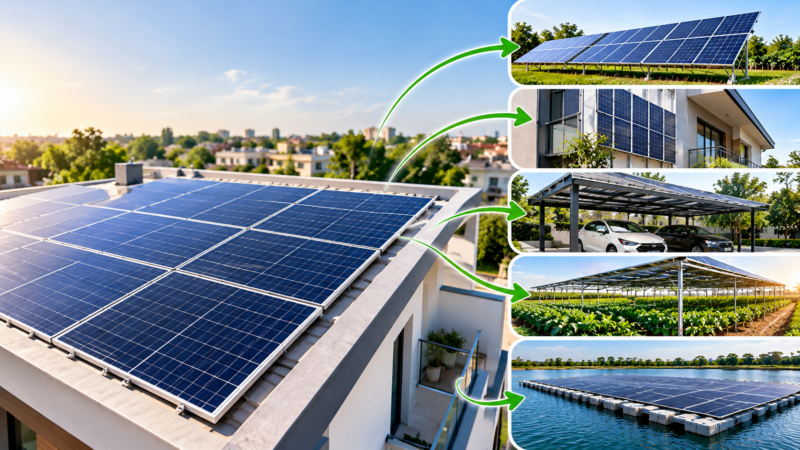
India has 3,445 GWp of assessed solar potential, but land to actually build it on is getting scarcer every year. That tension is why space-optimised solar cells have moved from a niche engineering idea to a genuine national strategy in 2026, and why so many new formats of space-optimised solar cells are reaching commercial scale at once.
Instead of competing with farms, forests, and cities for flat ground, these formats put panels on water, over crops, inside building walls, and standing upright between rows. Here’s what’s actually trending, and what’s still mostly a pilot project.
Why Space-Optimised Solar Cells Matter Now
Ground-mounted solar dominates India’s roughly 164 GW of installed capacity, and it requires three to four times more land than the panels themselves occupy, which is precisely the constraint space-optimised solar cells are designed to get around.
That land requirement is becoming the real bottleneck, not panel cost or technology. Land acquisition disputes, agricultural competition, and ecological concerns now slow projects more than financing does, pushing developers toward space-optimised solar cells as a practical workaround.
Space-optimised solar cells solve this by sharing land that already has another use, water, cropland, rooftops, facades, instead of claiming new ground outright.
Trend 1: Floating Solar Panels
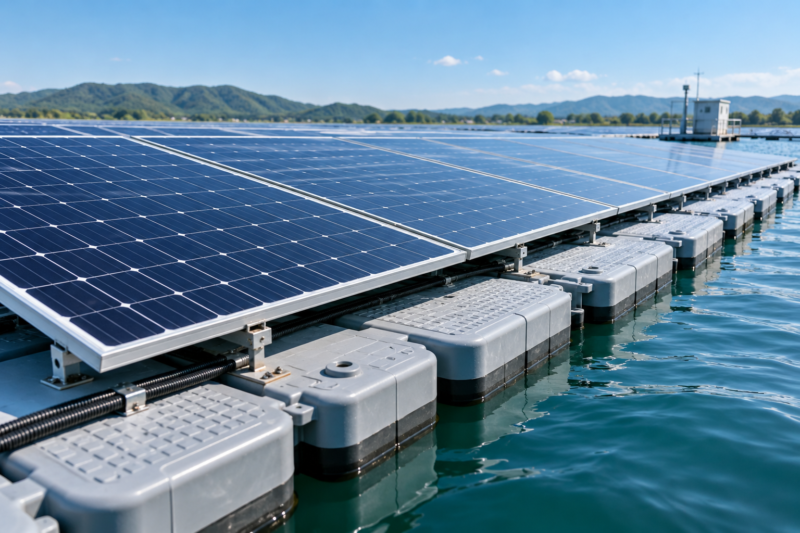
This format sits on pontoons across reservoirs, canals, and ponds instead of occupying land at all, one of the clearest examples of space-optimised solar cells in action.
The India numbers are large. NISE’s first national assessment, released in June 2026, put India’s floating solar potential at over 102 GWp across 682 technically feasible water bodies. A separate Indo-German study puts the figure even higher, at roughly 207 GWp.
Policy is catching up fast. The Cabinet approved the Pradhan Mantri Surya Sarovar Yojana in August 2026, a ₹5,070 crore scheme targeting 5,000 MW of this capacity paired with at least 10,000 MWh of storage, running from FY2026-27 through FY2032-33.
Current deployment is still small. India had only about 600 to 700 MW installed as of mid-2026, against that 102 GWp potential. The flagship project, Omkareshwar on the Narmada River, runs at 278 MW and is planned to scale toward 600 MW.
The trade-offs are real. This format costs roughly 25% more upfront than ground-mounted systems, due to floats, anchoring, and waterproofing. In exchange, water cooling boosts output by 5% to 10%, and evaporation drops meaningfully, a real benefit in drought-prone states.
Maharashtra, Madhya Pradesh, Karnataka, Odisha, and Telangana hold the largest share of India’s floating solar potential, together accounting for well over half the national total.
Trend 2: Vertical Bifacial Solar
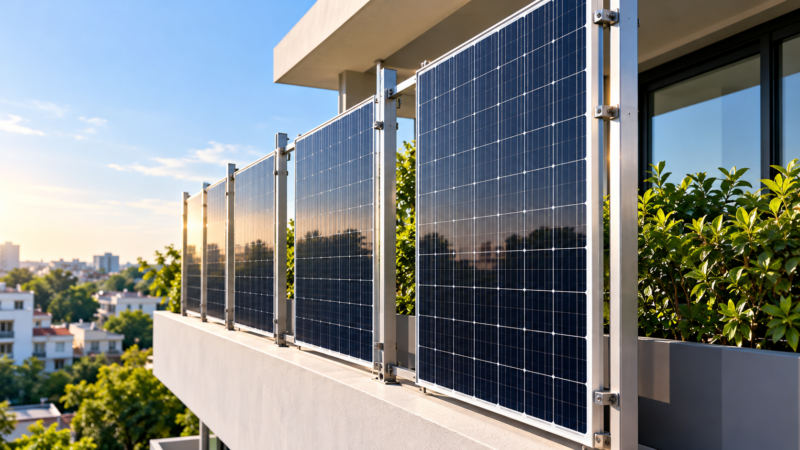
Most panels lie flat or tilt toward the sun. Vertical bifacial solar stands panels upright instead, usually facing east-west rather than south.
The output curve looks different, and that’s the point. A flat panel peaks sharply at noon. This upright design produces two smaller peaks, morning and evening, which lines up far better with when people actually use electricity.
It solves a real grid problem. Germany has used this upright format specifically to flatten the midday oversupply that causes the so-called duck curve, where solar floods the grid at noon and vanishes by evening peak.
It works well on farmland. Spaced rows leave enough room for tractors and other machinery to pass between them, making this one of the more practical formats for combining power generation with continued farming.
The catch is shading. Because the panels face sideways rather than up, this format needs genuinely open space to the east and west; anything blocking low-angle sun sharply cuts output.
Trend 3: Agrivoltaics in India
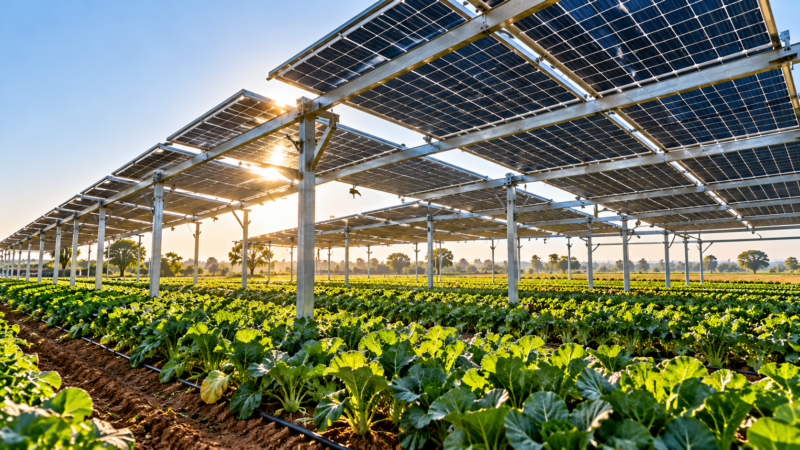
Agrivoltaics in India means mounting panels on elevated structures above farmland, letting crops grow underneath while electricity is generated overhead.
MNRE is actively pursuing this. The Ministry’s Secretary confirmed in mid-2026 that discussions are underway with the finance ministry specifically to design dedicated financial schemes for this approach and floating solar together.
It directly targets the land bottleneck. Elevated or stilt-mounted panels let the same acre generate power and produce crops simultaneously, which is exactly the kind of dual-use approach India’s 500 GW non-fossil target by 2030 needs more of.
It’s not just panels on stilts. PM-KUSUM, India’s solar pump scheme, already supports over 14 lakh standalone pumps as part of a push toward 34.8 GW of decentralised capacity, much of it on or near farmland.
Early results favour specific crops. Shade-tolerant crops tend to do best underneath elevated arrays, while full-sun crops see more of a trade-off, meaning agrivoltaics in India works best when the crop choice matches the shading pattern rather than being retrofitted onto existing farming plans.
Trend 4: Building-Integrated Photovoltaics
This format replaces ordinary construction material, windows, facades, roof tiles, with material that also generates electricity.
This is the most space-efficient format of all, since it adds zero additional footprint; the building was going to need walls and windows regardless.
It’s arriving through several different products. Transparent solar windows, coloured facade panels, and even nanoparticle-coated smart glass that tints and generates power at once were all showcased as near-market examples of space-optimised solar cells at CES 2026.
India has a natural reason to adopt it. Buildings are projected to account for more than a third of India’s electricity demand by 2047, and the Energy Conservation and Sustainable Building Code already pushes new construction toward on-site generation.
Efficiency is the honest trade-off. This format typically runs at 15% to 18% efficiency, lower than a standard rooftop panel, because the material is doing double duty as both structure and generator.
Space-Optimised Solar Cells Compared
| Floating | Vertical bifacial | Agrivoltaics | BIPV | |
|---|---|---|---|---|
| Saves land by | Using water instead | Using narrow footprint | Sharing farmland | Replacing building material |
| India potential | 102–207 GWp | Early stage | Scaling under PM-KUSUM | Concentrated in premium builds |
| Main advantage | Cooling boost, less evaporation | Matches evening demand | Dual income for farmers | Zero extra footprint |
| Main limitation | 25% cost premium | Needs open east-west sky | Crop-dependent yield | Lower efficiency |
The Honest Limitations
None of these space-optimised solar cells formats are free upgrades. Each comes with a real cost or constraint attached.
- Higher upfront capital is common across nearly all of them, whether it’s floats and anchoring for water, elevated structures for farmland, or specialised glass for buildings.
- Deployment is still small relative to potential, especially for floating solar panels, where installed capacity is a tiny fraction of the assessed 102 GWp.
- Standardisation is lagging, particularly for building-integrated photovoltaics, where consistent product and safety standards are still catching up to the pace of new product launches.
- Site-specific performance means none of these formats are universal wins; the upright design needs open sky, elevated farm canopies need the right crop, and water-based systems need a suitable, accessible body.
What's Next Through 2030
Expect water-based deployment to scale fastest among these space-optimised solar cells formats, backed by a dedicated national scheme and a clear land-saving rationale that aligns directly with India’s 500 GW target.
This dual-use farming approach is likely to follow a similar trajectory as MNRE finalises dedicated financing, particularly in states already running large PM-KUSUM pump deployments.
Vertical bifacial solar will likely stay a specialised choice for grid-balancing and farmland co-location rather than a mainstream rooftop product, at least through the next few years.
This building-first format should keep expanding in premium commercial construction as green building codes tighten, even as cost and standardisation keep it out of ordinary homes for now.
Final Thoughts
Space-optimised solar cells exist because India is running out of the one thing solar has always assumed was abundant: empty land. Floating solar panels, vertical bifacial solar, agrivoltaics in India, and building-integrated photovoltaics each answer that constraint differently, by using water, air, farmland, or a building’s own walls instead of claiming new ground.
None of these space-optimised solar cells will replace ground-mounted solar outright. But as the easy land runs out, these formats are quickly becoming the difference between India meeting its 2030 target on schedule and stalling on acquisition disputes instead.
FAQs
What are space-optimised solar cells? Space-optimised solar cells are formats like floating solar, vertical bifacial panels, agrivoltaics, and building-integrated photovoltaics that generate electricity without requiring dedicated open land, instead sharing space with water bodies, farmland, or buildings.
How much floating solar potential does India actually have? NISE’s 2026 national assessment puts India’s floating solar panels potential at over 102 GWp across technically feasible reservoirs, though installed capacity remained under 1 GW as of mid-2026.
Does agrivoltaics in India actually work with farming? Yes, when elevated correctly, agrivoltaics in India allows crops to continue growing beneath panels, with shade-tolerant crops generally performing best under the altered light conditions.
Is building-integrated photovoltaics as efficient as regular solar panels? No, building-integrated photovoltaics typically runs at 15% to 18% efficiency, lower than standard rooftop panels, because the material serves a dual structural and electricity-generating purpose.
Trusted by 50000+ Customers
Anya Green Energy is a leading solar company and Solar Energy service provider established in 2013. We are recognized by startup India and customer best choice award 2022.
Our Achievements :
Recognized by Startup India.
Purvanchal’s first solar company to operate exclusively with solar products.
Certified by well-known institutions such as MSME, IndiaMart, and Just Dial and many more.
Winner of the Best Customer Choice Award 2022.
Over 50,000 happy customers across India.