Hydrogen Solar Panels: What Are They and Are They the Future of Solar Energy?
Solar technology is evolving rapidly. Alongside conventional solar PV panels, new technologies that combine solar energy and hydrogen production are gaining attention. One such term is Hydrogen Solar Panels.
But what exactly are Hydrogen Solar Panels? Do they produce hydrogen directly from sunlight? Can they replace conventional solar panels? And are they suitable for homes and businesses?
The answer requires a little clarification because “Hydrogen Solar Panels” is not a single standardized commercial solar-panel category. The term is often used broadly for emerging technologies and systems that combine solar power generation with hydrogen production.
Traditional solar PV panels convert sunlight directly into electricity.
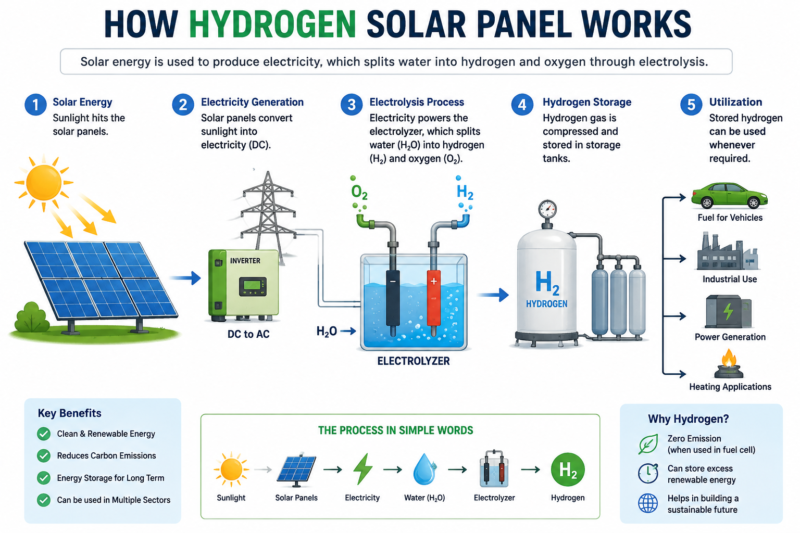
A solar-hydrogen system, on the other hand, can use electricity generated by solar panels to produce hydrogen from water through a process called electrolysis.
The basic process is:
Sunlight → Solar Electricity → Electrolyzer → Hydrogen
An electrolyzer uses electricity to split water into hydrogen and oxygen. When the electricity comes from renewable sources such as solar energy, the resulting hydrogen can be classified as Green Hydrogen, subject to the applicable production criteria.
Therefore, Hydrogen Solar Panels should not be considered a direct replacement for conventional solar panels. Instead, they are part of a broader Solar-to-Hydrogen energy system.
How Does Solar-to-Hydrogen Technology Work?
The process involves several important components.
1. Solar Panels
Solar PV panels capture sunlight and generate electricity.
2. Electrolyzer
The electricity is supplied to an electrolyzer, which separates water into hydrogen and oxygen.
3. Hydrogen Storage
The produced hydrogen can be stored in specially designed storage systems.
4. End Use
Stored hydrogen can later be used in fuel cells, industrial processes, transportation applications or other suitable systems.
The complete process can be simplified as:
Solar Energy → Electricity → Electrolysis → Hydrogen → Storage → End Use
This makes hydrogen an energy carrier rather than simply another form of electricity generation.
Hydrogen Solar Panels vs Traditional Solar Panels
There is an important difference between conventional Solar PV and Solar-Hydrogen systems.
| Feature | Traditional Solar PV | Solar-Hydrogen System |
|---|---|---|
| Primary output | Electricity | Hydrogen + potentially electricity |
| Main technology | Solar PV panels | Solar PV + electrolyzer |
| Storage | Battery or grid | Hydrogen storage |
| System complexity | Lower | Higher |
| Typical applications | Homes and businesses | Industrial and large-scale applications |
| Infrastructure requirement | Relatively simple | More complex |
For a typical household, conventional rooftop Solar remains much simpler.
Benefits of Hydrogen Solar Technology
1. Renewable Hydrogen Production
Solar electricity can provide renewable power for hydrogen production. This can help reduce dependence on fossil-fuel-based hydrogen when the overall production pathway meets green-hydrogen requirements.
2. Energy Storage
Solar generation is variable. Hydrogen can potentially act as an energy carrier, allowing renewable energy to be stored for later use.
3. Industrial Applications
Hydrogen already has important industrial applications, and clean hydrogen could help reduce emissions in sectors where direct electrification is difficult.
4. Long-Duration Energy Storage
Hydrogen is being explored as an option for storing energy over longer periods, complementing batteries and other storage technologies.
5. Decarbonization Potential
Combining renewable electricity with hydrogen production could support decarbonization in industries, heavy transport and other hard-to-electrify sectors.
Challenges of Hydrogen Solar Panels
Despite its potential, Solar-to-Hydrogen technology has several challenges.
One major challenge is overall system efficiency. Converting solar electricity into hydrogen involves energy losses during electrolysis. Additional energy may be required for hydrogen compression, storage and transportation.
The equipment is also more complex than a conventional rooftop Solar system. An integrated system may require an electrolyzer, water treatment, hydrogen storage, compressors, controls and specialized safety equipment.
As a result, the overall cost can be significantly higher than a conventional Solar PV installation.
Can Hydrogen Solar Panels Be Used in Homes?
Technically, solar electricity can be used to produce hydrogen, but this is not currently as straightforward for a typical household as installing an on-grid Solar system or a battery-based hybrid system.
If the main goal is to reduce electricity bills, an On-Grid Solar System is generally a much simpler solution.
If the homeowner also needs backup power, a Hybrid Solar System with Battery Storage can be considered.
A residential hydrogen system may make sense only where there is a specific hydrogen requirement and the additional infrastructure can be justified.
Future of Hydrogen and Solar Energy
Solar and hydrogen could become important parts of the future clean-energy ecosystem.
As electrolyzer technology improves and renewable electricity becomes increasingly available, Solar-to-Hydrogen projects could become more attractive.
Large Solar power plants could potentially be integrated with electrolyzers to produce renewable hydrogen at scale. The hydrogen could then be supplied to industrial facilities, transport applications or energy-storage systems.
However, successful deployment will require more than Solar panels. It will also depend on improvements in:
- Electrolyzer technology
- Hydrogen storage
- Compression systems
- Transportation infrastructure
- Safety standards
- Renewable electricity availability
- Overall project economics
Hydrogen Solar Panels in India
India has identified Green Hydrogen as an important part of its clean-energy strategy. Solar energy can play a major role because India has significant renewable-energy potential.
However, developing a hydrogen economy requires an entire ecosystem involving renewable power, electrolyzers, storage, transportation, industrial demand and appropriate infrastructure.
This means Solar-to-Hydrogen technology is likely to be more relevant for large-scale and industrial applications than for ordinary residential rooftops in the near term.
Will Hydrogen Solar Panels Replace Normal Solar Panels?
Not necessarily.
Conventional Solar PV is already a mature and widely deployed technology for generating electricity. Solar-Hydrogen systems solve a different problem: converting renewable electricity into hydrogen that can be stored, transported or used in applications where direct electricity may not be practical.
Therefore, these technologies are more likely to complement each other rather than completely replace one another.
Conclusion
Hydrogen Solar Panels are better understood as part of an emerging Solar-to-Hydrogen energy system rather than as a completely new type of Solar panel.
Traditional Solar follows:
Sunlight → Electricity
Solar-Hydrogen systems follow:
Sunlight → Electricity → Electrolysis → Hydrogen
For homes, conventional On-Grid and Hybrid Solar Systems are currently much simpler and more practical for reducing electricity costs and providing backup power.
For large-scale renewable energy projects, industries and long-duration energy storage, Solar-powered hydrogen could become increasingly important.
The future of clean energy may therefore not be about choosing between Solar and Hydrogen, but about finding efficient ways to integrate both technologies.