24 Solar Panel Myths and Facts in India You Should Know
India is undergoing a massive renewable energy transition. With national initiatives like the PM Surya Ghar: Muft Bijli Yojana offering subsidies for rooftop installations, more homeowners than ever are looking to reduce their electricity bills.
Despite rapid adoption, myths and misinformation prevent many people from taking action. Knowing the reality behind each Solar Panel myth can help you make an informed investment.

1. Weather and Climate Myths
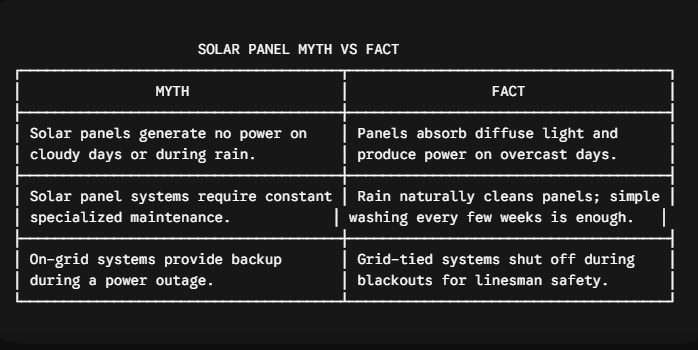
Myth 1: A Solar Panel does not work during monsoon seasons or cloudy weather.
Fact: Photovoltaic cells generate electricity from daylight, not heat. While efficiency dips on overcast days, a Solar Panel still produces 10% to 25% of its peak capacity using diffuse sunlight.
Myth 2: Extreme summer heat makes a Solar Panel generate more power.
Fact: Excessive heat lowers photovoltaic efficiency. Panels are rated at optimal performance around 25°C; temperatures above 40°C slightly reduce voltage output.
Myth 3: Cold winter days stop power generation.
Fact: Cold, bright winter days actually provide high operating efficiency for any Solar Panel array, as low temperatures improve semiconductor performance.
Myth 4: Hailstorms and heavy Indian monsoons easily crack panels.
Fact: Modern panels feature tempered, shock-resistant safety glass tested to withstand heavy hail impacts and strong winds.
2. Cost and Financial Myths
Myth 5: Installing a Solar Panel system is too expensive for middle-class Indian households.
Fact: Government subsidies under schemes like PM Surya Ghar cover up to ₹78,000 for residential setups, dramatically lowering initial investment costs.
Myth 6: Payback periods take decades to achieve.
Fact: With rising electricity tariffs in Indian states, most residential rooftop systems pay for themselves within 3 to 5 years.
Myth 7: Buying a cheap, unbranded Solar Panel saves money in the long run.
Fact: Tier-1 manufacturer panels offer standard 25-year performance warranties. Unbranded alternatives degrade faster and lack reliable warranty enforcement.
Myth 8: Government solar subsidies are a hassle to claim.
Fact: The national rooftop solar portal streamlines subsidy applications, depositing funds directly into consumer bank accounts upon commissioning.
3. Operation and Maintenance Myths
Myth 9: A Solar Panel requires daily manual cleaning and technical maintenance.
Fact: Panels have no moving parts. Cleaning them with water every 2 to 3 weeks to remove dust buildup is generally all the maintenance needed.
Myth 10: An on-grid Solar Panel system supplies power during a blackout.
Fact: On-grid systems automatically shut off during grid outages (anti-islanding) to protect utility workers repairing power lines. Emergency backup requires a hybrid inverter with battery storage.
Myth 11: Solar energy generation stops working entirely at night.
Fact: While panels do not generate power in the dark, net-metering allows you to draw power back from the grid at night using credits earned during the day.
Myth 12: Batteries are mandatory for every residential setup.
Fact: On-grid systems skip expensive battery banks entirely by utilizing the central power grid for balance.
4. Technology and Efficiency Myths
Myth 13: All panel types offer identical efficiency levels.
Fact: Monocrystalline panels achieve efficiency rates up to 22%, outperforming older polycrystalline alternatives in space-constrained urban rooftops.
Myth 14: Bifacial panels only work in commercial solar farms.
Fact: Bifacial modules installed on white or reflective roof surfaces capture light from both front and rear sides, increasing energy yield on residential roofs.
Myth 15: A Solar Panel degrades drastically after just a few years of operation.
Fact: Quality panels degrade at an average rate of less than 0.5% per year, retaining over 80% of their output capacity after 25 years.
Myth 16: Solar inverters last just as long as the panels themselves.
Fact: While panels last 25+ years, string inverters typically require replacement or servicing every 10 to 12 years.
5. Installation, Roof, and Structural Myths
Myth 17: Installing a Solar Panel damages roof waterproofing.
Fact: Certified installers use non-penetrating mounting structures or elevated frames sealed with weather-resistant chemicals to protect roof integrity.
Myth 18: Residential solar panels require massive roof space.
Fact: A standard 3 kW system requires roughly 250 to 300 square feet of unshaded space, making it compatible with most terrace designs.
Myth 19: You cannot install a Solar Panel if you live in a rented property.
Fact: Portable plug-and-play solar setups and modular balcony kits allow renters to generate clean energy without making permanent structural modifications.
Myth 20: Flat roofs in India cannot harvest solar energy effectively.
Fact: Mounting structures tilt panels at optimal angles (typically 15° to 30° facing South) to capture maximum sunlight on flat concrete terraces.
6. Environmental and Utility Myths
Myth 21: Manufacturing a Solar Panel takes more energy than the panel generates in its lifetime.
Fact: Most silicon panels offset the carbon footprint of their production within 1 to 2 years of operation, delivering 23+ years of net-zero energy.
Myth 22: Discarded panels create unmanageable electronic waste.
Fact: Over 90% of panel materials—including glass, aluminum frames, and silicon—are fully recyclable under emerging e-waste guidelines.
Myth 23: High-voltage rooftop panels emit harmful electromagnetic radiation.
Fact: Solar equipment operates within strict international health and electromagnetic safety standards, emitting low levels comparable to everyday household electronics.
Myth 24: Net metering in India does not offer real financial value.
Fact: Net metering allows users to export excess daytime power back to the grid, directly offsetting nighttime utility bill charges.
Key Takeaways for Homeowners
| Parameter | On-Grid System | Hybrid System |
| Ideal For | Regions with reliable grid power | Areas with frequent power outages |
| Battery Needed? | No | Yes |
| Upfront Cost | Lower | Higher |
| Grid Export Support | Full Net-Metering | Full Net-Metering |
Evaluating these realities makes it clear that investing in a Solar Panel setup is one of the most reliable ways for Indian households to lower utility expenses while adopting clean energy.