How Solar Panels Produce Energy: The Physics Behind Every Ray of Sunlight
Every day, the sun delivers more energy to the earth in a single hour than the entire world consumes in a year. The challenge has never been the availability of sunlight — it has been capturing it efficiently. Understanding how solar panels produce energy requires stepping intotwo very different worlds at once: the microscopic realm of atoms, electrons, and photons, and the macroscopic world of circuits, inverters, and power grids. This blog breaks down the science from first principles, walking through the physics, the materials science, and the full engineering process that turns sunlight into usable electricity. Whether you’re a student researching the science of solar power for a class project, a homeowner considering rooftop panels, or simply someone curious about how a piece of glass converts sunshine into usable power, this guide covers every layer of the story — from the smallest photon to the largest power plant. If you’ve ever wondered why a flat, silent sheet of glass and silicon can light up a home, run a factory, or charge an electric vehicle, you’re really asking a question about quantum physics, semiconductor materials, and clever engineering working together. Let’s explore this in detail, step by step, from the smallest particle of light to the electricity flowing through your walls
What Is Solar Energy Conversion?
At its core, solar energy conversion is the process of transforming sunlight — a form of electromagnetic radiation — into electrical energy that can power homes, businesses, and machines. This is fundamentally different from solar thermal systems, which use sunlight to heat water or air instead of generating electricity. Solar panels, or photovoltaic (PV) panels, convert light directly into electricity using a quantum-level phenomenon that scientists first documented in the nineteenth century.
Sunlight itself is not a single, uniform thing. It arrives as a spectrum of electromagnetic radiation spanning ultraviolet, visible, and infrared wavelengths, each carrying a different amount of energy. Solar panels are engineered to capture as much of this spectrum as possible, though — as we’ll see — no material can absorb every wavelength with perfect efficiency.
Understanding this energy transformation means understanding both ends of the scale. On one end, you have photons — individual packets of light energy — striking atoms inside a solar cell. On the other end, you have entire arrays of panels feeding alternating current into a home’s electrical panel. Bridging these two extremes is exactly what makes how solar panels produce energy such a fascinating intersection of quantum mechanics and practical engineering.
—
The Photovoltaic Effect Explained
The single most important concept behind how solar panels produce energy is the photovoltaic effect. Discovered by French physicist Edmond Becquerel in 1839, this effect describes how certain materials generate an electric voltage or current when exposed to light.
Here’s the basic physics: light behaves both as a wave and as a particle. This dual nature comes from light’s particle side — specifically, photons. Each photon carries a discrete amount of energy determined by its wavelength, a relationship first described mathematically by Max Planck and later refined by Albert Einstein, whose 1905 explanation of this exact phenomenon earned him the Nobel Prize in Physics. Blue light photons carry more energy than red light photons, for instance, because energy is inversely proportional to wavelength.
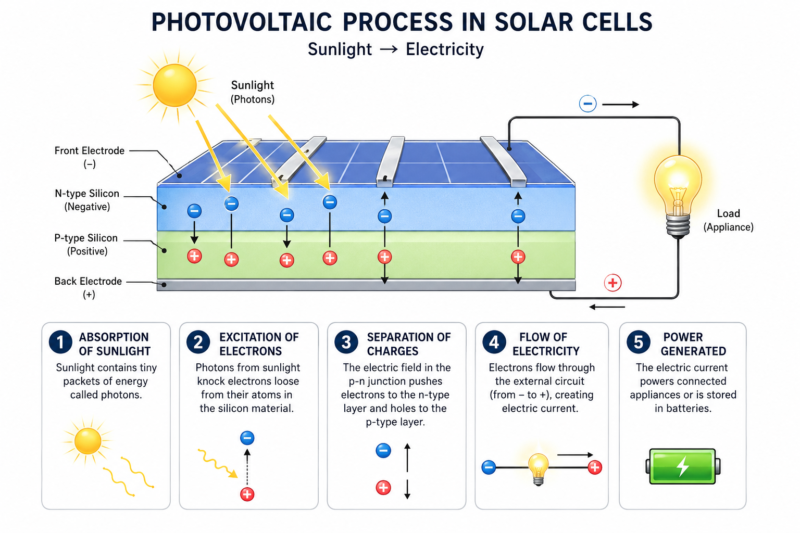
When a photon with sufficient energy strikes a semiconductor material like silicon, it can transfer its energy to an electron in the material. If the photon’s energy exceeds the material’s “band gap” — the energy threshold required to free an electron from its atomic bond — that electron breaks loose and becomes a free-moving charge carrier. This single interaction, repeated billions of times per second across a solar panel’s surface, is the essence of quantum-level solar physics and the starting point for how solar panels produce energy.
Microscopic Details: Inside the Solar Cell
To truly appreciate this energy-generating process, we need to zoom into the atomic structure of the solar cell itself. This is where solar cell physics becomes essential to the story.
Silicon: The Foundation of Solar Cell Physics
Most solar panels are built from silicon, a semiconductor element from Group 14 of the periodic table. Silicon atoms have four valence electrons, which they share with neighboring atoms to form a stable crystal lattice. In its pure form, silicon is not particularly useful for generating electricity because it doesn’t have loose charge carriers available to flow as current.
This is where doping comes in — a critical part of solar cell physics. Manufacturers intentionally introduce impurities into the silicon crystal to alter its electrical properties:
N-type silicon is created by adding phosphorus, which has five valence electrons. The extra electron isn’t needed for bonding, so it becomes a free-floating negative charge carrier.
P-type silicon is created by adding boron, which has only three valence electrons. This creates a “hole” — a missing electron — that acts as a positive charge carrier.
The P-N Junction
When n-type and p-type silicon layers are joined together, they form what’s called a p-n junction. At this junction, electrons from the n-type layer diffuse into the p-type layer, and holes diffuse in the opposite direction. This creates a thin region called the depletion zone, along with a built-in electric field.
This electric field is the engine that makes how solar panels produce energy possible at the microscopic level. When a photon strikes the depletion zone and knocks an electron loose, the built-in electric field immediately pushes that electron toward the n-type layer and pushes the corresponding hole toward the p-type layer. This directional push is what converts random photon-electron collisions into an organized, usable electric current.
Understanding this atomic-level behavior reveals why silicon purity matters so much. Impurities beyond the intentional doping can trap electrons before they escape the depletion zone, reducing efficiency. This is why solar-grade silicon must be refined to extremely high purity — often 99.9999% pure or higher — before it can be used in commercial panels.
Band Gap Energy and Photon Absorption
The Complete Process
To summarize the full energy-generation sequence step by step:
Sunlight (photons) strikes the surface of the solar panel.
Photons with sufficient energy are absorbed by the silicon inside the solar cell.
Absorbed photon energy excites electrons, freeing them from their atomic bonds.
The built-in electric field at the p-n junction directs freed electrons toward the n-type layer, creating a flow of direct current.
Metal contacts on the cell collect this current and route it through wiring to the panel’s junction box.
Multiple panels combine their output into a solar array, increasing total voltage and current.
The inverter converts direct current into alternating current suitable for household or grid use.
Electricity is metered, consumed, stored, or exported to the grid depending on demand.
This eight-step process is the practical embodiment of the science covered earlier, translating quantum-level events into megawatts of usable renewable energy.
Why Solar Panels Matter for Renewable Energy
Solar technology sits at the center of the global shift toward clean power. Unlike fossil fuel combustion, which releases stored chemical energy through burning and produces carbon emissions, solar panels generate electricity through a purely physical process with no combustion, no moving parts in the cell itself, and no direct emissions during operation.
This makes solar one of the cleanest large-scale renewable energy sources available today. As global demand for clean power grows, understanding the underlying physics helps engineers, students, and policymakers make better decisions about deploying, maintaining, and improving solar technology. It also explains why continued research into new light-absorbing compounds — such as perovskites, cadmium telluride, and gallium arsenide — is such an active area of renewable energy innovation
Factors That Affect Solar Panel Efficiency
Several physical and environmental factors influence how effectively sunlight is converted into usable power:
Temperature: Contrary to intuition, solar panels actually lose efficiency as they get hotter, because increased thermal energy raises electron activity in ways that reduce voltage output.
Angle of incidence: Panels perform best when sunlight strikes them perpendicularly, which is why tracking systems and optimal tilt angles matter.
Spectral mismatch: Since no single semiconductor absorbs the entire solar spectrum perfectly, some light energy is always lost as heat.
Material purity: Defects and impurities in the silicon crystal create recombination sites where freed electrons can lose their energy before reaching the electrical circuit.
Shading and soiling: Even partial shading on one cell can disproportionately reduce output across an entire series-connected string.
Engineers account for all these variables when designing solar installations, which is why real-world performance always differs somewhat from laboratory-rated efficiency figures.
Not all solar panels are built the same way, and the differences come directly from how their underlying semiconductor materials are structured at the crystal level.
Monocrystalline panels are cut from a single, continuous silicon crystal grown as one large cylindrical ingot. Because the atomic structure is uniform throughout, electrons have fewer obstacles to navigate, which translates into higher efficiency — typically 20% to 22% — and the recognizable uniform black appearance seen on most premium residential installations.
Polycrystalline panels are made by melting multiple silicon fragments together in a mold rather than growing a single crystal. This is faster and cheaper to manufacture, but the grain boundaries between individual crystals create more opportunities for electrons to recombine before reaching the circuit, resulting in slightly lower efficiency, usually in the 15% to 17% range.
Thin-film panels skip crystalline silicon altogether, instead depositing a microscopically thin layer of light-absorbing compounds — such as cadmium telluride or amorphous silicon — onto a supporting substrate like glass or flexible plastic. Thin-film technology trades some efficiency for lower weight, flexibility, and better performance in low-light or high-temperature conditions, making it popular for large utility-scale fields and specialized applications like curved surfaces or portable chargers.
Choosing between these semiconductor materials and cell designs ultimately comes down to a trade-off between cost, available roof space, aesthetic preference, and the specific environmental conditions of the installation site.
Frequently Asked Questions
What is the basic physics behind how solar panels produce energy?
The basic physics relies on the photovoltaic effect, where photons strike a semiconductor material and transfer enough energy to free electrons, which are then directed into a usable electric current by a built-in electric field at the p-n junction.
Do solar panels work without direct sunlight?
Yes. Solar panels can still generate electricity from diffuse daylight on cloudy days, though output is significantly lower than under direct, unobstructed sunlight.
Why is silicon used in most solar panels?
Silicon is abundant, relatively inexpensive to refine, and has a band gap well-suited to absorbing a large portion of the solar spectrum, making it the dominant choice for commercial solar cells.
How efficient are modern solar panels?
Most commercial silicon panels operate between 18% and 23% efficiency, while laboratory cells using advanced multi-junction designs have exceeded 40% efficiency under concentrated sunlight.
What happens to solar energy at night?
Without sunlight, no photon-electron interaction can occur, so panels stop generating electricity. Homes with battery storage or grid connections draw on stored or grid-supplied power instead. write us if u have any doubts regarding how solar panels produce energy