PM-KUSUM 2.0: How Farmers Can Earn Double Income From Crops and Solar Power
For years, a solar pump under the original PM-KUSUM scheme meant one thing for farmers: lower irrigation costs. Diesel-powered irrigation can cost close to ₹6,790 per acre for wheat and over ₹8,000 per acre for crops like cotton — money that solar pumps have already helped over 10 lakh farmers eliminate. But the next phase of the scheme is aiming for something bigger than cost-cutting. The scheme’s upgraded phase is being built around an idea that changes the entire economics of farmland: growing crops and generating solar power on the very same plot, at the very same time.
This article breaks down what this upgraded phase actually is, what’s new compared to the original scheme, how agrivoltaics farming works in practice, and how it could let farmers double their income — one stream from the harvest, one from the electricity meter. This is written purely for general awareness; formal guidelines for the new phase are still being finalized by the Ministry of New and Renewable Energy (MNRE), so always check official sources before making any financial decisions.
What Is PM-KUSUM 2.0?
PM-KUSUM 2.0 is the successor to the original Pradhan Mantri Kisan Urja Suraksha evam Utthaan Mahabhiyan scheme, which ran through March 2026 with an outlay of ₹34,422 crore aimed at adding roughly 34,800 MW of solar capacity across India. Union Minister Pralhad Joshi announced the shape of the next phase at the 4th National Agro-RE Summit in March 2026, confirming that the upgraded scheme will include a dedicated 10 GW agrivoltaics component — a first for the scheme.
The Union Budget 2026-27 backed this direction with numbers: the annual allocation for PM-KUSUM nearly doubled to around ₹5,000 crore for the year, with the overall scheme outlay expected to reach approximately ₹50,000 crore — a roughly 45% increase over the original scheme’s total budget. As of now, MNRE has not yet issued the formal notification with detailed guidelines, component-wise benchmark costs, and state-wise targets for PM-KUSUM 2.0, so several specifics are still evolving
What's New in PM-KUSUM 2.0 Compared to Phase 1
The original scheme delivered real, measurable results — over 10 lakh standalone solar pumps installed and roughly 13 lakh grid-connected irrigation pumps solarised nationally. The next phase builds on that foundation with a few clear shifts:
- A dedicated 10 GW agrivoltaics component — formally recognizing simultaneous crop cultivation and solar generation on the same land, rather than treating farmland solar purely as a power-generation asset.
- A significantly larger budget — nearly ₹50,000 crore total, up from ₹34,422 crore, signaling stronger long-term government commitment.
- Greater emphasis on decentralised, feeder-level solarisation — expanding beyond just individual pumps to broader grid integration.
- Likely inclusion of battery storage — to improve reliability and allow farmers to draw power even outside direct sunlight hours.
- Stronger DISCOM participation — intended to smoothen power purchase agreements so farmers face fewer delays getting paid for surplus electricity.
What Is Agrivoltaics Farming, Exactly?
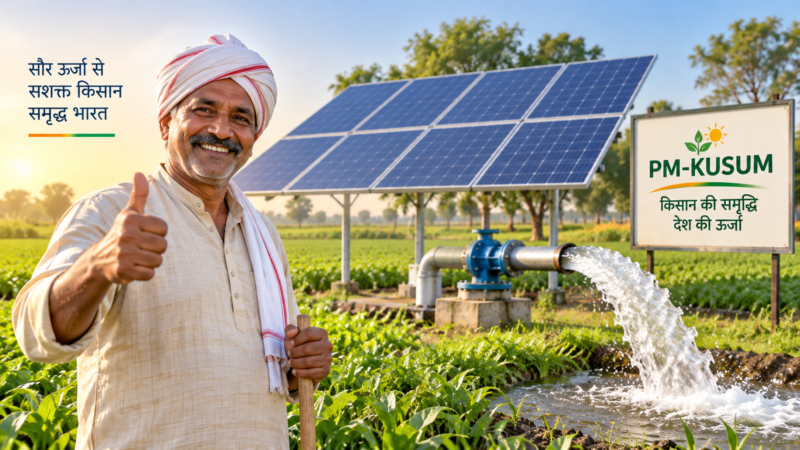
Agrivoltaics farming is the practice of installing solar panels on elevated structures above farmland, high enough that crops can continue growing underneath and between the rows of panels. Instead of choosing between “farm the land” or “put solar panels on the land,” agrivoltaics lets both happen on the same acre simultaneously.
For many crops — leafy vegetables, certain spices, and shade-tolerant produce in particular — the partial shading from elevated panels can actually reduce water evaporation and heat stress, in some cases supporting yields rather than hurting them. Meanwhile, the panels above generate electricity that can either be used on-farm or sold to the local DISCOM under a long-term power purchase agreement. This is the structural reason this technique is being positioned as the centerpiece of the upgraded scheme rather than a side feature — it directly solves the long-standing “land use conflict” between food production and energy generation that has limited solar expansion on farmland in the past.
How PM-KUSUM 2.0 Could Help Farmers Double Income
This is the part that matters most for a farmer deciding whether to pay attention to this scheme at all. Here’s how the farmers double income model is expected to work under PM-KUSUM 2.0:
- Income Stream One — The Crop. The farmer continues cultivating the land as usual underneath the elevated solar structure, harvesting and selling produce exactly as before.
- Income Stream Two — The Power. Solar energy generated by the panels above is sold to the DISCOM under a fixed-tariff power purchase agreement, typically running 25 years, creating a steady, largely passive second income.
- Reduced input costs on both sides. Irrigation costs drop because on-site solar can power pumps directly, and in shade-tolerant crops, water requirements can fall too.
- Predictable, long-term cash flow. Unlike crop income, which fluctuates with weather and market prices, the power-sale income is contracted and comparatively stable, giving farmers a financial cushion during a bad harvest season.
For farmers on land that’s partially fallow, underutilized, or simply not generating enough from crops alone, this dual-income structure is what’s driving so much of the current interest — it isn’t a replacement for farming, it’s a second revenue line layered directly on top of it. Even a modest-sized plot, structured this way, gives farmers double income potential that a crop-only or solar-only approach simply can’t match.
PM Kusum Component A: Where Agrivoltaics Actually Lives
Adopting these varied types of renewable energy offers advantages far beyond lowering carbon emissions.
Long-Term Cost Savings: Solar panels and wind installations harvest free fuel sources (sunlight and atmospheric air), insulating businesses and consumers from unpredictable fossil fuel price spikes.
Energy Independence: Harvesting local, non-depletable resources reduces dependence on foreign oil and gas imports, boosting national energy security.
Health and Environmental Quality: Replacing fossil combustion with clean energy sources removes sulfur dioxide, nitrogen oxides, and fine particulate matter from the air, improving public health and reducing environmental degradation.
Getting Ready for PM-KUSUM 2.0: What Farmers Can Do Now
Since formal guidelines for this upgraded phase are still pending, there’s no application to submit yet — but there’s plenty a farmer can do to prepare:
- Clarify land ownership documentation. Component A applications require clean land records, and mismatched names or unresolved shared-ownership disputes are the most common reason applications stall once submitted.
- Assess land suitability for elevated structures. Not every plot layout suits agrivoltaics equally well; land with reliable sun exposure and manageable access for installation equipment will likely be prioritized.
- Understand DISCOM connectivity in your area. Since income depends on selling power under a PPA, proximity to grid infrastructure matters for how quickly a project can actually start generating revenue.
- Stay updated through official channels. Once MNRE issues the formal notification, state agencies will publish the specific application process — bookmark the official state portal rather than relying on aggregator websites for updates
What Agrivoltaics Could Mean for Land Value
There’s a second-order effect worth mentioning that most coverage of this scheme skips entirely: land value. A plot generating two income streams — one from the harvest, one from a 25-year power purchase agreement — is inherently a more valuable asset than a plot generating crop income alone, regardless of whether the owner ever plans to sell it. Banks and financial institutions increasingly factor contracted income streams into lending decisions, which means a farmer with an active Component A agrivoltaics setup may find it easier to secure agricultural credit for other purposes, using the PPA as a form of demonstrated, stable cash flow. This is still an emerging area with limited India-specific data so far, but it’s a reason agrivoltaics adoption is being watched closely by rural finance institutions, not just energy planners.
Challenges Worth Knowing About
Agrivoltaics isn’t without friction, and any honest awareness piece should say so:
- Higher upfront structural cost. Elevated mounting systems designed for crop access underneath cost more than standard ground-mounted arrays.
- Crop-specific suitability. Not every crop tolerates partial shading well, so choice of crop under the panels matters significantly for yield outcomes.
- Pending policy clarity. Because benchmark costs and state-wise targets haven’t been formally notified yet, farmers should treat current news coverage as directional rather than final.
- DISCOM payment delays. A known friction point under the original scheme’s Component A rollout in several states — something the new phase’s “stronger DISCOM participation” language is specifically meant to address.
Frequently Asked Questions
1. What is PM-KUSUM 2.0? It’s the upcoming successor to the original PM-KUSUM scheme, expected to carry a total outlay of around ₹50,000 crore with a dedicated 10 GW agrivoltaics component allowing crops and solar power generation on the same land.
2. What is agrivoltaics farming? Agrivoltaics farming means growing crops underneath elevated solar panels on the same plot of land, allowing simultaneous food production and electricity generation.
3. How exactly do farmers double income under this scheme? Farmers double income by earning from their regular crop harvest while separately selling solar power generated above the same land to the DISCOM under a long-term power purchase agreement.
4. What is PM Kusum Component A, and how does it relate to agrivoltaics? PM Kusum Component A covers ground or stilt-mounted grid-connected solar plants on farmland up to 2 MW, and it’s the component into which the new agrivoltaics structures under this upgraded scheme are expected to be integrated.
5. What is JREDA Jharkhand’s role in this? JREDA Jharkhand is the state’s nodal implementing agency and will be responsible for publishing local benchmark costs, empanelling vendors, and processing Component A / agrivoltaics applications once formal PM-KUSUM 2.0 guidelines are notified.
Conclusion
PM-KUSUM 2.0 represents a genuine shift in how India is thinking about farmland — not as a choice between growing food and generating energy, but as a space capable of doing both at once. With a 10 GW agrivoltaics target, a near-doubled budget, and stronger DISCOM integration on the table, the scheme’s core promise is straightforward even if the fine print is still being written: agrivoltaics farming could let a farmer’s land work two jobs instead of one, and farmers double income as a result — one paycheck from the harvest, another from the meter. Understanding PM Kusum Component A .

Trusted by 50000+ Customers
Anya Green Energy is a leading solar company and Solar Energy service provider established in 2013. We are recognized by startup India and customer best choice award 2022.
Our Achievements :
Recognized by Startup India.
Purvanchal’s first solar company to operate exclusively with solar products.
Certified by well-known institutions such as MSME, IndiaMart, and Just Dial and many more.
Winner of the Best Customer Choice Award 2022.
Over 50,000 happy customers across India.