PM Kusum Yojana 2026: Complete Guide to India's Solar Farming Scheme
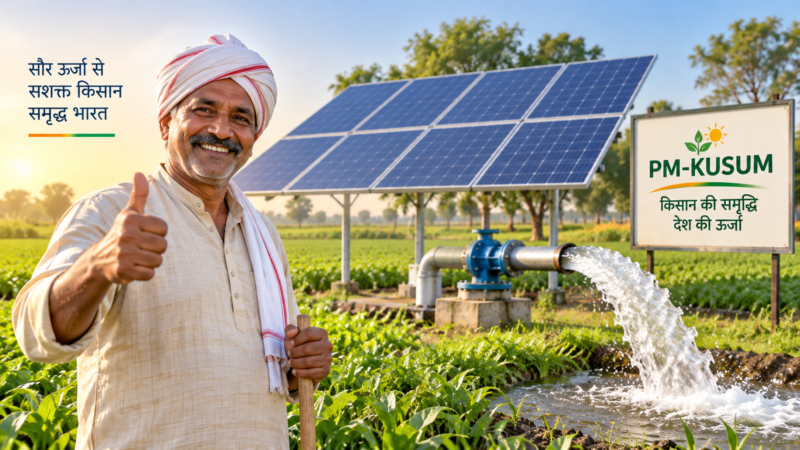
India’s farmers have historically depended on diesel pumps and an overburdened electricity grid to irrigate their fields. The PM Kusum Yojana was designed to break that dependency for good by turning farmland itself into a source of clean power and steady income. If you’ve heard the name but never fully understood how it works, this guide walks through the entire scheme in plain language: what it offers, who qualifies, how much subsidy you actually get, and what’s changing in 2026 and beyond.
This is purely an awareness piece. No sales pitch, no agenda just a clear breakdown of one of India’s most ambitious renewable energy programs for the agriculture sector.
What Is PM Kusum Yojana?
PM Kusum Yojana, formally called Pradhan Mantri Kisan Urja Suraksha evam Utthaan Mahabhiyan, is a central government initiative launched in 2019 by the Ministry of New and Renewable Energy (MNRE). The core idea is simple: help farmers install solar power plants and solar-powered irrigation pumps so they can generate their own electricity, cut diesel costs, and even sell surplus power back to the grid.
Unlike a typical rooftop solar subsidy program, PM Kusum Yojana is built specifically around agricultural land and irrigation needs. It doesn’t just aim to power farms — it aims to turn farmers into small-scale power producers, a shift often described in policy circles as moving farmers from “Annadata” (food provider) to “Urjadata” (energy provider).
Why the PM Kusum Scheme Was Needed
To understand why the PM Kusum scheme exists, look at the numbers behind India’s agriculture-energy problem:
- Agriculture consumes roughly 17% of India’s total electricity but contributes only a fraction of the revenue, because farm power is heavily subsidized or free in most states.
- Free electricity for groundwater pumping has driven severe water-table depletion in states like Punjab and Haryana.
- State electricity distribution companies (DISCOMs) collectively lose over ₹1.5 lakh crore annually due to agricultural power subsidies.
- Millions of farmers in off-grid areas still rely on expensive, polluting diesel pumps for irrigation.
The PM Kusum scheme was designed to attack all four problems at once: reduce the subsidy burden on DISCOMs, cut diesel dependency, promote judicious water use through metering, and give farmers an additional income stream from solar power generation.
The Three Components of PM Kusum Yojana
This national solar irrigation program is structured into three distinct components, each targeting a different irrigation scenario.
Component A: Grid-Connected Solar Power Plants
Farmers can set up small solar power plants — from 500 kW up to 2 MW — on barren, fallow, or even cultivable land. The generated electricity is sold directly to the local DISCOM at a pre-fixed tariff, giving landowners a predictable annual income, often estimated between ₹60,000 and ₹1,00,000 per acre depending on the state and tariff structure.
Component B: Standalone Solar Agriculture Pumps
This component targets off-grid areas where farmers currently rely on diesel. Under this part of the PM Kusum scheme, individual farmers can get standalone solar pumps ranging from 1 HP to 7.5 HP (up to 10 HP in some states), completely replacing diesel-powered irrigation.
Component C: Solarisation of Grid-Connected Pumps
Farmers who already have a grid-connected pump can convert it to solar power. There are two delivery models here: Individual Pump Solarisation (IPS), where a solar panel set is installed at each pump, and Feeder-Level Solarisation (FLS), where an entire agricultural feeder or substation is solarised to serve multiple farmers at once — now the preferred and more scalable approach.
PM Kusum Yojana Solar Pump Subsidy: How Much Do You Actually Get?
The solar pump subsidy structure is one of the most attractive parts of the entire program, and it’s also where the most confusion exists, because the split differs slightly by component and by state category.
Standard cost-sharing formula (Components B and C):
- 30% central government subsidy
- 30% state government subsidy
- 40% farmer contribution (of which up to 30% can be financed through a bank loan, leaving the farmer to pay as little as 10% out of pocket)
Special category states (North-East, hilly, and island regions):
- 50% central subsidy
- 30% state subsidy
- 20% farmer contribution
In effect, most farmers end up paying only 10% of the total pump cost upfront, with the rest covered by government subsidy and low-interest institutional loans. This solar pump subsidy structure is precisely what makes solar irrigation pumps financially accessible even for small and marginal farmers who could never afford the full cost of a solar setup on their own
PM Kusum Eligibility: Who Can Apply?
PM Kusum eligibility rules are fairly broad, covering multiple categories of applicants across all Indian components:
- Individual farmers
- Groups of farmers or farmer cooperatives
- Panchayats
- Farmer Producer Organisations (FPOs)
- Water User Associations
- Developers and entrepreneurs (for Component A grid-connected plants)
Basic PM Kusum eligibility conditions typically include owning or having legal rights to the land where the plant or pump will be installed, being an Indian citizen or a registered agricultural entity, and — for Component B — either lacking a grid connection or falling within the capacity limits defined by the state nodal agency. Because implementation is state-driven, exact documentation requirements can vary slightly from one state to another, so checking your specific state renewable energy agency’s guidelines is always recommended.
How to Complete PM Kusum Registration
The PM Kusum registration process is designed to be done almost entirely online through the official portal, pmkusum.mnre.gov.in, or through your respective state nodal agency’s dedicated solar portal.
- Visit the official PM Kusum registration portal and select your state.
- Choose the relevant component — A, B, or C — based on whether you want a power plant, a standalone pump, or pump solarisation.
- Fill in landholding and identity details, including Aadhaar, land records, and bank account information for direct subsidy transfer.
- Upload required documents such as land ownership proof, electricity connection details (for Component C), and bank statements.
- Submit and track application status through the portal dashboard; state agencies typically conduct site verification before final approval.
- Loan and installation coordination — once approved, empanelled vendors and financing institutions are assigned to complete the installation.
Completing this application correctly the first time avoids the most common delays, which usually stem from mismatched land records or incomplete bank verification.
Benefits of PM Kusum Yojana
These advantages extend well beyond the individual farmer’s electricity bill.
Economic benefits
- Extra income from selling surplus solar power under Components A and C
- Elimination of recurring diesel costs for irrigation
- Reduced financial burden on state DISCOMs from agricultural power subsidies
Environmental benefits
- Estimated reduction of around 27 million tonnes of CO₂ emissions annually at full scheme capacity
- Cut in diesel consumption by an estimated 1.4 billion litres per year
- Support for India’s broader renewable energy and decarbonisation targets
Social benefits
- Energy independence and reliable irrigation for farmers in remote, off-grid regions
- New self-employment opportunities for local solar entrepreneurs and technicians
- Better groundwater management in areas covered by Component C, since metered solar power discourages excessive pumping
PM Kusum Yojana: Progress, Challenges, and 2026 Updates
Since its 2019 launch, the PM Kusum scheme has gone through multiple deadline extensions, most recently to March 2026 and then further to March 2027 for project commissioning, largely because on-ground progress has lagged behind targets. As of late 2025, Component B had crossed roughly 71% of its target, while Component A and both modes of Component C remained well below 50% completion — a gap officials attribute to financing delays, land acquisition issues, and slow state-level implementation.
To address these bottlenecks, the Ministry of New and Renewable Energy has revised financial closure and commissioning timelines: financial closure for Component A and Feeder-Level Solarisation projects has been pushed to September 2026, with commissioning allowed until March 2027, provided power purchase agreements were signed before the end of 2025.
Looking ahead, discussions around “PM Kusum 2.0” have already begun, with proposals to integrate Battery Energy Storage Systems (BESS) so that excess daytime solar power can be stored and released during evening peak demand — a move that would significantly strengthen grid stability in rural areas.
Solar Irrigation vs. Diesel Pumps: A Real Cost Comparison
Numbers explain this program’s popularity better than any brochure. A typical 5 HP diesel pump used for agricultural irrigation consumes roughly 3–4 litres of diesel per hour of operation. Across an average irrigation season, that adds up to tens of thousands of rupees in fuel costs alone — before accounting for engine maintenance, oil changes, and the labour of arranging fuel supply in remote areas.
A solar pump installed under the standalone component, by contrast, has effectively zero running fuel cost once installed. The farmer’s only ongoing expense is occasional panel cleaning and minor upkeep. Over a 25-year solar panel lifespan, the total savings on diesel alone can run into several lakhs of rupees per farm, which is why the subsidised upfront cost — even after the farmer’s own 10% contribution — pays for itself within just a handful of irrigation seasons in most regions.
There’s also a reliability angle that rarely gets discussed. Diesel availability in remote rural pockets can be inconsistent, especially during monsoon disruptions or fuel price spikes. A solar-powered pump removes that dependency entirely, giving farmers predictable, sun-driven irrigation that doesn’t fluctuate with fuel markets.
Documents Typically Required to Apply
While exact paperwork varies by state nodal agency, most applications across all three components ask for a similar core set of documents:
- Aadhaar card and a valid mobile number linked to it
- Land ownership records or a registered lease agreement
- Bank passbook or a cancelled cheque for direct subsidy transfer
- Passport-size photograph
- Existing electricity connection details (only required for Component C solarisation)
- No-objection certificate from co-owners, if the land is jointly held
Keeping digital copies of these documents ready before starting the online form significantly speeds up processing, since most rejections and delays at the state level trace back to incomplete or mismatched paperwork rather than actual ineligibility.
Challenges Farmers Commonly Face
No large-scale rural infrastructure rollout is without friction, and this one is no exception. Farmers and implementing agencies have repeatedly flagged a few recurring pain points:
- Financing delays: Banks have at times been slow to sanction the loan portion of the cost-sharing formula, stalling projects even after subsidy approval.
- Vendor availability: In states with fewer empanelled solar vendors, farmers face longer waiting periods between approval and actual installation.
- Land verification bottlenecks: Component A projects, which require larger parcels of barren or fallow land, often face delays during site inspection and DISCOM interconnection approval.
- Awareness gaps: Many eligible farmers in remote districts still don’t know the program exists or assume it’s only for large landowners, which is one reason awareness content like this matters.
Recognising these issues, the ministry has repeatedly revised timelines and pushed states to speed up coordination with lenders and DISCOMs, which is part of why implementation deadlines keep shifting forward.
States Leading PM Kusum Yojana Adoption
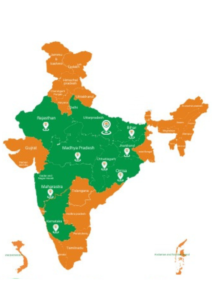
Implementation success under this solar irrigation scheme varies widely by state, largely depending on how efficiently state nodal agencies process applications and coordinate with DISCOMs. States like Maharashtra, Rajasthan, Gujarat, Madhya Pradesh, Karnataka, and Tamil Nadu have consistently led adoption, particularly for Component A grid-connected plants and Component C feeder-level solarisation. Farmers in these states typically report shorter approval timelines and better vendor availability compared to states still building out their solar infrastructure ecosystem.
Common Myths About PM Kusum Yojana
Myth 1: Only large landholders can benefit. False — Component B specifically targets small and marginal farmers with standalone pumps as small as 1 HP.
Myth 2: The subsidy covers 100% of the cost. False — farmers still contribute a share, though it’s often reduced to as little as 10% through loan support.
Myth 3: You need an existing electricity connection to apply. False — Component B is built specifically for off-grid farmers with no grid access at all.
Myth 4: Applications can only be made through agents or middlemen. False — the entire application process is available directly through the official government portal, and applicants are encouraged to avoid unauthorized intermediaries.
Frequently Asked Questions
What is the objective of PM Kusum Yojana? The scheme aims to boost solar power capacity in the agriculture sector, reduce diesel dependency for irrigation, and give farmers an additional income source through surplus power sales.
How much solar pump subsidy do farmers get under the scheme? Most farmers receive around 60% combined central and state subsidy, pay roughly 30% through an institutional loan, and contribute only about 10% from their own pocket.
Who is eligible to apply? Individual farmers, farmer groups, panchayats, cooperatives, and Water User Associations generally meet PM Kusum eligibility requirements, subject to state-specific rules.
Where can I complete PM Kusum registration? Applications are processed through the official portal, pmkusum.mnre.gov.in, or through your state’s renewable energy nodal agency.
Is PM Kusum Yojana still active in 2026? Yes. The scheme’s implementation deadline has been extended, with financial closure and commissioning timelines now running into 2026 and 2027, and a possible “PM Kusum 2.0” upgrade under discussion.
Expert Tips to Get Your Application Approved Faster
Having reviewed how state nodal agencies process applications, a few practical habits consistently separate fast approvals from stuck files:
- Match your name exactly across documents. Even minor spelling differences between Aadhaar, land records, and bank account details are among the top reasons applications get flagged for manual review.
- Choose the right component the first time. Applying under Component B when you actually have an existing grid connection (which falls under Component C) creates unnecessary back-and-forth with the verifying officer.
- Confirm empanelled vendors before finalising. Only vendors listed on the state agency’s approved panel are eligible for subsidy disbursement — working with an unlisted installer, even unknowingly, can disqualify your claim.
- Track your capacity eligibility. Pump capacity limits (1 HP to 7.5 HP, or up to 10 HP in select states) are strictly enforced; requesting a size outside your sanctioned category is a common cause of rejection.
- Follow up through the portal, not just offline offices. The online dashboard usually reflects real-time status faster than physical visits to district offices, and it creates a documented trail if you need to escalate a delay.
How This Scheme Fits India's Larger Solar Push
It’s worth placing this program in the context of India’s broader renewable energy trajectory. The country has set ambitious non-fossil fuel capacity targets for the coming years, and agriculture — being both energy-hungry and land-abundant — is a natural sector to decentralise power generation. Rooftop solar programs address urban and household demand, large utility-scale solar parks address industrial and grid-level demand, and this farm-focused initiative fills the gap in between: distributed generation on agricultural land that directly benefits the people who own it.
This is also why policymakers increasingly view the scheme not just as a subsidy program but as a structural fix for the agriculture-power-water triangle that has strained India’s rural economy for decades. Metered solar pumps naturally discourage the kind of unchecked groundwater extraction that flat-rate free electricity has historically encouraged, while feeder-level solarisation reduces technical and commercial losses that DISCOMs have struggled with for years. Very few single programs touch energy security, water conservation, farmer income, and emissions reduction all at once — which is part of why this initiative continues to receive renewed funding and extended timelines even amid slower-than-planned rollout.
Final Thoughts
PM Kusum Yojana represents one of the most practical intersections of climate policy and rural livelihood support that India has attempted at this scale. Between the solar pump subsidy structure, flexible PM Kusum eligibility rules, and a straightforward PM Kusum registration process, the scheme has already changed how hundreds of thousands of farmers irrigate their land and earn income. Delays and shifting deadlines are real, but the direction is clear — this Kusum initiative is steadily turning Indian farmland into a genuine source of clean, decentralised power.
Trusted by 50000+ Customers
Anya Green Energy is a leading solar company and Solar Energy service provider established in 2013. We are recognized by startup India and customer best choice award 2022.
Our Achievements :
Recognized by Startup India.
Purvanchal’s first solar company to operate exclusively with solar products.
Certified by well-known institutions such as MSME, IndiaMart, and Just Dial and many more.
Winner of the Best Customer Choice Award 2022.
Over 50,000 happy customers across India.