7 Proven Tips to Compare DCR vs Non DCR Panels for Maximum Savings
Choosing the right technology for your solar energy setup can often feel overwhelming due to complex regulations, technical specifications, and fluctuating pricing models. When evaluating solar modules for residential, industrial, or utility-scale projects, the decision frequently comes down to comparing dcr vs non dcr panels.
Making an informed choice between dcr vs non dcr panels requires a clear understanding of manufacturing origins, financial incentives, and performance metrics. To help you maximize return on investment, here are 7 proven tips to compare dcr vs non dcr panels for your upcoming energy project.
1. Understand the Manufacturing Origin and Policy Context
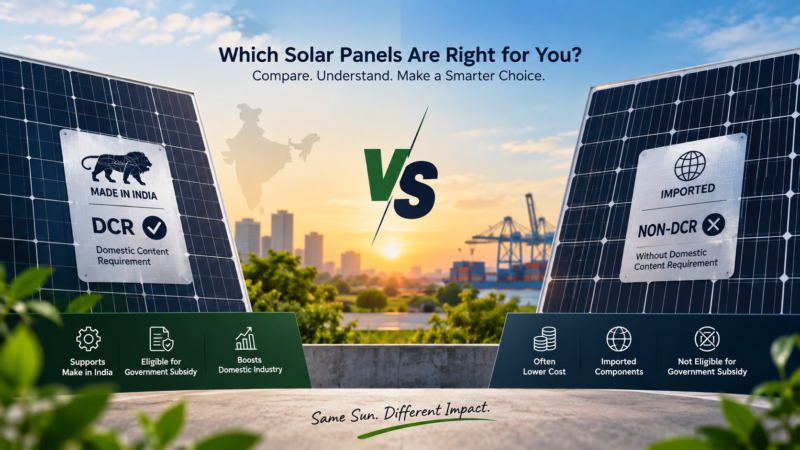
The primary difference when looking at dcr vs non dcr panels lies in their manufacturing pipeline and regulatory origin:
DCR Modules: DCR stands for domestic content requirement. To qualify, both the photovoltaic solar cells and the final solar module assembly must physically take place in India.
Non-DCR Modules: These modules carry no restriction on cell origin. A module assembled in India using imported cells—or imported as a fully finished unit—is classified as non-DCR.
Enforced by the Ministry of New and Renewable Energy (MNRE), the domestic content requirement policy was introduced to bolster local manufacturing capabilities, strengthen national energy security, and lessen reliance on global supply chain fluctuations.
2. Check Government Solar Subsidy Eligibility
If you are planning a residential rooftop setup, financial incentives play a pivotal role in your decision-making process.
Residential Subsidies: Central Financial Assistance (CFA) programs—such as the PM Surya Ghar: Muft Bijli Yojana or PM-KUSUM—strictly require DCR compliance. To claim a government solar subsidy, your project must use verified domestic modules.
Loss of Incentive: Selecting non-DCR options for a residential setup instantly disqualifies your property from receiving any government solar subsidy.
When reviewing financial options for home installations, the value of the government solar subsidy usually offsets the higher module cost of domestic options, making them the economically superior choice.
3. Compare Initial Upfront Costs vs. Net Outlay
Upfront procurement costs differ significantly when comparing dcr vs non dcr panels. Because domestic solar cell manufacturing capacity is still scaling, DCR modules carry a price premium per watt compared to imported alternatives.
For Residential Users: Although DCR modules carry a higher base cost, applying the government solar subsidy yields a lower net out-of-pocket expense and accelerates payback.
For Private Projects: For projects that do not qualify for state or central financial aid, non-DCR modules offer lower initial procurement costs.
Analyzing your net capital expenditure rather than raw sticker price ensures an accurate financial forecast.
4. Evaluate Solar Panel Efficiency and Cell Technologies
Module output directly impacts total energy yield. Evaluating solar panel efficiency across both options reveals key technical differences:
DCR Module Capabilities: Domestic cell manufacturing primarily focuses on high-volume Mono-PERC technology, providing reliable and steady solar panel efficiency suited for standard environmental conditions.
Non-DCR Options: Global markets offer rapid access to advanced N-type TOPCon and Heterojunction (HJT) cell architectures, yielding slightly higher solar panel efficiency ratings.
While global technologies can offer marginal gains in power output, rapid expansion in domestic cell manufacturing is quickly closing the gap in solar panel efficiency.
5. Match the Panel Type to Your Specific Project Application
Your specific installation model dictates which panel category you should specify.
Residential Rooftops: Ideal for DCR modules due to central financial incentives that drastically reduce net payback times.
Agricultural Pumps & Schemes: Mandatory DCR compliance applies under government-backed rural electrification programs.
Commercial & Industrial Real Estate: Private business properties benefit greatly from selecting non-DCR modules for a commercial solar installation.
For any unsubsidized commercial solar installation, avoiding domestic sourcing mandates allows business owners to optimize procurement budgets while delivering strong power yields.
6. Factor in Supply Chain Continuity and Sourcing Speed
Sourcing timeline availability is another factor when weighing dcr vs non dcr panels. Because domestic solar cell supply is allocated heavily toward national priority schemes, lead times for large-scale domestic procurement can vary.
DCR Projects: Require verified documentation proving compliance with domestic content requirement mandates alongside Approved List of Models and Manufacturers (ALMM) listings.
Non-DCR Procurement: Offers broad vendor flexibility and high volume availability for private developers managing tight construction deadlines.
Working closely with certified engineering and procurement partners prevents project delay regardless of the selected panel route.
7. Review Warranty Coverage and Long-Term Reliability
A common misconception when comparing dcr vs non dcr panels is that domestic modules are inherently lower in quality. In practice, both panel categories must meet identical safety, performance, and durability standards:
Regulatory Certification: All panels sold in the market must clear Bureau of Indian Standards (BIS) testing.
Standard Warranties: Standard performance warranties range from 25 to 30 years, featuring comparable linear degradation rates across both categories.
Evaluating individual manufacturer warranty terms and testing credentials ensures long-term reliability regardless of manufacturing origin.
How to Decide: DCR vs Non DCR Panels
Making a final selection between dcr vs non dcr panels comes down to project scope:
Choose DCR Panels if you are installing a residential system and intend to claim a government solar subsidy. Fulfilling the domestic content requirement rule is legally mandatory to receive public funds.
Choose Non-DCR Panels if you are executing an unsubsidized private commercial solar installation. Bypassing domestic sourcing mandates gives access to cost savings without compromising output.
By systematically evaluating procurement budgets, incentives, and technical requirements, you can confidently choose between dcr vs non dcr panels to achieve optimal energy savings
Trusted by 50000+ Customers
Anya Green Energy is a leading solar company and Solar Energy service provider established in 2013. We are recognized by startup India and customer best choice award 2022.
Our Achievements :
Recognized by Startup India.
Purvanchal’s first solar company to operate exclusively with solar products.
Certified by well-known institutions such as MSME, IndiaMart, and Just Dial and many more.
Winner of the Best Customer Choice Award 2022.
Over 50,000 happy customers across India.
Products
-
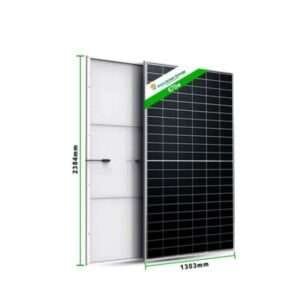 670W MONO PERC HALFCUT SOLAR PANEL
₹26,999.00Original price was: ₹26,999.00.₹23,999.00Current price is: ₹23,999.00. -
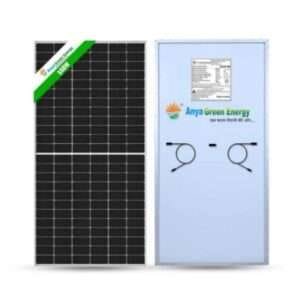 550W MONO PERC HALFCUT SOLAR MODULE
₹22,999.00Original price was: ₹22,999.00.₹19,999.00Current price is: ₹19,999.00. -
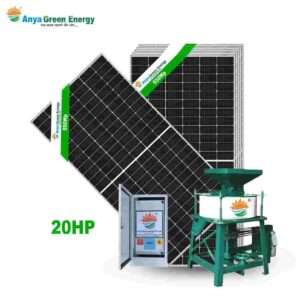 20HP Atta Chakki with Mone Perc Half cut 550W Panel
₹1,200,000.00Original price was: ₹1,200,000.00.₹1,060,000.00Current price is: ₹1,060,000.00. -
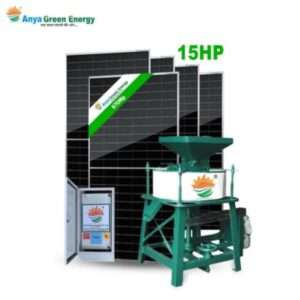 15HP Atta Chakki with Mone Perc Half cut 670W Panel
₹900,000.00Original price was: ₹900,000.00.₹850,000.00Current price is: ₹850,000.00. -
 10HP Atta Chakki with Mone Perc Half cut 550W Panel
₹650,000.00Original price was: ₹650,000.00.₹590,000.00Current price is: ₹590,000.00.