
Fossil Fuels and Their Harms: What the 2026 Data Actually Shows
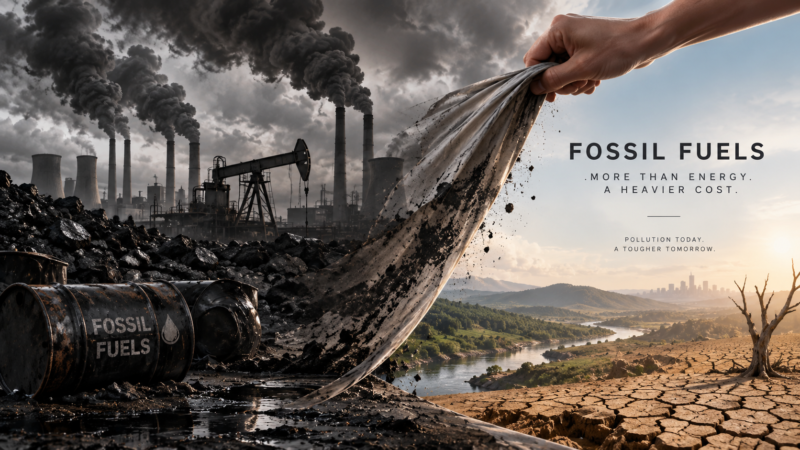
Fossil fuels still quietly power most of the modern world — your commute, your electricity, the plastic in your phone case. But 2025 also produced a grim milestone: global energy-related CO2 emissions hit a new record of nearly 38.4 billion tonnes, even as clean energy expanded faster than ever before. That contradiction — record renewable growth alongside record emissions — is the real story of where these fuels stand today.
This isn’t meant to be alarmist. It’s meant to lay out, plainly and with current numbers, what fossil fuels are, how much of the world still runs on them, and what the actual, measurable harms look like — from the air people breathe to the warming risks everyone now lives with.
What Are Fossil Fuels?
Fossil fuels are energy sources formed from the buried remains of plants and animals that lived millions of years ago, compressed underground into carbon-rich deposits. The three main types are, in order of their typical emissions intensity:
- Coal — a solid fuel burned mainly for electricity generation and heavy industry, and the single largest source of global CO2 emissions.
- Oil (petroleum) — a liquid fuel refined into petrol, diesel, and jet fuel, dominating the transport sector.
- Natural gas — a gaseous fuel used for electricity, heating, and industrial processes, often marketed as “cleaner” because it emits less CO2 than coal per unit of energy, though it still carries significant climate and safety concerns.
These fuels became the backbone of industrial civilization because they’re energy-dense, easy to transport, and — for over a century — cheap to extract. That same convenience is now central to why shifting away from them is proving so difficult, even as the environmental consequences of continued use become harder to ignore.
Fossil Fuels by the Numbers: The 2025–2026 Global Picture
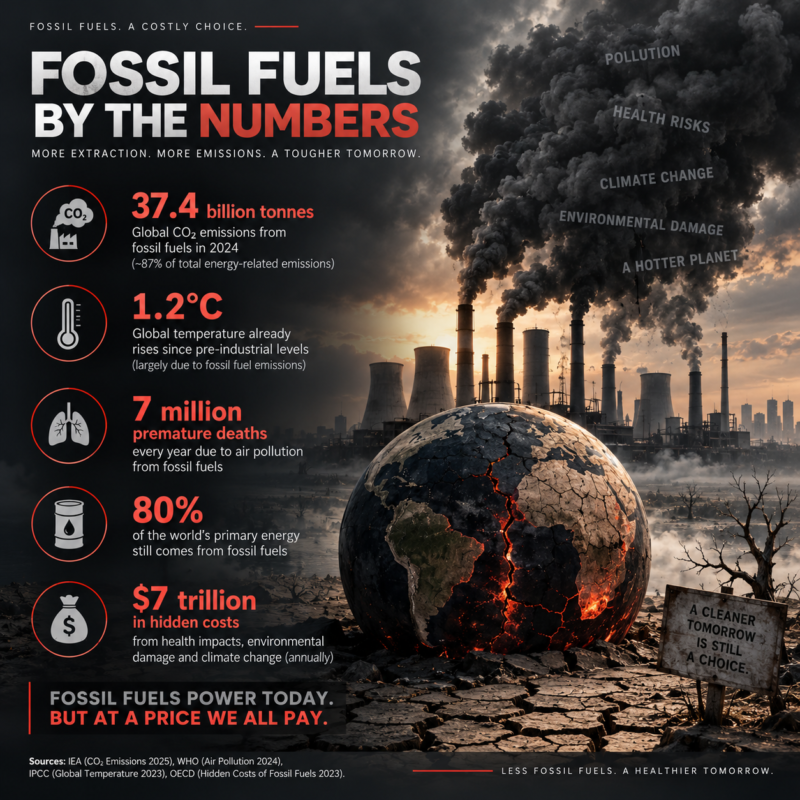
According to the IEA’s Global Energy Review 2026, coal, oil, and gas remain deeply embedded in the global energy system, even as the pace of change accelerates:
- Global energy-related CO2 emissions reached a record 38.4 billion tonnes in 2025, an increase of around 145 million tonnes and roughly 5% above pre-pandemic 2019 levels.
- Weather-related factors — including drought-driven hydropower shortfalls and weaker wind speeds — pushed coal, oil, and gas use up further, adding an estimated 90 million tonnes of extra CO2 in 2025 alone.
- Emissions from coal, oil, and natural gas all continued to rise through 2024–2025, with gas emissions growing fastest as countries substituted it for coal and, in some cases, switched back to coal amid high prices.
- Despite this, clean energy technologies deployed since 2019 avoided more than 35 exajoules of demand for these fuels in 2025 — about 7% of total global use — showing the transition is gaining real traction even as absolute emissions climb.
- Globally, subsidies for coal, oil, and gas remain enormous: the IMF estimates direct and indirect subsidies at around USD 7 trillion annually, roughly 7% of global GDP, with about 70% of that figure reflecting the uncounted environmental and health costs of burning them.
The pattern that emerges is one of transition happening in parallel with continued dependence — renewables are growing at record speed, but overall energy demand is growing too, and traditional energy sources are still filling much of that gap.
The Human Cost: Fossil Fuels and Air Pollution
The climate impact of burning coal, oil, and gas gets most of the headlines, but the immediate, measurable human toll is arguably just as serious. According to a major study published in the journal Environmental Research and widely cited in subsequent BMJ-linked analyses, air pollution from fossil fuels caused an estimated 8.7 million deaths globally in a single recent year — nearly one in five deaths worldwide.
A separate, widely referenced global analysis found that of roughly 8.3 million total deaths linked to ambient air pollution, about 61%, or 5.1 million deaths annually, were directly attributable to burning coal, oil, and gas — from power plants, vehicles, and industrial processes. IQAir’s global air quality reporting puts total premature deaths from all outdoor pollution sources at around 7 million people per year, with the heaviest burden falling on countries in the Global South with limited access to clean energy alternatives.
Regionally, the toll is concentrated in the world’s most populous, rapidly industrialising nations — China and India together account for well over 4 million attributable deaths a year from ambient air pollution, driven heavily by fine particulate matter (PM2.5) released when these fuels are burned. This exposure has been linked to a wide range of chronic conditions, including ischaemic heart disease, stroke, chronic obstructive lung disease, and lung cancer.
Beyond Emissions: The Multiple Dimensions of Harm
1. Climate Change and Extreme Weather Burning coal, oil, and gas releases carbon dioxide and methane, greenhouse gas emissions that are the primary drivers of climate change. Rising temperatures are already intensifying droughts, heatwaves, and storms — and, ironically, even reducing the output of hydropower and wind projects, pushing grids back toward more coal and gas generation in a feedback loop.
2. Public Health and Respiratory Illness Beyond the millions of deaths linked to breathing polluted air, burning these fuels is associated with rising rates of asthma, cardiovascular disease, and reduced life expectancy, particularly in dense urban areas and communities near power plants and refineries.
3. Water and Land Degradation Coal mining, oil drilling, and fracking can contaminate groundwater, degrade soil, and disrupt ecosystems, while oil spills continue to cause long-lasting damage to marine environments.
4. Economic Distortion Through Subsidies With global subsidies for these fuels estimated at trillions of dollars annually, governments are effectively using public money to keep coal, oil, and gas artificially cheap — money that economists argue could otherwise accelerate the clean energy transition or fund healthcare and education.
5. Energy Security and Price Volatility Because supply chains for these fuels are concentrated in a handful of exporting countries and regions, importing nations remain exposed to geopolitical shocks and price spikes, as seen repeatedly during recent energy crises.
6. Disproportionate Impact on Vulnerable Communities Low-income countries and communities — often those that have contributed least to historical emissions — bear a disproportionate share of both the health and climate harms associated with burning coal, oil, and gas, a pattern researchers and policymakers increasingly describe as a climate justice issue.
Why Fossil Fuels Are Still So Hard to Replace
Despite the well-documented harms, coal, oil, and gas haven’t disappeared from the energy mix for a few structural reasons worth understanding honestly:
- Existing infrastructure — power plants, refineries, pipelines, and vehicles built around these fuels represent trillions of dollars of sunk investment that isn’t easily replaced overnight.
- Rising overall energy demand — global electricity demand is growing faster than overall energy demand, driven by cooling needs, industrial growth, electric vehicles, and data centres, meaning even record renewable additions aren’t always enough to fully displace generation from coal and gas.
- Reliability and dispatchability — coal and gas plants can run continuously regardless of weather, a role increasingly filled by pumped storage hydropower, batteries, and grid upgrades, but not yet everywhere at the needed scale.
- Massive ongoing subsidies — with these fuels still receiving trillions in direct and indirect government support annually, the true cost of coal, oil, and gas rarely reaches consumers, weakening the price signal that would otherwise favour cleaner alternatives.
- Economic dependence in producing regions — many economies and millions of jobs remain tied to extraction and export, making a rapid, disorderly transition politically and socially difficult.
What's Changing: Signs of a Real Shift
It isn’t all bad news. Several 2025–2026 data points suggest the balance is genuinely starting to shift:
- Solar PV, itself a form of renewable energy, met more than a quarter of global energy demand growth in 2025 — the first time a modern renewable source has contributed the largest share of new demand, according to the IEA.
- China’s energy-related CO2 emissions fell in 2025, driven by its renewables boom and slower growth in energy-intensive industry — a significant shift for the world’s largest emitter.
- India’s energy-related CO2 emissions were flat for the first time since the 1970s, supported by strong monsoon-driven hydropower output and continued renewable energy expansion.
- Renewables and nuclear together met nearly 60% of new global energy demand in 2025, showing that clean energy is no longer just supplementing coal, oil, and gas but increasingly competing directly with them for new demand growth.
Fossil Fuels and Global Climate Goals
At COP28, nations agreed for the first time to a global call to “transition away” from coal, oil, and gas in energy systems as part of tackling climate change, alongside a pledge to triple renewable energy capacity to over 11 TW by 2030. Progress on the subsidy side has been far slower — attempts to phase out support for these fuels by 2025, pushed by bodies including the European Parliament, have largely missed their targets, with global subsidies remaining near record highs.
The tension is clear: the same governments committing to climate change targets are, in many cases, still subsidising the fuels driving greenhouse gas emissions higher. Closing that gap — through carbon pricing, subsidy reform, and continued renewable energy investment — is widely viewed by economists and climate researchers as one of the most direct levers available to accelerate the transition.
What's Next: Trends to Watch
- Continued tension between demand growth and decarbonisation — expect emissions to stay near record levels even as renewable capacity additions break new records each year.
- Growing scrutiny of fossil fuel subsidies — expect renewed international pressure, particularly from the IMF and climate finance bodies, to reform the roughly USD 7 trillion in annual global support for coal, oil, and gas.
- Weather-driven volatility — as droughts and weak wind years increasingly disrupt hydropower and wind output, watch for short-term reversions to coal and gas, even in countries otherwise on a clean energy trajectory.
- Faster electrification — electric vehicles, heat pumps, and industrial electrification are expected to keep displacing oil and gas demand and cutting greenhouse gas emissions, particularly in transport and heating.
- Wider adaptation planning — as extreme weather events increase, expect more countries to pair emissions-cutting policy with infrastructure built to withstand the warming impacts already locked in.
- Divergence between major economies — China and India’s differing emissions trajectories in 2025 suggest the next few years will reveal which large economies are genuinely decoupling growth from coal, oil, and gas.
Final Thoughts: Why Understanding Fossil Fuels' Harms Still Matters
These fuels aren’t going away overnight, and pretending otherwise doesn’t help anyone make better decisions, especially as renewable energy keeps setting fresh deployment records each year. What the 2025–2026 data does show is a system in genuine, measurable transition — record emissions and record clean energy growth happening side by side, with millions of preventable deaths and trillions in hidden subsidies sitting underneath the headline numbers.
Understanding exactly where fossil fuels cause harm — in the air people breathe, the climate change risks everyone now shares, and the economic incentives that keep coal, oil, and gas artificially cheap — is the first step toward evaluating the trade-offs honestly, rather than treating the energy transition as a slogan instead of a set of hard, quantifiable choices.
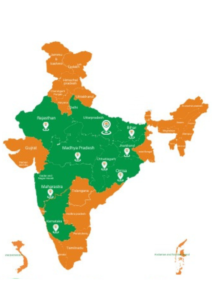
Trusted by 50000+ Customers
Anya Green Energy is a leading solar company and Solar Energy service provider established in 2013. We are recognized by startup India and customer best choice award 2022.
Our Achievements :
Recognized by Startup India.
Purvanchal’s first solar company to operate exclusively with solar products.
Certified by well-known institutions such as MSME, IndiaMart, and Just Dial and many more.
Winner of the Best Customer Choice Award 2022.
Over 50,000 happy customers across India.
Products
-
 670W MONO PERC HALFCUT SOLAR PANEL
₹26,999.00Original price was: ₹26,999.00.₹23,999.00Current price is: ₹23,999.00. -
 550W MONO PERC HALFCUT SOLAR MODULE
₹22,999.00Original price was: ₹22,999.00.₹19,999.00Current price is: ₹19,999.00. -
 20HP Atta Chakki with Mone Perc Half cut 550W Panel
₹1,200,000.00Original price was: ₹1,200,000.00.₹1,060,000.00Current price is: ₹1,060,000.00. -
 15HP Atta Chakki with Mone Perc Half cut 670W Panel
₹900,000.00Original price was: ₹900,000.00.₹850,000.00Current price is: ₹850,000.00. -
 10HP Atta Chakki with Mone Perc Half cut 550W Panel
₹650,000.00Original price was: ₹650,000.00.₹590,000.00Current price is: ₹590,000.00.