
Solar Energy Carbon Footprint Reduction: What the Data Actually Shows in 2026
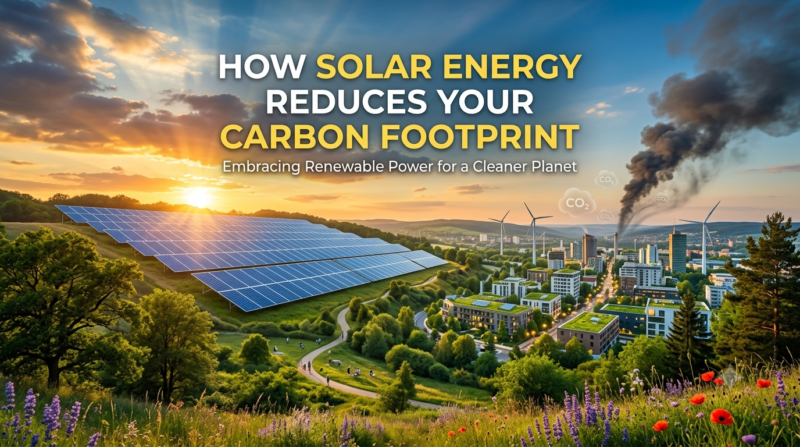
Solar panels aren’t zero-carbon to build — but the math behind solar energy carbon footprint reduction is more compelling than most people realise. A typical solar panel offsets the entire carbon footprint of its own manufacturing within just 2 to 3 years of operation, then spends the remaining 22 to 28 years of its working life generating electricity with essentially no emissions at all. A peer-reviewed study published in Nature Energy in 2026 confirmed that solar, wind, and nuclear power all have “amazingly low” lifecycle carbon footprints compared to fossil fuels, even after accounting for manufacturing, transport, and construction — strong independent validation of solar energy carbon footprint reduction claims.
This piece looks past the marketing language and gets into the actual numbers behind solar energy carbon footprint reduction — how solar panels lower emissions across their full lifecycle, what the honest manufacturing footprint looks like, and how this compares to other climate strategies people often assume are more effective.
How Solar Panels Lower Emissions: The Basic Mechanism
Understanding how solar panels lower emissions starts with the basic mechanism: they generate electricity through the photovoltaic effect, converting sunlight directly into power with zero emissions during operation. But understanding how solar panels lower emissions requires looking at the full lifecycle, not just the generation phase:
- Manufacturing — producing solar cells, panels, and supporting hardware currently generates roughly 33–50 grams of CO2 per kilowatt-hour of eventual lifetime output, primarily from mining silicon, energy-intensive cell processing, and manufacturing plant electricity use.
- Transport and installation — moving panels from factories to installation sites and mounting them adds a comparatively small additional footprint.
- Operation — once installed, a solar system produces electricity for 25 to 30 years with essentially no direct emissions, which is where the overwhelming majority of its climate benefit accumulates.
- End-of-life — recycling and material recovery remain an evolving part of the lifecycle, with growing investment in reducing waste and reusing materials across old panels.
The key insight behind how solar panels lower emissions is that the “debt” incurred during manufacturing gets repaid many times over during decades of clean generation — a dynamic fossil fuel plants never achieve, since every additional hour of fossil generation adds more emissions rather than paying down an existing footprint.
Solar Energy Carbon Footprint Reduction by the Numbers: The 2025–2026 Picture
The scale of solar energy carbon footprint reduction becomes clear once you look at the actual lifecycle comparisons:
- Life-cycle emissions of solar electricity run around 12 times lower than natural gas and 20 times lower than coal, according to current lifecycle assessment data.
- A typical residential solar system delivers a net CO2 avoidance of 500–800 tons over its 25–30 year lifespan, with annual savings typically running 3–4 tons for a standard household installation.
- Solar panel manufacturing emissions intensity fell by around 45% between 2011 and 2021, driven largely by improved material efficiency — for example, the amount of silver used per solar cell dropped by a third between 2009 and 2018.
- On a per-acre basis, solar installations avoid an estimated 175–198 metric tons of CO2 annually, compared to just 0.84 metric tons sequestered annually by an equivalent acre of forest — meaning solar panels offset roughly 208 to 236 times more carbon per acre than natural forest sequestration.
- Globally, solar power’s own manufacturing-related footprint equates to just 0.15% of the world’s total energy-related emissions, a strikingly small share given how central solar has become to climate strategy.
- A 2026 Nature Energy study modelling full lifecycle emissions out to 2050 confirmed that solar, wind, and nuclear carbon footprints remain dramatically lower than coal or even gas paired with carbon capture and storage, directly rebutting long-standing claims that “hidden” manufacturing emissions might cancel out renewable energy’s climate benefits.
Environmental Benefits of Solar Energy Beyond Carbon Alone
While solar energy carbon footprint reduction gets most of the attention, the environmental benefits of solar energy extend into several other dimensions worth understanding:
1. Air Quality Improvement
Because solar generates electricity without combustion, it eliminates the particulate matter and toxic emissions associated with burning coal, oil, or gas — a direct public health benefit layered on top of the climate impact.
2. Water Conservation
Unlike thermal power plants, which require significant water for cooling, solar panels generate electricity without any water input at all, easing pressure on water resources in drought-prone or water-stressed regions.
3. Land Efficiency and Dual-Use Potential
Agrivoltaics — combining solar installations with agricultural land use — allows the same land to generate both electricity and crops, improving the overall land-use efficiency of every acre committed to generation.
4. Reduced Resource Extraction Over Time
Unlike fossil fuels, which require ongoing, continuous extraction for the lifetime of a power plant, solar panels are built once and then generate electricity for decades without requiring continuous fuel input — a core part of solar energy carbon footprint reduction, since the environmental cost is front-loaded rather than perpetual.
5. Declining Footprint Over Time
As manufacturing becomes more efficient and increasingly powered by renewable electricity itself, this compounding effect strengthens solar energy carbon footprint reduction further — each new generation of panels arrives with a smaller manufacturing footprint than the last.
Reducing Carbon Footprint With Solar Power: Practical Impact at Different Scales
The practical work of reducing carbon footprint with solar power looks different depending on whether you’re a homeowner, a business, or a national grid operator, but the strategy of reducing carbon footprint with solar power scales consistently across all three:
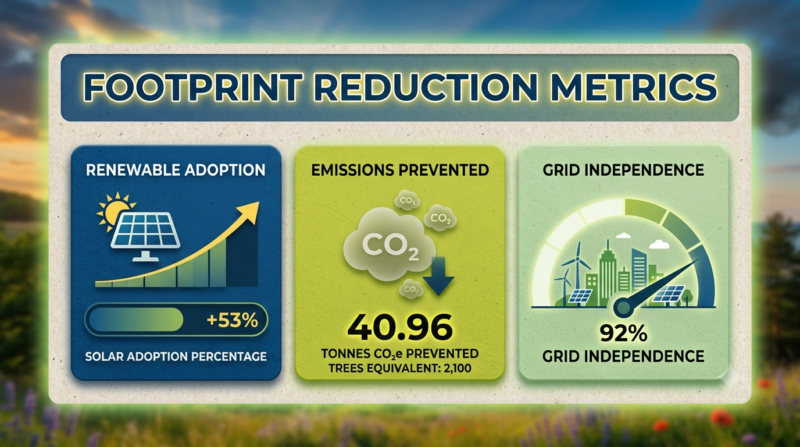
- Residential scale — a standard home solar system saves approximately 1.1 tonnes of CO2 per year, accumulating to 33–44 tonnes of avoided emissions across a 30–40 year lifespan, roughly equivalent to the carbon sequestration of 2,000–3,000 trees.
- Commercial and industrial scale — larger installations scale this benefit proportionally, with businesses increasingly required to measure and disclose their solar energy carbon footprint reduction under corporate sustainability reporting standards.
- Utility and grid scale — national solar capacity additions displace fossil fuel generation directly, with every gigawatt of solar capacity avoiding a proportional volume of coal or gas-fired electricity that would otherwise have been generated.
- The payback period keeps shrinking — as manufacturing becomes cleaner and more material-efficient, the time it takes for a panel to “pay back” its own production emissions continues to fall, meaning each new panel installed delivers proportionally more net climate benefit than the one before it.
Renewable Energy and Climate Change: Why Solar's Role Matters So Much
The broader relationship between renewable energy and climate change is why solar energy carbon footprint reduction matters at a scale far beyond individual households:
- Global climate targets, including the pledge to triple renewable energy capacity to over 11 TW by 2030, depend heavily on solar’s continued expansion and its contribution to solar energy carbon footprint reduction at scale, since it remains the fastest-growing electricity source in the world.
- The connection between renewable energy and climate change is direct and measurable: every unit of solar-generated electricity displaces a unit that would otherwise likely come from fossil fuels, translating cleanly into avoided emissions.
- Because solar’s own manufacturing footprint keeps shrinking while fossil fuel extraction and combustion emissions do not, solar energy carbon footprint reduction widens its climate mitigation advantage further with each passing year.
- Countries pursuing net-zero commitments, including India’s 2070 target and similar pledges worldwide, explicitly rely on solar’s favourable emissions profile and its role in the wider link between renewable energy and climate change strategy.
The Honest Caveats: Where Solar's Carbon Story Gets Complicated
A credible discussion of solar energy carbon footprint reduction needs to include the genuine limitations and open questions:
- Manufacturing transparency gaps — some analysts argue the true emissions intensity of solar panel manufacturing may be underestimated, particularly where production is concentrated in regions with carbon-intensive electricity grids.
- Geographic concentration of manufacturing — a large share of global solar panel production remains concentrated in a small number of countries, creating both supply chain risk and uneven manufacturing-emissions accounting depending on the electricity mix used to power factories.
- End-of-life management is still maturing — recycling infrastructure and processes for decommissioned solar panels remain less developed than manufacturing itself, representing an area where the full lifecycle picture is still being worked out.
- Land-use trade-offs in some contexts — while solar significantly outperforms forest sequestration per acre, land conversion for utility-scale solar can still involve short-term carbon release, though studies show net positive impact toward solar energy carbon footprint reduction is typically achieved within about 2 years of operation.
- Not a complete climate solution alone — solar energy carbon footprint reduction is powerful but still needs to be paired with storage, grid upgrades, and other renewable sources to fully displace fossil fuels across an entire electricity system.
What's Next: Trends Shaping Solar's Carbon Story Through 2030
- Continued manufacturing efficiency gains — expect further reductions in per-panel manufacturing emissions as material efficiency improves and factories increasingly run on renewable electricity themselves.
- Growing corporate carbon accounting rigour — solar’s contribution to emissions reduction is increasingly subject to the same measurement, verification, and disclosure standards applied to other corporate sustainability metrics.
- Recycling infrastructure maturing — as the first large wave of solar panels installed a decade or more ago approaches end-of-life, expect faster development of dedicated recycling and material-recovery systems.
- Wider agrivoltaic adoption — combining solar generation with agricultural land use is expected to expand as a way to improve land-use efficiency without requiring additional dedicated land.
- Deeper integration with the renewable energy and climate change policy agenda — as national climate commitments tighten, solar’s documented, favourable lifecycle emissions profile is likely to keep it central to decarbonisation strategy globally.
Final Thoughts: Is Solar's Carbon Footprint Reduction Real?
Based on the evidence, yes — decisively so. Solar energy carbon footprint reduction isn’t a marketing claim; it’s a well-documented, peer-reviewed reality confirmed by lifecycle studies published as recently as 2026. Panels pay back their own manufacturing emissions within 2 to 3 years and then spend decades generating power with life-cycle emissions 12 to 20 times lower than fossil fuels. The environmental benefits of solar energy extend well beyond carbon too — cleaner air, less water use, and more efficient land use all layer on top of the core climate impact.
The honest picture includes real caveats — manufacturing transparency, end-of-life recycling, and geographic concentration of production all deserve continued scrutiny — but none of them come close to undermining the core conclusion: reducing carbon footprint with solar power remains one of the most measurable, well-evidenced strategies available today, whether you’re a homeowner, a business, or a country reducing carbon footprint with solar power at grid scale.

Trusted by 50000+ Customers
Anya Green Energy is a leading solar company and Solar Energy service provider established in 2013. We are recognized by startup India and customer best choice award 2022.
Our Achievements :
Recognized by Startup India.
Purvanchal’s first solar company to operate exclusively with solar products.
Certified by well-known institutions such as MSME, IndiaMart, and Just Dial and many more.
Winner of the Best Customer Choice Award 2022.
Over 50,000 happy customers across India.
Products
-
 670W MONO PERC HALFCUT SOLAR PANEL
₹26,999.00Original price was: ₹26,999.00.₹23,999.00Current price is: ₹23,999.00. -
 550W MONO PERC HALFCUT SOLAR MODULE
₹22,999.00Original price was: ₹22,999.00.₹19,999.00Current price is: ₹19,999.00. -
 20HP Atta Chakki with Mone Perc Half cut 550W Panel
₹1,200,000.00Original price was: ₹1,200,000.00.₹1,060,000.00Current price is: ₹1,060,000.00. -
 15HP Atta Chakki with Mone Perc Half cut 670W Panel
₹900,000.00Original price was: ₹900,000.00.₹850,000.00Current price is: ₹850,000.00. -
 10HP Atta Chakki with Mone Perc Half cut 550W Panel
₹650,000.00Original price was: ₹650,000.00.₹590,000.00Current price is: ₹590,000.00.