
Green Hydrogen in 2025: The Clean Energy Revolution Powering Our Future
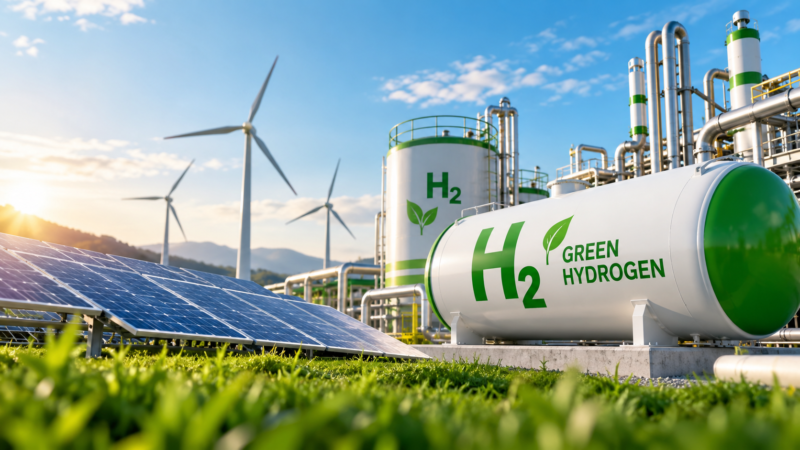
Imagine a fuel that emits nothing but water vapor, can power steel plants, ships, and trucks, and is made using nothing but water and sunlight. That’s not science fiction — it’s green hydrogen, and it’s rapidly becoming one of the most talked-about solutions in the global fight against climate change. As one industry report puts it, “green hydrogen isn’t just an energy source, it’s an entire industrial revolution in the making.”
In this blog, we break down what green hydrogen really is, why governments worldwide are pouring billions into it, the current data behind the hype, and what the future looks like — across environmental, economic, technological, and policy dimensions.
What Is Green Hydrogen?
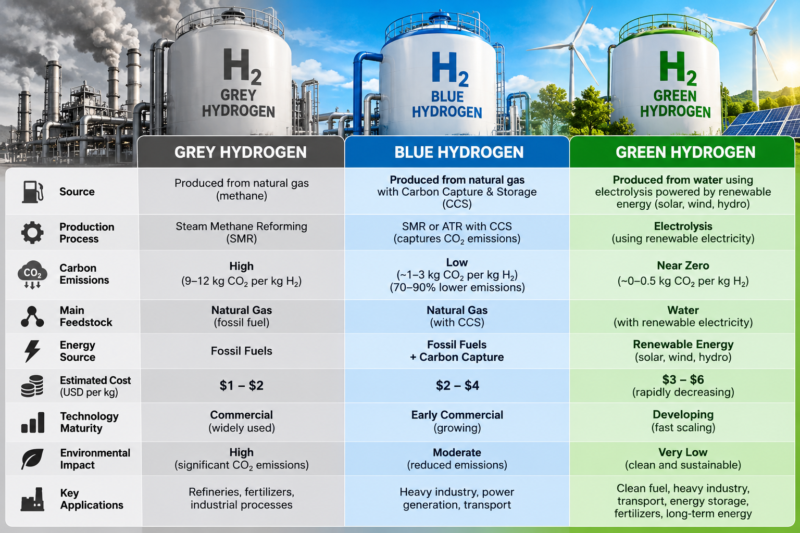
Green hydrogen is hydrogen gas produced through electrolysis — splitting water into hydrogen and oxygen — using electricity generated entirely from renewable energy sources like solar, wind, or hydropower. Unlike “grey hydrogen” (made from natural gas) or “blue hydrogen” (natural gas with carbon capture), green hydrogen produces zero carbon emissions during its entire production cycle.
This makes it fundamentally different from other hydrogen types and a cornerstone of the broader clean energy transition happening across industries today.
Why Green Hydrogen Matters: The Multi-Dimensional Impact
1. Environmental Dimension
Green hydrogen could eliminate up to 830 million tonnes of CO2 emissions annually by 2030, according to the International Renewable Energy Agency (IRENA). Sectors that are notoriously hard to decarbonize — steel manufacturing, cement production, heavy shipping, and aviation — can use green hydrogen as a direct substitute for fossil fuels, something electricity alone cannot achieve.
2. Economic Dimension
The global green hydrogen market was valued at approximately $7.4 billion in 2023 and is projected to reach $320 billion by 2030, growing at a staggering CAGR of over 50%. This growth is creating millions of jobs in manufacturing, electrolyzer production, and infrastructure development — a critical pillar of the hydrogen economy taking shape worldwide.
3. Energy Security Dimension
Countries heavily reliant on imported fossil fuels see green hydrogen as a path to energy independence. Since it can be produced domestically using local renewable resources, nations like India, Japan, and Germany are investing heavily to reduce dependency on volatile global oil and gas markets.
4. Technological Dimension
Electrolyzer technology — the core machinery behind hydrogen production — has seen costs drop nearly 60% over the past decade. Advances in Proton Exchange Membrane (PEM) and alkaline electrolyzers are making production more efficient and scalable than ever before.
Current Global Data & Goals (2024-2025 Snapshot)
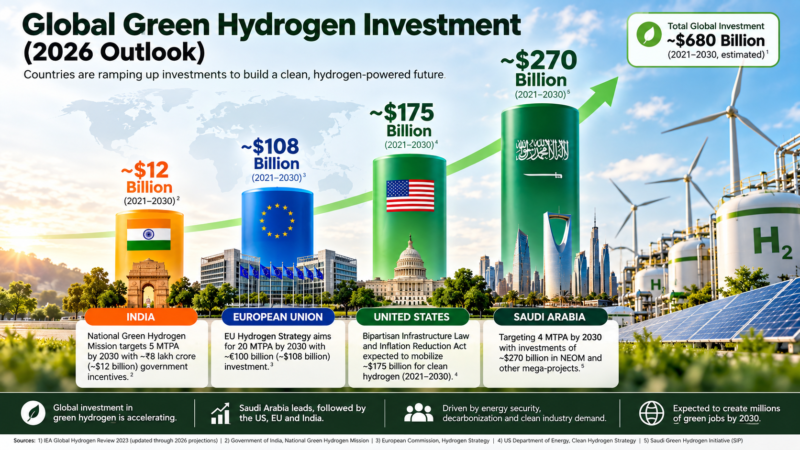
Let’s look at where the world actually stands right now:
Global Capacity:
As of 2024, global electrolyzer capacity for green hydrogen stands at roughly 1.4 GW, but over 520 GW of projects are in various planning and development stages worldwide — a clear signal of massive future scale-up.
India’s National Green Hydrogen Mission:
India launched its National Green Hydrogen Mission with an outlay of ₹19,744 crore (~$2.4 billion), targeting 5 million tonnes of annual green hydrogen production by 2030. This positions India as a potential global export hub, leveraging its abundant solar and wind resources alongside its push for renewable energy expansion.
European Union:
The EU’s REPowerEU plan targets 10 million tonnes of domestic green hydrogen production plus 10 million tonnes of imports by 2030, backed by the European Hydrogen Bank, which has already allocated €3 billion in subsidies through auctions.
United States:
Through the Inflation Reduction Act, the U.S. offers a production tax credit of up to $3 per kilogram for green hydrogen, alongside seven designated Hydrogen Hubs receiving $7 billion in federal funding to accelerate hydrogen production infrastructure.
Middle East:
Saudi Arabia’s NEOM project alone represents a $8.4 billion investment, aiming to produce 600 tonnes per day of green hydrogen once operational, powered entirely by 4 GW of solar and wind energy.
Australia:
Australia aims to become a top-three global hydrogen exporter by 2030, with projects like the Asian Renewable Energy Hub targeting massive scale production for export to Japan and South Korea.
The Cost Challenge: Why Green Hydrogen Isn't Everywhere Yet
Currently, green hydrogen costs between $4-6 per kilogram to produce, compared to $1-2 per kilogram for grey hydrogen made from fossil fuels. This price gap is the single biggest barrier to widespread adoption.
However, BloombergNEF projects that green hydrogen costs could fall to $1-2 per kilogram by 2030 in regions with cheap renewable electricity, making it cost-competitive with fossil-fuel-based alternatives. This cost reduction hinges on three factors:
- Falling costs of renewable energy (solar and wind prices have dropped over 80% in the last decade)
- Economies of scale in electrolyzer manufacturing
- Supportive government policies and subsidies
Real-World Applications Making Headlines
Steel Industry: Swedish company HYBRIT has successfully produced the world’s first fossil-fuel-free steel using green hydrogen instead of coal, a breakthrough many called “the beginning of the end for carbon-intensive steel.”
Shipping: Maersk has ordered vessels capable of running on green methanol derived from green hydrogen, aiming to decarbonize global shipping routes.
Aviation: Airbus is researching hydrogen-powered aircraft, with a target of launching zero-emission commercial flights by 2035.
Transportation: Hydrogen fuel-cell trucks and buses are already operational in Germany, California, and South Korea, offering longer ranges than battery electric vehicles for heavy-duty transport.
Challenges Still Standing in the Way
Despite the optimism, green hydrogen faces real hurdles:
Infrastructure Gap: Pipelines, storage tanks, and refueling stations for hydrogen are virtually non-existent compared to oil and gas infrastructure built over a century.
Energy Efficiency Losses: The process of converting electricity to hydrogen and back loses significant energy — roughly 30-40% — making direct electrification more efficient for many applications.
Water Usage: Producing hydrogen requires substantial water resources, raising concerns in water-scarce regions planning large-scale projects.
High Capital Costs: Building electrolyzer facilities and renewable energy capacity simultaneously requires massive upfront investment that many developing nations struggle to secure.
As one energy analyst commented in a recent industry report, “green hydrogen will not replace all fossil fuels overnight — but it will become indispensable wherever direct electrification simply isn’t possible.”
The Road Ahead: What to Expect by 2030
Green hydrogen represents one of the most promising solutions to decarbonize sectors that renewable electricity alone cannot fix. From steel mills in Sweden to shipping routes crossing the Atlantic, from India’s ambitious mission to Saudi Arabia’s desert mega-projects, the momentum behind green hydrogen is undeniable.
While challenges around cost, infrastructure, and efficiency remain, the trajectory is clear: green hydrogen is no longer a futuristic concept — it’s an emerging reality shaping how the world will produce energy, manufacture goods, and move people and products for decades to come.
As global investments accelerate and technology matures, green hydrogen stands poised to become one of the defining stories of the 21st century’s energy transformation.
Conclusion: Why You Should Care About Green Hydrogen Now
Green hydrogen represents one of the most promising solutions to decarbonize sectors that renewable electricity alone cannot fix. From steel mills in Sweden to shipping routes crossing the Atlantic, from India’s ambitious mission to Saudi Arabia’s desert mega-projects, the momentum behind green hydrogen is undeniable.
While challenges around cost, infrastructure, and efficiency remain, the trajectory is clear: green hydrogen is no longer a futuristic concept — it’s an emerging reality shaping how the world will produce energy, manufacture goods, and move people and products for decades to come.
As global investments accelerate and technology matures, green hydrogen stands poised to become one of the defining stories of the 21st century’s energy transformation.
FAQs About Green Hydrogen
Q: Is green hydrogen actually better than regular hydrogen?
A: Yes. Green hydrogen is produced using renewable energy with zero carbon emissions, unlike grey or blue hydrogen, which rely on fossil fuels.
Q: Why is green hydrogen so expensive right now?
A: High electrolyzer costs and limited renewable energy capacity currently make green hydrogen 3-4 times more expensive than fossil-fuel-based hydrogen, though prices are falling rapidly.
Q: Which countries are leading in green hydrogen production?
A: China, India, Germany, Australia, and Saudi Arabia are currently the biggest investors and producers in the global hydrogen economy.
Trusted by 50000+ Customers
Anya Green Energy is a leading solar company and Solar Energy service provider established in 2013. We are recognized by startup India and customer best choice award 2022.
Our Achievements :
Recognized by Startup India.
Purvanchal’s first solar company to operate exclusively with solar products.
Certified by well-known institutions such as MSME, IndiaMart, and Just Dial and many more.
Winner of the Best Customer Choice Award 2022.
Over 50,000 happy customers across India.