Bifacial vs Monofacial Solar Panels: Which Is Better?
Choosing solar panels is no longer simply about selecting the highest wattage available. Buyers today have to consider panel technology, installation conditions, available roof area, expected energy generation and long-term value.
One comparison that frequently creates confusion is bifacial vs monofacial solar panels. Both technologies convert sunlight into electricity, but they interact with sunlight differently.
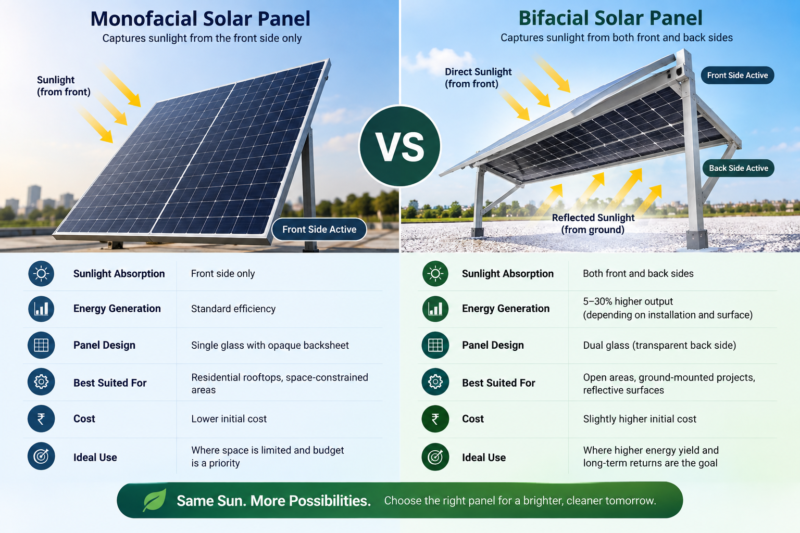
A monofacial module primarily generates electricity from light reaching its front surface. A bifacial module can generate electricity from both its front and rear sides when the installation allows useful light to reach the back of the module.
So, does that automatically make bifacial technology better?
Not necessarily.
The answer depends on where and how the solar system is installed. This guide explains the difference, advantages, limitations, efficiency considerations and practical applications so you can make a more informed decision.
What Are Bifacial Solar Panels?
Bifacial solar panels are photovoltaic modules designed to generate electricity from light reaching both the front and rear sides of the module.
The front receives direct sunlight, while the rear side can capture suitable reflected and scattered light from the surrounding environment. The amount of additional energy generated from the rear depends heavily on system design and site conditions.
For example, a bifacial module installed above a surface that reflects more sunlight can potentially receive more useful rear-side irradiance than the same module installed very close to a dark, non-reflective surface.
This means bifacial technology should be considered as part of the complete solar installation, rather than as an isolated panel feature
What Are Monofacial Solar Panels?
Monofacial solar panels are designed primarily to generate electricity through their front surface.
They remain one of the most straightforward choices for many rooftop and ground-mounted solar applications. Their performance depends on factors such as solar irradiance, orientation, tilt, temperature, shading, module quality and system design.
For conventional rooftop installations where the rear of a module receives little or no useful light, monofacial technology can remain a practical choice.
Bifacial vs Monofacial Solar Panels: The Main Difference
The simplest distinction is how the module uses available sunlight.
| Feature | Bifacial Panels | Monofacial Panels |
|---|---|---|
| Front-side generation | Yes | Yes |
| Rear-side generation | Yes, when conditions permit | Primarily no |
| Dependence on reflected light | Higher | Lower |
| Importance of mounting design | High | Moderate |
| Performance potential from rear irradiance | Possible | Not applicable |
| Suitable applications | Certain rooftops, elevated structures and ground systems | Wide range of conventional installations |
| Site-specific evaluation | Very important | Important |
The important point in the bifacial vs monofacial solar panels comparison is that the rated power of a module does not tell the entire story.
A bifacial module may have the ability to use additional light, but the actual benefit depends on whether that additional light is available at the installation site.
How Do Bifacial Panels Generate More Energy?
The rear side of a bifacial module can receive irradiance reflected from the ground, roof or surrounding surfaces as well as scattered light.
Several factors influence this:
1. Mounting height
The amount of space beneath and around a module can affect how much light reaches its rear surface.
2. Surface reflectivity
A lighter or more reflective surface can provide more reflected light than a dark surface.
3. Row spacing
In ground-mounted systems, the arrangement and spacing of module rows can influence rear-side irradiance.
4. Shading
Objects, structural components and neighbouring rows can reduce the useful light reaching the rear side.
5. System design
Mounting structures, orientation, tilt and site layout all contribute to the actual performance of a bifacial installation.
Therefore, bifacial solar panel efficiency should not be interpreted as a fixed percentage that applies identically to every project.
Bifacial vs Monofacial Solar Panels: Efficiency Comparison
One of the biggest reasons buyers investigate bifacial vs monofacial solar panels is the possibility of higher energy yield.
However, there is an important distinction between module efficiency and system energy yield.
Module efficiency describes how effectively a module converts available solar radiation into electricity under specified test conditions. System energy yield describes how much electricity the installed system actually produces over time.
A bifacial module can benefit from rear-side irradiance, but the additional generation is site-dependent.
This is why comparing panels only on their headline efficiency number can produce a misleading conclusion.
For a real project, the better question is:
How much electricity can each technology realistically generate at this specific site?
That requires considering the roof or ground surface, mounting arrangement, shading, orientation, tilt, available space and other system-design factors.
Advantages of Bifacial Solar Panels
There are several reasons bifacial solar panels are attracting attention in modern solar projects.
Better utilisation of available irradiance
The rear side provides another opportunity to convert useful light into electricity.
Potentially higher energy yield
Where installation conditions are favourable, rear-side generation can increase total electricity production compared with relying only on front-side irradiance.
Useful for suitable elevated installations
Systems with sufficient clearance beneath modules can provide conditions that are more favourable for rear-side light capture.
Strong fit for carefully designed projects
Bifacial technology can be particularly interesting when the site and mounting structure are designed specifically to take advantage of its two-sided generation capability.
Limitations of Bifacial Panels
Bifacial technology is not universally superior.
Its potential benefits can be reduced when the rear side receives very little useful light.
For example, if a module is installed extremely close to an opaque surface, rear-side irradiance may be limited. Similarly, shading from structural components or other modules can affect the rear side.
This is why bifacial solar panel efficiency should always be evaluated in the context of the complete installation.
The technology can also require more careful system design because mounting arrangement, surface conditions and spacing matter more when rear-side generation is part of the business case.
Advantages of Monofacial Solar Panels
Monofacial solar panels continue to make sense for many applications.
Straightforward installation
They are well suited to conventional solar installations where useful rear-side irradiance is limited.
Broad application range
They can be used across residential, commercial and other solar applications, subject to appropriate system design.
Predictable design approach
When the rear surface is not expected to contribute meaningful generation, the system can be designed primarily around front-side solar exposure.
Practical for conventional rooftops
For many rooftops, especially where panels sit close to the roof surface, the additional rear-side opportunity offered by bifacial technology may be limited.
Bifacial vs Monofacial Solar Panel Cost
Cost should never be evaluated only by comparing the purchase price of two modules.
The more useful question is bifacial vs monofacial solar panel cost over the life of the system.
A project evaluation should consider:
- Module purchase price
- Mounting structure
- Installation requirements
- Available roof or ground area
- Expected annual energy generation
- System maintenance
- Site-specific design requirements
- Expected financial return
A bifacial module could potentially generate more electricity in a suitable installation, but if the site does not provide meaningful rear-side irradiance, the additional technology may not deliver the expected advantage.
Similarly, a monofacial system can be highly practical when the installation design does not provide favourable conditions for rear-side generation.
Therefore, do not select a module simply because it is labelled “bifacial.”
Bifacial vs Monofacial Solar Panels for Indian Conditions
India has a wide variety of solar installation environments, from residential rooftops to large commercial and utility-scale projects.
That makes site assessment particularly important.
For a typical residential rooftop, the decision may depend on the roof surface, panel mounting arrangement, available clearance and shading.
For a commercial or ground-mounted installation, factors such as row spacing, ground conditions, mounting height and surface reflectivity may become more important.
This means there is no universal answer to bifacial vs monofacial solar panels for every Indian customer.
The best technology is the one that provides the strongest combination of practical installation, expected generation and project economics for that particular site.
Bifacial vs Monofacial Solar Panels: Which Should You Choose?
Use this simple decision framework.
Choose bifacial when:
- The rear side can receive useful irradiance.
- The mounting arrangement provides suitable clearance.
- The surrounding surface can provide useful reflected light.
- The project design can take advantage of rear-side generation.
- A site-specific assessment supports the additional investment.
Consider monofacial when:
- The rear side receives little useful light.
- Modules are mounted close to an opaque roof surface.
- The installation is designed primarily around front-side generation.
- Simplicity and conventional installation are priorities.
- The economic case for bifacial generation is weak at the site.
Ultimately, bifacial vs monofacial solar panels is not a competition where one technology wins everywhere.
The correct choice depends on the interaction between the module and the installation environment.
What Should You Check Before Buying Solar Panels?
Before choosing between the two technologies, ask your installer to evaluate:
- Roof or ground conditions
- Available installation area
- Orientation and tilt
- Shading
- Mounting height
- Surface reflectivity
- Expected annual generation
- Complete system cost
- Warranty and product documentation
- Long-term maintenance requirements
Ask for an energy-generation estimate based on your actual site rather than relying solely on a generic panel comparison.
Final Verdict
The most important lesson from the bifacial vs monofacial solar panels comparison is simple: panel technology should be selected according to the installation, not just the product label.
Bifacial modules can make effective use of rear-side irradiance and may provide additional energy generation where site conditions support it. Monofacial modules, meanwhile, remain a practical and versatile solution for many conventional installations.
If you are planning a solar project, compare the expected energy yield, installation design and overall economics before making the final decision.
A professional site assessment can help determine whether the additional potential of bifacial technology is actually useful for your roof or project.
Frequently Asked Questions
Are bifacial panels better than monofacial panels?
Not in every installation. Bifacial modules can provide additional generation when useful light reaches their rear surface. If the rear side receives little light, their potential advantage may be limited.
What is the main advantage of bifacial solar panels?
Their main advantage is the ability to generate electricity from both sides of the module when installation conditions allow useful rear-side irradiance.
Are monofacial panels still worth buying?
Yes. Monofacial solar panels remain suitable for many residential, commercial and other conventional solar installations, particularly where rear-side light availability is limited.
Are bifacial panels more expensive?
The total project cost depends on the modules, mounting system, installation design and other components. Bifacial vs monofacial solar panel cost should therefore be evaluated at the complete-system level rather than only by module price.
Do bifacial panels work on rooftops?
They can, but the benefit depends heavily on the rooftop surface, mounting arrangement, clearance, shading and rear-side light availability.
How do I choose between bifacial and monofacial panels?
Compare the expected energy generation, site conditions, installation requirements and total project economics. A site-specific assessment is more useful than choosing purely from the panel name.
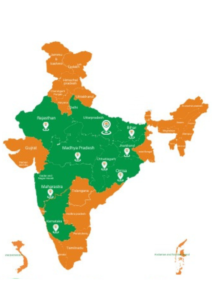
Trusted by 50000+ Customers
Anya Green Energy is a leading solar company and Solar Energy service provider established in 2013. We are recognized by startup India and customer best choice award 2022.
Our Achievements :
Recognized by Startup India.
Purvanchal’s first solar company to operate exclusively with solar products.
Certified by well-known institutions such as MSME, IndiaMart, and Just Dial and many more.
Winner of the Best Customer Choice Award 2022.
Over 50,000 happy customers across India.
Products
-
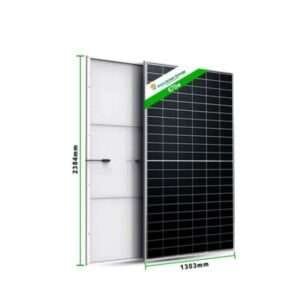 670W MONO PERC HALFCUT SOLAR PANEL
₹26,999.00Original price was: ₹26,999.00.₹23,999.00Current price is: ₹23,999.00. -
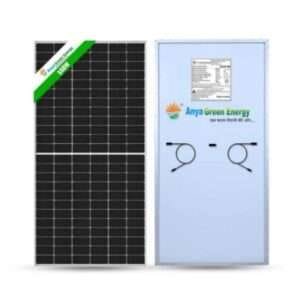 550W MONO PERC HALFCUT SOLAR MODULE
₹22,999.00Original price was: ₹22,999.00.₹19,999.00Current price is: ₹19,999.00. -
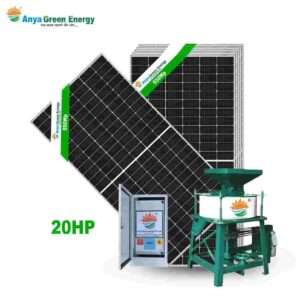 20HP Atta Chakki with Mone Perc Half cut 550W Panel
₹1,200,000.00Original price was: ₹1,200,000.00.₹1,060,000.00Current price is: ₹1,060,000.00. -
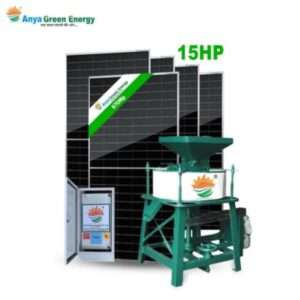 15HP Atta Chakki with Mone Perc Half cut 670W Panel
₹900,000.00Original price was: ₹900,000.00.₹850,000.00Current price is: ₹850,000.00. -
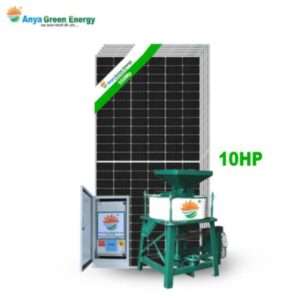 10HP Atta Chakki with Mone Perc Half cut 550W Panel
₹650,000.00Original price was: ₹650,000.00.₹590,000.00Current price is: ₹590,000.00.