
Biogas in 2026: How Turning Waste Into Energy Is Becoming a Serious Clean Energy Bet
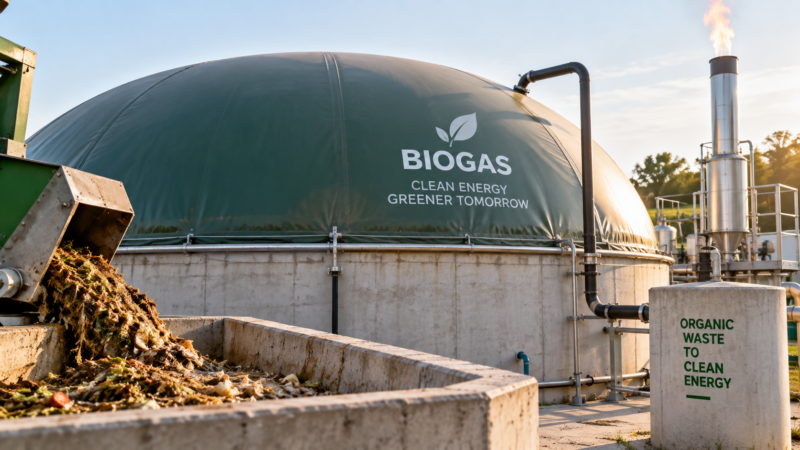
Every day, farms, sewage plants, and landfills across the world quietly produce a gas that could replace a meaningful chunk of the natural gas we import and burn. That gas is biogas — and in 2026, governments are finally treating it as more than a rural curiosity. India just approved a ₹23,731 crore national scheme built almost entirely around it, and globally, only about 5% of the world’s sustainable potential is even being used today.
If you’ve been hearing about compressed biogas, GOBARdhan, or plants that turn cattle dung and food waste into fuel, this guide breaks down what biogas actually is, where the technology stands right now, and why it’s suddenly central to energy security conversations — using the latest 2025–2026 data.
What Is Biogas?
Biogas is a renewable fuel produced when microorganisms break down organic matter — like cattle dung, crop residue, food waste, or sewage sludge — in the absence of oxygen, a process called anaerobic digestion. The gas that comes out is typically 45–75% methane, with the rest mostly carbon dioxide and trace gases.
Raw can be used directly for cooking, heating, or generating electricity. But when it’s purified to remove carbon dioxide, moisture, and other impurities, it becomes biomethane — a near-pure methane stream that’s chemically similar to natural gas. A further-compressed version, known as Compressed Biogas (CBG) or bio-CNG, has methane content above 90% and can be used exactly like CNG in vehicles, homes, and industry.
The core appeal is simple: biogas turns organic waste that would otherwise rot, pollute, or emit methane uncontrolled into a usable, renewable energy source — while also producing a nutrient-rich by-product called bio-slurry that can be used as fertiliser.
Biogas by the Numbers: The Global Picture in 2025–2026
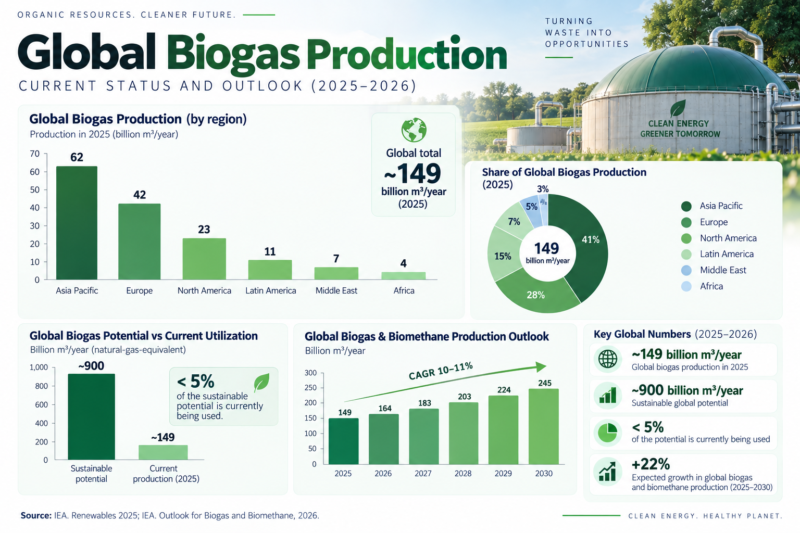
According to the IEA’s Outlook for Biogas and Biomethane, the world is nowhere close to using its full potential — but growth is accelerating fast:
- Today’s sustainable production potential for biomethane globally is nearly 1,000 billion cubic metres of energy (bcme) — roughly a quarter of global natural gas demand — yet only about 5% of that potential is currently being utilised.
- Combined biogas and biomethane production is projected to rise 23% between 2025 and 2030, and by around 80% when only medium- and large-scale projects are considered.
- Europe currently accounts for over 60% of global biogas production, with more than 21,100 anaerobic digestion plants, and Germany alone hosting over 10,000 of them.
- Biogas power plant capacity is expected to grow from 11 GW in 2023 to 20 GW by 2035, while biomethane use in the power sector could roughly triple over the same period.
- China operates more than 100,000 biogas plants, and along with Brazil and India, accounts for 80% of the world’s remaining sustainable biogas potential — with India’s potential alone larger than its entire natural gas consumption.
- The global biogas and biomethane market was valued at close to USD 88 billion in 2025, with steady single-digit annual growth projected through the early 2030s.
The IEA notes that emerging and developing economies — led by China, Brazil, and India — will account for the majority of new production growth going forward, even though Europe and North America still dominate today’s installed capacity.
India's Biogas Story: Betting Big on Waste-to-Energy
India’s journey has had a slow start but is now getting a major policy push. The flagship SATAT scheme, launched in 2018, originally targeted 5,000 compressed biogas plants and 15 million tonnes of annual production by 2023–24. Progress fell well short — as of mid-2026, only around 132–217 plants had actually been commissioned, even though nearly 1,908 CBG plants were registered under the government’s unified GOBARdhan portal.
Recognising the gap, the Union Cabinet approved a much bigger intervention in 2026:
- The GOBARdhan (National Circular Bioenergy) Scheme — a ₹23,731 crore programme running from FY2026–27 to FY2035–36, designed to scale up compressed biogas production through assured offtake, stable pricing, capital support, pipeline connectivity, and easier financing.
- A mandatory CBG Blending Obligation — requiring oil marketing companies to blend compressed biogas into natural gas and transport fuel, scaling from 1% in 2025–26 to 5% by 2028–29, creating guaranteed built-in demand.
- Dedicated infrastructure funding — including ₹564 crore for biomass collection machinery and ₹994 crore to connect biogas plants to the gas pipeline grid.
- Feedstock from a massive base — India’s over 300 million cattle, along with crop residue and municipal solid waste, give the country one of the largest untapped feedstock reserves in the world, and using paddy straw for biogas also offers a direct alternative to stubble burning.
The ambition is significant: India imports close to 85% of its crude oil and around 90% of its LPG passes through the Strait of Hormuz, making domestic biogas production a genuine energy security lever, not just an environmental initiative.
Why Biogas Matters for the Clean Energy Transition
1. Turning a Waste Problem Into an Energy Solution Landfills, farms, and sewage systems already generate organic waste — biogas captures methane that would otherwise escape into the atmosphere (a far more potent greenhouse gas than CO₂) and converts it into usable energy instead.
2. Reducing Fossil Fuel Import Dependence Because compressed b is chemically similar to natural gas, it can directly substitute imported LPG, CNG, and piped natural gas — a major draw for import-dependent economies like India.
3. Supporting Rural Incomes and the Circular Economy Farmers and rural communities can earn income by supplying feedstock like cattle dung and crop residue, while the bio-slurry by-product doubles as organic fertiliser, closing the loop between agriculture and energy.
4. Complementing Other Renewable Energy Sources Unlike solar or wind, biogas can be produced and used on demand, making it a dispatchable renewable energy source that can support grid stability alongside more variable clean energy sources.
5. Cutting Emissions from Stubble Burning and Landfills Redirecting crop residue and municipal waste into biogas plants offers a practical alternative to burning, which is a major contributor to seasonal air pollution in regions like North India.
The Real Challenges Facing Biogas
Biogas has clear advantages, but scaling it up has proven harder than policymakers initially expected:
- Persistent gap between targets and delivery — India’s SATAT scheme aimed for 5,000 plants by 2023 but had only a few hundred operational years later, highlighting how difficult execution has been.
- Feedstock supply chain issues — reliable collection, storage, and quality management of organic waste remains one of the biggest bottlenecks to scaling compressed production.
- High capital costs — installed costs for biogas plants typically range from USD 2,000–5,000 per kW, making financing a challenge, especially for smaller community-scale projects.
- Grid and pipeline infrastructure gaps — connecting plants to the gas distribution network requires significant pipeline investment that many regions still lack.
- Underutilised potential — globally, only about 5% of sustainable biogas potential is being used today, showing how far the sector still has to go despite decades of policy support.
- Competitive pressure from other renewables — falling solar and wind costs mean biogas projects must increasingly prove their unique value in energy security and waste management, not just electricity generates
Biogas's Role in Global Climate Goals
It plays a distinct role in decarbonisation because it addresses two problems at once: it displaces fossil natural gas and reduces methane emissions from decomposing organic waste. The IEA highlights that bio gas and biomethane can also directly reduce environmental damage from waste dispersal, strengthening the case for it beyond simple emissions accounting.
For countries pursuing net-zero targets, it is increasingly framed alongside green hydrogen, wind energy, and hydropower as part of a diversified clean energy mix. India’s push through GOBARdhan sits within its broader National Bioenergy Programme and complements its ethanol blending and green hydrogen missions — all aimed at reducing fossil fuel dependence while supporting its 2070 net-zero
What's Next for Biogas: Trends to Watch
- Mandatory blending obligations take effect — India’s CBG Blending Obligation and similar mandates in countries like France are set to create structural, guaranteed demand for biogas over the next few years.
- A shift toward medium and large-scale plants — growth is expected to be significantly stronger for bigger bio gas and biomethane projects compared to small community-scale units.
- Rising demand from emerging economies — China, Brazil, and India are expected to drive most of the world’s bio gas production growth through 2035, gradually shifting the centre of gravity away from Europe.
- Better feedstock utilisation — as collection and aggregation systems mature, expect more focus on unlocking currently wasted feedstock like crop residue and municipal solid waste.
- Integration with carbon markets — carbon credit economics are increasingly factored into bio gas project financing, particularly for landfill and manure-based projects.
Final Thoughts: Why Biogas Deserves More Attention
It doesn’t get the same attention as solar panels or electric vehicles, but it solves two problems most other renewable energy sources can’t touch at once — waste management and fossil fuel substitution. With the world using only a fraction of its sustainable potential, and countries like India now backing the sector with multi-billion-dollar national schemes, biogas is quietly positioning itself as one of the more practical, dispatchable pieces of the clean energy transition.
As blending mandates take effect and infrastructure investment ramps up over the next few years, its trajectory will say a lot about how seriously countries take the harder, less glamorous parts of the energy transition — the ones involving farms, landfills, and sewage plants rather than rooftops and highways. Understanding how it works, where it’s scaling, and what’s still holding it back is the first step to appreciating why this unglamorous fuel matters more than it gets credit for.
Trusted by 50000+ Customers
Anya Green Energy is a leading solar company and Solar Energy service provider established in 2013. We are recognized by startup India and customer best choice award 2022.
Our Achievements :
Recognized by Startup India.
Purvanchal’s first solar company to operate exclusively with solar products.
Certified by well-known institutions such as MSME, IndiaMart, and Just Dial and many more.
Winner of the Best Customer Choice Award 2022.
Over 50,000 happy customers across India.
Products
-
 670W MONO PERC HALFCUT SOLAR PANEL
₹26,999.00Original price was: ₹26,999.00.₹23,999.00Current price is: ₹23,999.00. -
 550W MONO PERC HALFCUT SOLAR MODULE
₹22,999.00Original price was: ₹22,999.00.₹19,999.00Current price is: ₹19,999.00. -
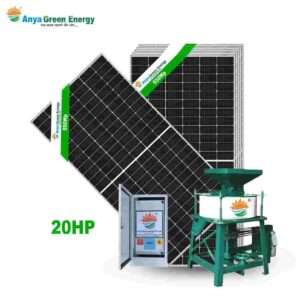 20HP Atta Chakki with Mone Perc Half cut 550W Panel
₹1,200,000.00Original price was: ₹1,200,000.00.₹1,060,000.00Current price is: ₹1,060,000.00. -
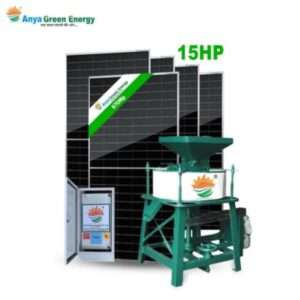 15HP Atta Chakki with Mone Perc Half cut 670W Panel
₹900,000.00Original price was: ₹900,000.00.₹850,000.00Current price is: ₹850,000.00. -
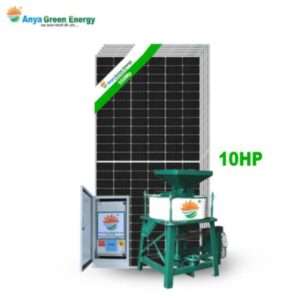 10HP Atta Chakki with Mone Perc Half cut 550W Panel
₹650,000.00Original price was: ₹650,000.00.₹590,000.00Current price is: ₹590,000.00.