Climate Change: Causes, Effects and the Role of Renewable Energy
Have summers started feeling harder to tolerate? Are rainfall patterns becoming less predictable? Are heatwaves, floods, droughts and extreme weather becoming more common topics in everyday conversations?
These questions all point toward a much larger environmental challenge: climate change.
It is often discussed as a problem affecting glaciers, oceans and distant ecosystems. But the reality is much closer to everyday life. The food we eat, the water we depend on, the electricity we consume, the air we breathe and the businesses we operate are all connected to the climate.
And behind much of this conversation lies a fundamental question:
How did we reach this point—and what can we do differently?
The answer begins with understanding how the Earth’s climate works, why human activities are changing it, what consequences we are already seeing and why changing the global energy system has become such an important part of the solution.
What Is Climate Change?
Climate change refers to long-term changes in temperatures and weather patterns.
Earth’s climate has changed naturally throughout its history. However, the current warming trend is fundamentally different because human activity has become the dominant driver of warming since the 1800s, primarily through the burning of coal, oil and natural gas.
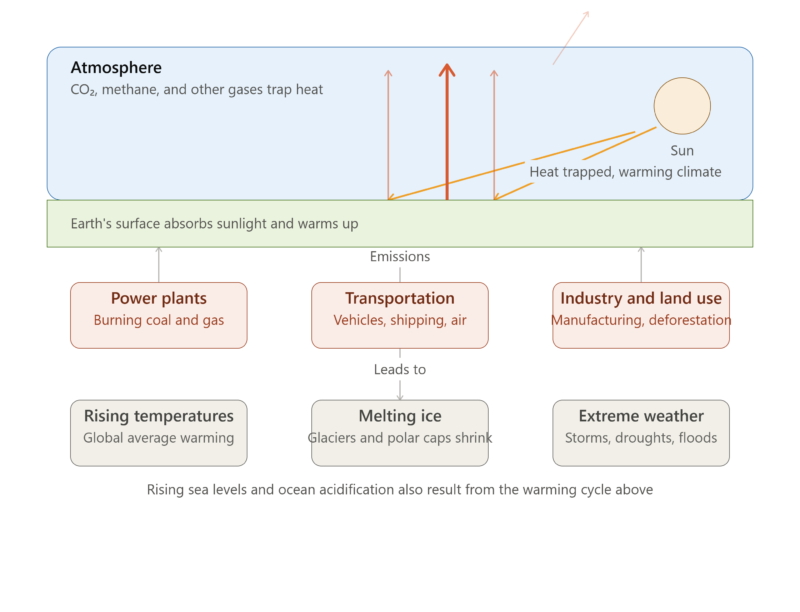
When fossil fuels are burned, they release greenhouse gases, particularly carbon dioxide. Other greenhouse gases, including methane and nitrous oxide, also contribute to warming.
These gases absorb heat in the atmosphere.
Think of the atmosphere as a protective layer around Earth. It naturally keeps some heat from escaping, making the planet warm enough for life. The problem occurs when human activities increase the concentration of greenhouse gases and strengthen this natural greenhouse effect.
As more heat remains within the climate system, temperatures rise and the balance of the atmosphere, oceans, land and ecosystems begins to change.
That is the fundamental science behind climate change.
It is therefore important not to confuse climate change with simply having hotter summers.
A single unusually hot day is weather.
A long-term shift in temperature patterns is climate.
Why Is Climate Change Happening?
To understand the causes of climate change, we need to look at the way modern societies produce energy, manufacture goods, travel, grow food and use land.
The largest contributor is the burning of fossil fuels.
Coal, oil and natural gas have powered industrial development for generations. They provide energy for electricity generation, factories, vehicles, buildings and countless everyday activities.
But burning them also releases greenhouse gases.
According to the United Nations, fossil fuels—coal, oil and gas—remain by far the largest contributor to global greenhouse-gas emissions.
Energy Production Is at the Centre of the Problem
Every time we switch on a light, operate a machine, cool a building or charge a device, we are using electricity.
But electricity does not appear by itself.
It has to be generated.
If that electricity comes from a fossil-fuel-based power plant, generating it can produce significant greenhouse-gas emissions.
This is why energy is at the heart of the climate discussion.
The United Nations describes energy as being at the centre of both the climate challenge and its solution.
And this creates an important opportunity.
If societies can increasingly generate electricity from sources that do not require continuously burning fossil fuels, the emissions associated with electricity generation can be reduced.
That is where renewable energy becomes particularly important
Transport, Industry and Everyday Consumption
Electricity generation is not the only contributor.
Cars, trucks, ships and aircraft consume large amounts of fossil fuels. Manufacturing industries require energy to produce steel, cement, plastics, electronics, textiles and other goods.
Buildings consume electricity and fuel for cooling, heating and other activities.
Agriculture also contributes to greenhouse-gas emissions through livestock, fertilizers, rice cultivation and land-use practices.
Deforestation creates another problem because forests store carbon and naturally absorb carbon dioxide. When forests are cleared, stored carbon can be released while the planet loses part of its natural capacity to absorb emissions.
These interconnected activities explain why the causes of climate change cannot be reduced to one industry or one technology.
It is a system-wide challenge.
And because it is a system-wide challenge, the response also needs to happen across multiple sectors.
What Are the Effects of Climate Change?
The effects of climate change are already being experienced in different parts of the world.
Some changes happen gradually, such as rising average temperatures and sea levels. Others appear through extreme events such as heatwaves, floods, droughts and intense storms.
The impacts also differ from region to region.
For a farmer, changing rainfall can be the biggest concern.
For a city, extreme heat and flooding may be more important.
For a coastal community, rising sea levels can be a major risk.
For a business, climate disruption can affect infrastructure, supply chains, energy demand and operating costs.
Rising Temperatures
One of the clearest indicators is the rise in global temperatures.
The UN reports that the 2015–2024 period was the warmest decade on record.
Higher temperatures can increase heat stress, affect outdoor work and raise demand for cooling.
This has a direct connection with electricity.
When temperatures rise, people often use more fans, air conditioners, refrigeration and cooling systems.
That means hotter conditions can increase electricity demand at precisely the time when energy systems are under greater pressure.
Changing Rainfall and Extreme Weather
A warming climate can alter precipitation patterns and increase risks from certain extreme rainfall events.
Some regions may experience heavier rainfall and flooding, while others face prolonged dry conditions.
This creates uncertainty for agriculture, water management and infrastructure planning.
The UN identifies hotter temperatures, stronger storms, heavier rainfall and flooding among the major climate impacts being observed.
Agriculture and Food Security
Agriculture depends heavily on temperature, rainfall and water availability.
When these conditions change, farmers may face greater uncertainty about planting, irrigation and harvesting.
Heat stress can also affect livestock.
This means climate change can eventually influence something as basic as the food available on our plates.
Water Resources
Water systems are also vulnerable.
Changes in rainfall, evaporation, drought and glacier or snow melt can affect water availability.
Water is required not only for households and agriculture but also for industries and some forms of electricity generation.
Climate and water security are therefore closely connected.
Human Health
The effects of climate change also extend to human health.
Extreme heat can increase heat-related illness. Changing environmental conditions can influence air quality, infectious diseases, food security and access to safe water.
The consequences are particularly serious for vulnerable communities and people whose livelihoods depend on outdoor work.
Ecosystems and Biodiversity
Plants and animals have evolved within particular environmental conditions.
Rapid changes in temperature, rainfall, oceans and habitats can make adaptation difficult for some species.
Ocean warming and acidification can also affect marine ecosystems.
The result is an environmental chain reaction rather than one isolated problem.
The Connection Between Climate Change and Energy
This is the point where the climate conversation becomes particularly relevant to everyday electricity use.
Modern life depends on energy.
Homes need electricity.
Factories need electricity.
Hospitals need electricity.
Schools need electricity.
Agriculture needs electricity.
Businesses need electricity.
The question is therefore not whether society should stop using energy.
The question is:
Can we produce the energy we need with fewer emissions?
That question is driving one of the biggest transformations in the global energy sector.
How Renewable Energy Is Changing the Equation
Renewable energy comes from naturally replenished sources such as sunlight, wind and flowing water.
Unlike fossil fuels, these resources do not need to be extracted and burned every time electricity is generated.
Solar panels use sunlight.
Wind turbines use moving air.
Hydropower uses flowing water.
These technologies have different characteristics and limitations, but they share an important advantage: electricity generation does not depend on continuously burning coal, oil or natural gas.
The United Nations states that renewable energy sources generally generate far lower emissions than fossil fuels and identifies the transition to renewable energy as central to addressing the climate crisis.
This is why the growth of clean energy is not simply an energy-sector trend.
It is also part of the global response to climate change.
Why Solar Energy Is Especially Important
Among the different forms of renewable energy, solar power has a particularly visible role.
The reason is simple:
Sunlight is available almost everywhere.
Solar photovoltaic technology allows sunlight to be converted directly into electricity.
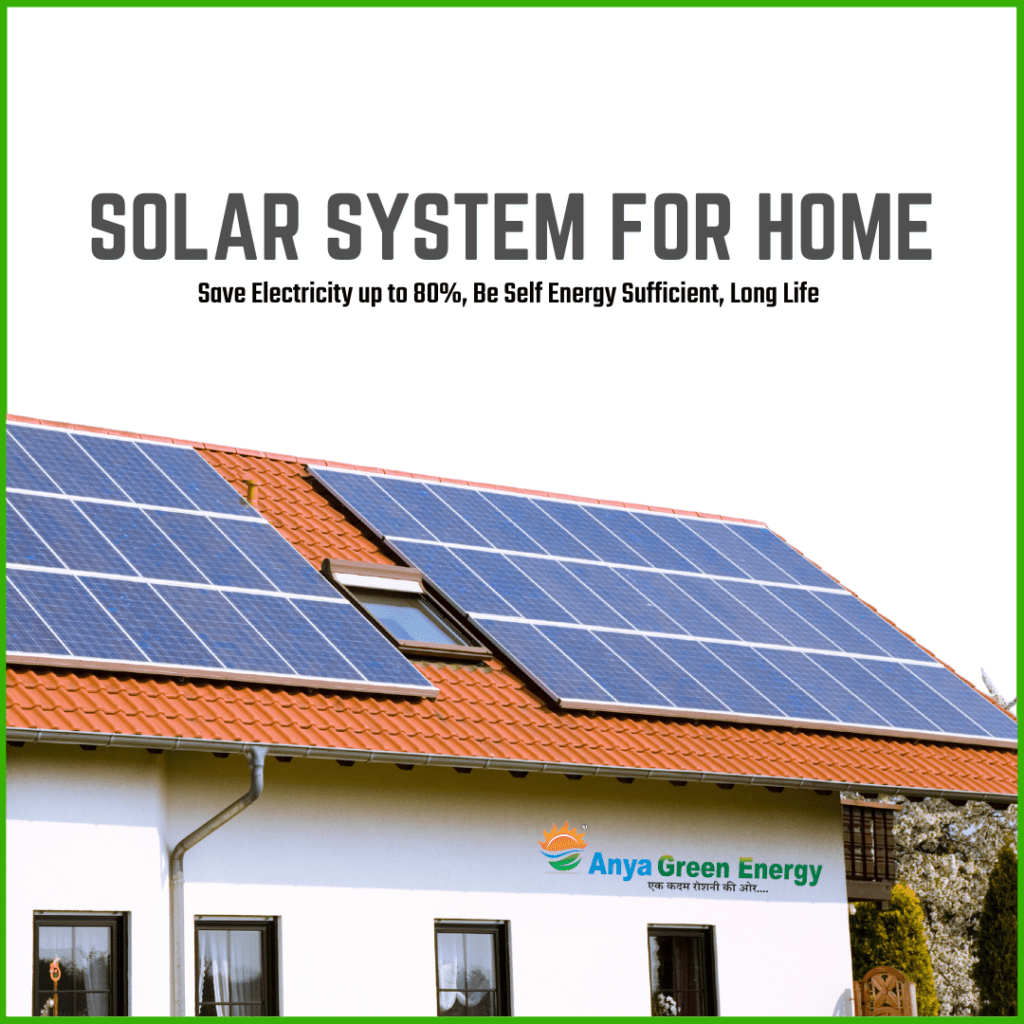
A rooftop solar system can generate electricity at the same location where it is consumed.
That changes the traditional electricity model.
Instead of electricity always travelling from a large power station through transmission and distribution networks to a consumer, a home or business can generate at least part of its electricity locally.
For an Indian household, this could mean using the rooftop as an energy-generating space.
For a business, it can mean integrating solar generation into its broader energy strategy.
For a school or institution, the solar installation can also become a practical demonstration of clean technology.
The environmental value goes beyond the panels themselves.
Every unit of electricity generated from solar can potentially reduce the amount of electricity that would otherwise need to come from other sources, depending on the grid and system configuration.
From Consumers to Energy Producers
One of the most interesting changes brought by renewable energy is the possibility of decentralising electricity generation.
For much of modern history, people have primarily been energy consumers.
A power plant produced electricity.
The grid delivered it.
The consumer used it.
Solar power changes this relationship.
A consumer can also become a producer.
A house can generate electricity.
A factory can generate electricity.
A school can generate electricity.
A commercial building can generate electricity.
This distributed approach is becoming an increasingly important part of the energy transition.
And when combined with battery storage, smart energy management and an increasingly renewable electricity grid, it has the potential to make energy systems more flexible and resilient.
Renewable Energy Is About More Than Climate
The advantages of renewable energy extend beyond reducing greenhouse-gas emissions.
It can also contribute to energy security.
Countries that depend heavily on imported fossil fuels are exposed to international fuel prices and geopolitical disruptions.
Sunlight and wind, by contrast, are naturally available resources.
The UN also highlights renewable energy’s potential to improve energy security, create employment and support economic development.
This makes the clean-energy transition both an environmental opportunity and an economic one.
Solar installers, engineers, manufacturers, maintenance professionals, project developers and other parts of the clean-energy ecosystem can all play a role in this transition.
Can Renewable Energy Solve Climate Change?
This is where it is important to avoid oversimplification.
Renewable energy is essential, but it is not the entire solution.
The climate change solutions required by the world are broader.
Electricity generation needs to become cleaner.
Transport needs to become more efficient and increasingly electrified.
Buildings need better energy efficiency.
Industries need lower-carbon production methods.
Forests and ecosystems need protection.
Agricultural practices need to become more resilient.
And communities need to adapt to climate impacts that are already occurring.
In other words, there is no single switch that will solve the problem.
The transition requires many changes working together.
But transforming the energy system is one of the biggest pieces of that puzzle.
What Can India Do?
India’s energy requirements are closely connected to its economic development.
Homes are becoming more electrified.
Businesses are expanding.
Industries are modernising.
Cities are growing.
Electricity demand is therefore an essential part of India’s future.
At the same time, India has significant solar potential.
This creates an opportunity to increase clean electricity generation while supporting development.
Rooftop solar is particularly interesting because it allows electricity generation to happen close to the point of consumption.
Imagine thousands of homes, shops, offices, schools, factories and institutions using their rooftops to generate electricity.
Individually, each system may seem small.
Collectively, distributed generation can become an important part of a larger energy transition.
This is one reason India’s solar sector has become such an important part of conversations around clean energy.
What Are the Most Practical Climate Change Solutions?
The most effective climate change solutions combine technology, policy, infrastructure and individual action.
Cleaner electricity
Increasing the share of solar, wind, hydropower and other low-emission sources can reduce dependence on fossil-fuel-based electricity.
Energy efficiency
Using less energy to achieve the same result is another important solution.
Efficient appliances, buildings, industrial machinery and lighting can reduce unnecessary energy consumption.
Electrification
Replacing fossil-fuel-based technologies with efficient electric alternatives can reduce direct fossil-fuel use, particularly when electricity generation becomes cleaner.
Cleaner transportation
Public transport, electric mobility, walking, cycling and more efficient vehicles can reduce dependence on petrol and diesel.
Protecting forests
Forests provide carbon storage, biodiversity, water and livelihood benefits.
Protecting them is an essential part of broader climate action.
Climate-resilient infrastructure
Reducing emissions is only one side of the challenge.
Communities also need to prepare for impacts that are already occurring through better water management, urban planning, agriculture and infrastructure.
What Will the Future Energy System Look Like?
The future is unlikely to depend on a single energy technology.
Instead, it will probably involve a combination of solar, wind, hydropower, energy storage, grid infrastructure, electric vehicles, energy-efficient buildings and smarter electricity management.
This is why the renewable transition is better understood as an energy-system transformation.
Solar panels are one part.
Batteries are another.
Smart grids are another.
Electric vehicles are another.
Energy efficiency is another.
Together, these technologies can gradually change how electricity is generated, stored, distributed and consumed.
Why Climate Action Matters Now
The science behind climate change tells us that continued greenhouse-gas emissions increase warming and climate risks.
But climate action does not mean that every problem can be solved immediately.
It means reducing the scale of future damage while preparing communities for changes that are already happening.
The UN notes that limiting warming reduces climate risks and that decisive action today can make future adaptation more effective and less costly.
This gives the energy transition a clear purpose.
Every step toward cleaner electricity reduces dependence on fossil fuels.
Every improvement in efficiency reduces unnecessary energy demand.
Every solar installation demonstrates that electricity can be generated differently.
Every cleaner technology adds another piece to the transition.
Frequently Asked Questions
What is climate change in simple words?
Climate change means long-term changes in Earth’s temperature and weather patterns. Although natural factors influence climate, human activities—particularly fossil-fuel combustion—are the main driver of current warming.
What are the main causes of climate change?
The major causes of climate change include fossil-fuel combustion, electricity and heat generation, transportation, industrial production, agriculture, deforestation and other activities that increase greenhouse-gas concentrations.
What are the major effects of climate change?
The effects of climate change include rising temperatures, heatwaves, changing rainfall patterns, droughts, flooding, stronger weather extremes, sea-level rise and impacts on ecosystems, agriculture and human health.
How does renewable energy help?
Renewable energy such as solar and wind can generate electricity with very low operational greenhouse-gas emissions compared with fossil-fuel combustion. Increasing its share of electricity generation can therefore help reduce power-sector emissions.
Is solar energy a solution to climate change?
Solar energy is an important part of broader climate change solutions because it generates electricity from sunlight without burning fossil fuels during operation. However, climate action also requires changes in transportation, industry, agriculture, land use and energy efficiency.
What can individuals do to reduce their impact?
Individuals can reduce unnecessary energy consumption, improve efficiency, consider suitable renewable-energy options such as rooftop solar, use cleaner transportation where practical and make more sustainable consumption choices.