Off-Grid Solar Systems: The Complete Guide to Powering Your Life Beyond the Grid
There’s a particular kind of freedom in flipping a light switch and knowing the electricity behind it came from your own roof, your own battery bank, and nobody else’s power line. That’s the appeal of going off-grid — no utility bills, no blackouts tied to someone else’s infrastructure, and no dependency on a grid that may not even reach your property.
But off-grid solar system isn’t just “put some panels on the roof and call it a day.” It’s a genuine engineering system, and getting it right means understanding how energy moves from sunlight to the appliance in your kitchen. This guide walks through exactly that — what an off-grid solar system is, how it works, what it costs, and how to figure out if it’s right for you.
What Is an Off-Grid Solar System?
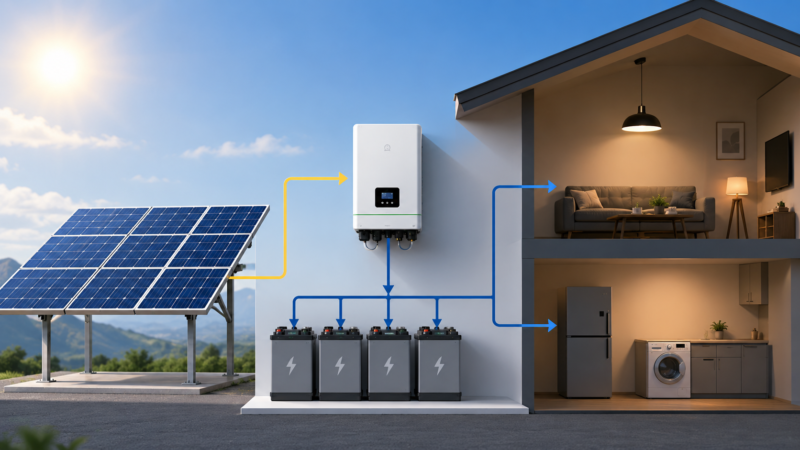
An off-grid solar system is a self-contained power setup that generates, stores, and distributes electricity without any connection to the public utility grid. Unlike grid-tied solar systems — which lean on the grid as a backup and often sell excess power back to the utility — an off-grid system has to stand entirely on its own. Every watt you use has to come from what you generated and stored yourself.
This makes off-grid systems the standard choice for:
- Remote cabins, homesteads, and rural homes with no nearby power lines
- Agricultural operations — irrigation pumps, electric fencing, barns
- RVs, vans, and boats
- Tiny homes and off-the-land living setups
- Telecom towers, weather stations, and remote monitoring equipment
- Areas prone to long grid outages, where energy independence doubles as resilience
The Core Components
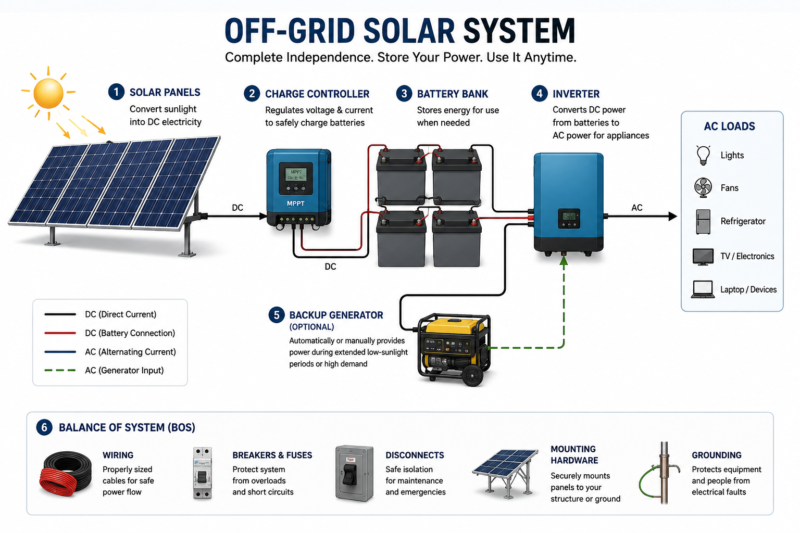
Every off-grid solar system, regardless of size, is built from the same handful of components working together.
1. Solar Panels
These convert sunlight into DC (direct current) electricity through the photovoltaic effect. Panel output is measured in watts, and the total array size is driven by your daily energy needs and the amount of usable sunlight your location gets.
2. Charge Controller
This sits between the panels and the battery bank, regulating voltage and current so the batteries charge properly without being damaged by overcharging. There are two main types:
- PWM (Pulse Width Modulation): Simpler and cheaper, but less efficient — it essentially throttles the panel’s output to match the battery’s needs.
- MPPT (Maximum Power Point Tracking): More sophisticated and efficient, especially in cold weather or partial shade, because it constantly hunts for the panel’s optimal operating point rather than just throttling it.
For anything beyond a small hobby setup, MPPT is almost always worth the extra cost.
3. Battery Bank
This is where the energy gets stored for use at night or on cloudy days — arguably the single most important and most expensive part of the off-grid solar system. The two dominant chemistries are:
- Lead-acid (flooded, AGM, or gel): Lower upfront cost, but shorter lifespan, lower usable capacity (you generally shouldn’t discharge them past 50%), and more maintenance.
- Lithium (typically LiFePO4): Higher upfront cost, but longer lifespan (often 10+ years), deeper safe discharge (80–100%), lighter weight, and less maintenance. Over the system’s life, lithium is often the cheaper option per usable kilowatt-hour.
4. Inverter
Household appliances run on AC (alternating current), but your panels and batteries produce and store DC power. The inverter converts DC to AC. Look for:
- Pure sine wave inverters: Produce clean power compatible with sensitive electronics (laptops, medical equipment, variable-speed motors). This is the standard choice for most home setups.
- Modified sine wave inverters: Cheaper, but can cause issues with certain electronics and appliances.
5. Backup Generator (Optional)
A generator — usually propane, diesel, or gasoline — can step in during extended stretches of low sunlight, letting you build a smaller (and cheaper) battery bank than you’d need to survive entirely on solar and storage alone.
6. Balance of System (BOS)
The unglamorous but essential parts: wiring rated for your system’s voltage and current, breakers and fuses for safety, disconnects, and mounting hardware. Skimping here is one of the most common — and most dangerous — mistakes in DIY installs.
How It All Works Together
The flow of energy through an off-grid solar system follows a consistent path:
- Sunlight hits the solar panels and is converted into DC electricity.
- The charge controller regulates that DC power before it reaches the batteries, protecting them from overcharging.
- The battery bank stores the energy for later use.
- The inverter pulls DC power from the batteries and converts it to AC.
- The AC power runs your household loads — lights, refrigerator, laptop, whatever’s plugged in.
- If sunlight is scarce for an extended period, an optional backup generator can recharge the batteries directly or supply the loads temporarily.
Sizing an Off-Grid Solar System: The Real Work
This is where most off-grid projects succeed or fail. Undersize the system and you’ll be rationing power during a rainy week; oversize it and you’ve overspent on batteries and panels you don’t need.
Step 1: Calculate your daily energy usage. List every appliance you plan to run, its wattage, and how many hours a day you’ll use it. Multiply wattage by hours to get watt-hours (Wh), then add everything up for a daily total.
Step 2: Determine your peak sun hours. This isn’t the same as daylight hours — it’s the number of hours of strong, direct sunlight-equivalent your location receives on average. A location might have 12 hours of daylight but only 4–5 peak sun hours.
Step 3: Size your solar array. Take your daily energy need, divide by peak sun hours, then divide by a system efficiency factor (typically 0.75–0.8 to account for losses in wiring, conversion, and battery charging).
Step 4: Size your battery bank. Decide how many days of “autonomy” you want — how many cloudy days in a row the batteries alone should be able to cover — and size accordingly, keeping your battery chemistry’s safe discharge depth in mind.
Step 5: Size your inverter. This should be based on your peak simultaneous load — the maximum wattage you might draw at any one moment, not just your daily average. If your fridge, well pump, and microwave might all kick on at once, your inverter needs to handle that combined peak.
Advantages of Going Off-Grid Solar System
- Total energy independence — no utility bills, no dependency on grid infrastructure.
- Resilience — power keeps flowing during regional outages, storms, or grid failures.
- Access anywhere — viable in locations where grid connection is impossible or prohibitively expensive.
- Environmental footprint — a clean, renewable power source with low operating emissions.
- Long-term savings — after the upfront investment, ongoing costs are relatively low.
The Trade-Offs
- High upfront cost, particularly for the battery bank.
- Weather and seasonal dependency — output drops with cloud cover, storms, and shorter winter days, requiring careful sizing and, often, some lifestyle adjustment.
- Maintenance responsibility — you’re the utility now. Monitoring, occasional part replacement, and battery care fall on you.
- Battery degradation — even the best batteries lose capacity over years of cycling and will eventually need replacement.
- Sizing risk — get the calculations wrong and you either overspend or run short of power exactly when you need it most.
Is Off-Grid Solar System Right for You?
Off-grid solar system makes the most sense when grid connection is unavailable, unreasonably expensive to extend, or when energy independence and resilience matter more to you than minimizing upfront cost. It’s a serious commitment — both financially and in terms of ongoing attention — but for the right property and the right mindset, it delivers something a grid connection never can: full ownership of your own power.
If you’re seriously considering it, the best next step isn’t buying panels — it’s building an honest, appliance-by-appliance load calculation for your actual home. Everything else in the system, from panel count to battery capacity to inverter rating, flows from that one number.
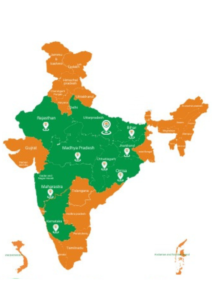
Trusted by 50000+ Customers
Anya Green Energy is a leading solar company and Solar Energy service provider established in 2013. We are recognized by startup India and customer best choice award 2022.
Our Achievements :
Recognized by Startup India.
Purvanchal’s first solar company to operate exclusively with solar products.
Certified by well-known institutions such as MSME, IndiaMart, and Just Dial and many more.
Winner of the Best Customer Choice Award 2022.
Over 50,000 happy customers across India.