Hybrid Solar Systems: The Complete Guide to Getting the Best of Both Worlds
Most homeowners exploring solar face a choice that feels more limited than it should be: stay connected to the grid and lose power the moment the grid does, or go fully off-grid and take on the cost and complexity of running your entire home on batteries. A hybrid solar system exists precisely to remove that trade-off. It keeps your grid connection for reliability and cost savings, while adding battery storage so you’re not left in the dark during an outage — and not fully dependent on the utility either.
This guide breaks down exactly what a hybrid solar system is, how it works, what it costs, and how to figure out whether it’s the right fit for your home
What Is a Hybrid Solar System?
Most homeowners exploring solar face a choice that feels more limited than it should be: stay connected to the grid and lose power the moment the grid does, or go fully off-grid and take on the cost and complexity of running your entire home on batteries. A hybrid solar system exists precisely to remove that trade-off. It keeps your grid connection for reliability and cost savings, while adding battery storage so you’re not left in the dark during an outage — and not fully dependent on the utility either.
This guide breaks down exactly what a hybrid solar system is, how it works, what it costs, and how to figure out whether it’s the right fit for your home.
What Is a Hybrid Solar System?
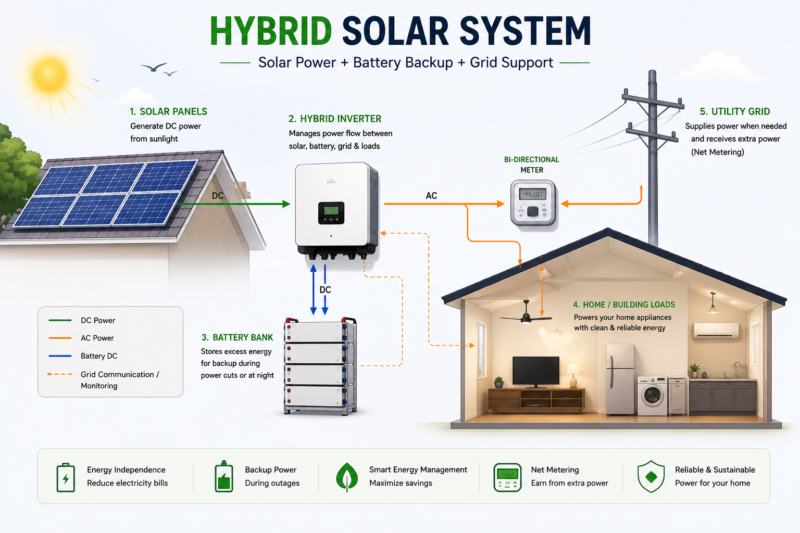
A hybrid solar system combines the two dominant solar setups — grid-tied and off-grid — into a single, more flexible design. Like a grid-tied system, it stays connected to the utility grid, letting you draw power when your panels aren’t producing enough and, in many regions, sell excess power back through net metering. Like an off-grid system, it includes a battery bank that stores solar energy for later use, whether that’s covering your evening usage or keeping the lights on during a blackout.
The result is a system that can automatically choose the cheapest, most reliable power source at any given moment: solar when the sun is out, battery when it’s stored and needed, or grid power when both are insufficient.
This flexibility has made hybrid systems the fastest-growing category of residential solar, particularly in regions with unreliable grid power, high electricity rates, or utility rate structures that reward shifting your usage to certain times of day.
Core Components of a Hybrid System
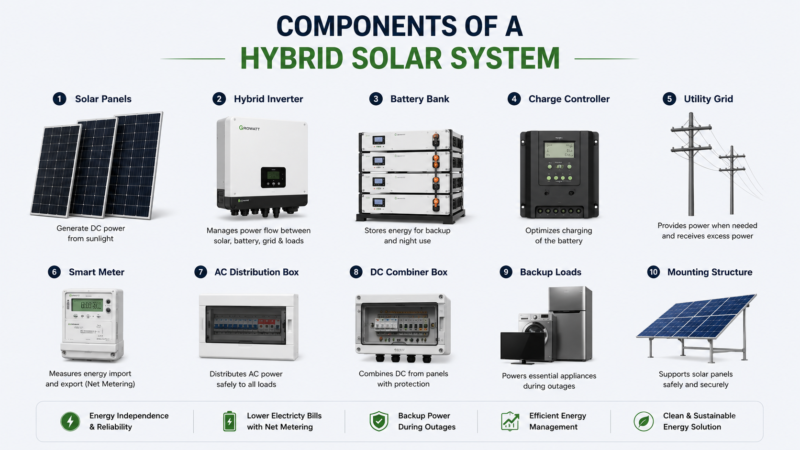
1. Solar Panels
As with any solar setup, panels convert sunlight into DC electricity. Sizing depends on your household’s energy consumption and the sunlight available at your location.
2. Hybrid Inverter
This is the component that sets hybrid systems apart. A hybrid inverter manages power from three sources — solar panels, battery storage, and the grid — routing electricity intelligently based on availability, demand, and your configured preferences. It converts DC power to AC for household use and can also charge the battery bank directly from solar or, in some setups, from the grid during off-peak hours.
3. Battery Bank
The battery stores surplus solar energy for later use. Lithium-based batteries (typically LiFePO4) are the standard choice in modern hybrid systems due to their longer lifespan, deeper safe discharge range, and lower maintenance compared to lead-acid alternatives. Battery capacity is usually sized around how many hours of backup you want during an outage, rather than full multi-day autonomy, since the grid remains available as a fallback.
4. Grid Connection
Unlike an off-grid system, a hybrid setup keeps its utility connection. This provides two key benefits: a backstop if solar and battery power run short, and — depending on local policy — the ability to export excess solar power back to the grid for credit.
5. Automatic Transfer Switch
Many hybrid systems include a transfer switch that detects grid outages and instantly isolates the home from the grid, allowing solar and battery power to continue supplying select circuits safely, without back-feeding power into grid lines during repairs (a critical safety requirement for utility workers).
6. Monitoring and Control System
Most hybrid inverters come with an app or dashboard that lets you monitor real-time energy production, battery state of charge, and grid usage, and often lets you set rules — such as prioritizing battery charging during low utility rate periods.
How a Hybrid Solar System Works
The daily operation of a hybrid system typically follows this logic:
- Solar production comes first. During the day, solar panels generate DC power, which the hybrid inverter converts to AC to directly power your home’s loads.
- Surplus power charges the battery. Once household demand is met, any extra solar energy charges the battery bank rather than going to waste.
- Excess beyond battery capacity goes to the grid. If the battery is full and solar production still exceeds household use, the surplus can be exported to the grid, often earning bill credits through net metering.
- Evening and night usage draws from the battery first. Once the sun goes down, the system pulls stored battery power to run the home, minimizing grid draw.
- The grid fills any remaining gap. If the battery is depleted and solar isn’t producing, the system seamlessly pulls power from the grid, so the household never experiences a shortfall under normal conditions.
- During an outage, the system isolates and switches to backup mode. The transfer switch disconnects from the grid, and the inverter runs the home (or a subset of critical circuits) directly from solar and battery power.
This automatic switching is what makes hybrid systems so appealing for homeowners who want resilience without sacrificing the financial benefits of staying grid-connected.
Sizing a Hybrid System
Sizing a hybrid system involves slightly different math than a pure off-grid setup, because the grid is available as a backstop rather than something you have to design around entirely.
Step 1: Calculate your daily and peak energy usage, just as you would for any solar system — total watt-hours per day, plus your highest simultaneous load.
Step 2: Decide how much backup runtime you want. Rather than sizing for multiple cloudy days, most hybrid battery banks are sized to cover essential loads — refrigeration, lighting, medical equipment, internet — for anywhere from a few hours to a day or two during an outage.
Step 3: Size the solar array around your consumption and export goals. If net metering is favorable in your area, you might size the array larger to maximize exports; if not, you may size it closer to your actual consumption to avoid excess unused production.
Step 4: Match the hybrid inverter’s capacity to your peak load and battery specifications, ensuring it can handle your home’s maximum simultaneous demand as well as the battery’s charge and discharge rates.
Advantages of Hybrid Solar
- Outage protection — battery backup keeps critical circuits running when the grid goes down.
- Lower battery costs than off-grid — since the grid is a backstop, battery banks can be smaller.
- Financial flexibility — potential to earn credits through net metering while also storing power for personal use.
- Smart energy management — many systems let you optimize for utility rate structures, shifting usage to avoid peak pricing.
- A practical middle ground — resilience and independence without the full cost and complexity of going fully off-grid.
The Trade-Offs
- Still grid-dependent — a hybrid system isn’t fully autonomous; extended, region-wide outages can still affect grid-dependent functionality if the battery depletes.
- More complex than grid-tied-only systems — additional components mean more potential points of failure and more nuanced installation requirements.
- Net metering policies vary and can change — some utilities offer generous export credits, others little to none, which directly affects the system’s payback period.
- Battery costs remain significant, even at smaller capacities than off-grid systems require.
Is a Hybrid Solar System Right for You?
A hybrid solar system tends to be the best fit for homeowners who want meaningful protection against outages and lower electricity bills, but who don’t want — or don’t need — to sever their connection to the grid entirely. It’s particularly compelling in areas with frequent but not prolonged outages, favorable net metering programs, or utility rate structures that reward shifting energy use to off-peak hours.
If you’re weighing hybrid against off-grid or grid-tied-only, the deciding factors usually come down to how often and how long your grid experiences outages, what net metering looks like in your area, and how much you’re willing to invest upfront for the added resilience a battery provides.
Curious whether a hybrid system makes sense for your home? Share your typical usage, local outage frequency, and net metering policy, and a tailored sizing and cost estimate can be worked out from there.
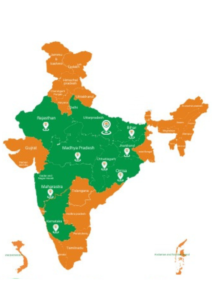
Trusted by 50000+ Customers
Anya Green Energy is a leading solar company and Solar Energy service provider established in 2013. We are recognized by startup India and customer best choice award 2022.
Our Achievements :
Recognized by Startup India.
Purvanchal’s first solar company to operate exclusively with solar products.
Certified by well-known institutions such as MSME, IndiaMart, and Just Dial and many more.
Winner of the Best Customer Choice Award 2022.
Over 50,000 happy customers across India.