Gujarat Green Hydrogen Policy: Goals, Incentives & Future Outlook
While the world debates how to decarbonize heavy industry, one Indian state has quietly positioned itself as a frontrunner in answering that question. Gujarat — already India’s renewable energy powerhouse — has rolled out one of the most comprehensive state-level frameworks for clean fuel production in the country. As one industry commentator put it, “if India wants to become a global hydrogen export hub, the road runs directly through Gujarat.” That ambition is precisely what the Gujarat Green Hydrogen Policy is designed to deliver.
In this blog, we’ll unpack what the Gujarat Green Hydrogen Policy actually contains, the incentives it offers, the infrastructure being built around it, and why this policy could define India’s clean hydrogen trajectory for the next decade.
Why Gujarat? The Natural Advantage
Gujarat isn’t a random choice for hosting India’s most aggressive hydrogen framework. The state already leads the country in renewable energy capacity, with over 20 GW of installed solar and wind power, a 1,600 km coastline ideal for port-based export infrastructure, and an established industrial base in chemicals, petrochemicals, and fertilizers — sectors that are among the largest potential consumers of green hydrogen.
This combination of abundant renewable energy, port connectivity, and industrial demand is exactly why the Gujarat Green Hydrogen Policy was designed to capitalize on existing strengths rather than build an ecosystem from scratch.
Key Highlights of the Gujarat Green Hydrogen Policy
Policy Timeline and Scope
The Gujarat Green Hydrogen Policy was notified to align directly with India’s National Green Hydrogen Mission, which targets 5 million tonnes of annual production nationally by 2030. Gujarat aims to capture a significant share of this target, positioning itself as the country’s leading hydrogen production hub.
Land Allocation
One of the standout features of the policy is dedicated land allocation for green hydrogen and derivative projects, particularly in coastal districts like Kutch, where vast tracts of wasteland are being converted into renewable energy and electrolyzer manufacturing zones. This addresses one of the biggest bottlenecks facing green hydrogen projects nationally — land acquisition delays.
Banking of Renewable Power
The policy allows project developers to “bank” surplus renewable energy generated from captcaptive solar or wind plants for up to one year, drawing it back when needed for electrolysis. This flexibility is critical since renewable generation is intermittent, while hydrogen production ideally requires a steady power supply.
Waiver on Transmission Charges
Under the Gujarat Green Hydrogen Policy, developers are granted exemptions from inter-state and intra-state transmission charges for renewable power used in hydrogen production for a defined period, significantly reducing operational costs for early movers.
Water Allocation for Electrolysis
Recognizing that hydrogen production through electrolysis requires substantial water resources, the policy guarantees assured water allocation from state sources for approved projects — a critical enabler given Gujarat’s partially arid geography.
Economic Impact and Investment Goals
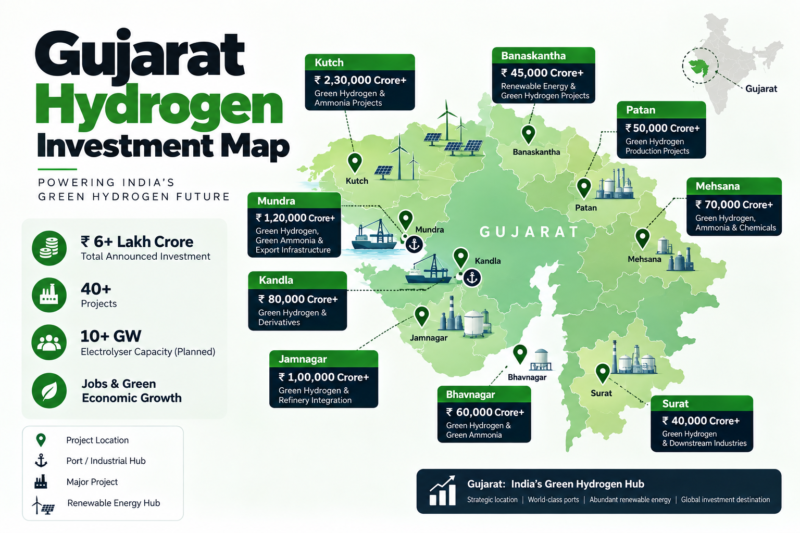
The Gujarat Green Hydrogen Policy has already attracted significant investor interest. Major companies including Adani New Industries, Reliance Industries, and Torrent Power have announced large-scale green hydrogen and ammonia projects within the state, with combined committed investments exceeding ₹5 lakh crore (~$60 billion) over the coming decade.
Job Creation Potential:
Industry estimates suggest Gujarat’s green hydrogen ecosystem could create over 100,000 direct and indirect jobs by 2030, spanning electrolyzer manufacturing, renewable energy plant operations, port logistics, and downstream chemical processing.
Export Hub Ambitions:
With Kandla and Mundra ports already handling significant cargo volumes, the state is positioning itself to export green hydrogen derivatives like green ammonia to Japan, South Korea, and European markets — regions actively seeking clean fuel imports as part of their own clean energy transition strategies.
Industrial and Technological Dimension
Gujarat’s existing industrial base gives the Gujarat Green Hydrogen Policy a unique advantage over other state-level frameworks. The state is home to major fertilizer and petrochemical complexes that currently rely on grey hydrogen produced from natural gas. Transitioning even a fraction of this demand to green hydrogen would represent one of the largest decarbonization shifts in Indian industrial history.
Electrolyzer Manufacturing Push:
In parallel with hydrogen production incentives, Gujarat is also attracting electrolyzer manufacturing investments, reducing dependency on imported equipment and supporting India’s broader push toward domestic clean technology manufacturing under the PLI scheme framework.
Green Ammonia and Methanol Projects:
Several approved projects under the policy focus specifically on converting green hydrogen into green ammonia and methanol — easier-to-transport derivatives that are gaining traction as shipping fuel alternatives and fertilizer feedstocks globally.
Environmental and Climate Dimension
Gujarat’s industrial sector is among India’s largest contributors to industrial carbon emissions, making it a logical priority zone for decarbonization. Scaling green hydrogen adoption across fertilizer, refining, and steel sectors within the state could offset several million tonnes of CO2 emissions annually once projects reach full operational capacity.
This directly supports India’s broader climate commitments under the Paris Agreement, while also strengthening the state’s own renewable energy credentials, building on its existing leadership in solar and wind capacity.
Policy and Regulatory Dimension
The Gujarat Green Hydrogen Policy doesn’t operate in isolation — it’s designed to complement the central government’s National Green Hydrogen Mission, which has allocated ₹19,744 crore (~$2.4 billion) nationally. Gujarat’s state-level incentives essentially stack on top of central subsidies, making the state one of the most financially attractive destinations for hydrogen investors in the entire country.
Additionally, the state government has streamlined single-window clearance mechanisms specifically for hydrogen projects, reducing bureaucratic delays that have historically slowed large infrastructure projects in India.
Challenges Facing Implementation
Despite the ambitious framework, the Gujarat Green Hydrogen Policy faces real-world hurdles:
High Capital Costs: Green hydrogen production remains expensive at $4-5 per kilogram, and even with incentives, achieving cost competitiveness with grey hydrogen will take years of scale-up.
Grid and Infrastructure Gaps: While renewable energy capacity is strong, dedicated transmission infrastructure connecting hydrogen production zones to ports and industrial consumers still requires significant buildout.
Water Scarcity Concerns: Despite policy guarantees, Kutch and other proposed project zones face genuine water stress, raising questions about long-term sustainability of water-intensive electrolysis at scale.
Global Demand Uncertainty: Export ambitions depend heavily on international buyers following through on their own hydrogen import commitments, which remain subject to shifting policy priorities in Europe and East Asia.
As one energy sector analyst observed, “Gujarat has built the policy runway — now it’s a question of execution speed matching investor enthusiasm.”
The Road Ahead
Industry projections suggest that if current momentum continues, Gujarat could account for nearly 30-40% of India’s total green hydrogen production capacity by 2030, firmly cementing the Gujarat Green Hydrogen Policy as a model framework that other Indian states are already beginning to replicate.
Continued success will depend on faster project execution, sustained renewable energy capacity additions, and successful commercial agreements with international buyers to absorb planned export volumes.
Conclusion: A Policy Built for the Hydrogen Economy
The Gujarat Green Hydrogen Policy represents a rare example of state-level policy matching the scale of its ambitions with concrete incentives, infrastructure planning, and investor engagement. By leveraging its renewable energy leadership, coastal export access, and established industrial base, Gujarat has positioned itself at the center of India’s clean hydrogen story.
While challenges around cost, water availability, and global demand remain real, the policy’s comprehensive design — from land allocation to transmission waivers — gives Gujarat a genuine head start in India’s race toward a clean energy transition powered by green hydrogen. As execution unfolds over the coming years, Gujarat’s experience will likely serve as the benchmark against which every other Indian state’s hydrogen ambitions are measured.
Ready to switch to Solar?
solar solutions with Anya Green Energy and discover how you can reduce your electricity bills.
Contact UsFAQs
Q: What is the Gujarat Green Hydrogen Policy?
A: It’s a state government framework offering incentives like land allocation, transmission waivers, and water access to accelerate green hydrogen production and investment within Gujarat.
Q: How much investment has the policy attracted?
A: Committed investments from major companies like Adani, Reliance, and Torrent Power exceed ₹5 lakh crore (~$60 billion) over the coming decade.
Q: Why is Gujarat chosen for green hydrogen projects?
A: Gujarat offers abundant renewable energy capacity, a long coastline for exports, and an existing industrial base that can consume hydrogen domestically.
Q: What challenges does the policy face?
A: High production costs, water scarcity in proposed zones, and infrastructure gaps remain key hurdles to full-scale implementation.
Trusted by 50000+ Customers
Anya Green Energy is a leading solar company and Solar Energy service provider established in 2013. We are recognized by startup India and customer best choice award 2022.
Our Achievements :
Recognized by Startup India.
Purvanchal’s first solar company to operate exclusively with solar products.
Certified by well-known institutions such as MSME, IndiaMart, and Just Dial and many more.
Winner of the Best Customer Choice Award 2022.
Over 50,000 happy customers across India.