The Solar Revolution in India: Goals, Growth & What's Next
Fifteen years ago, India generated less than 10 MW of solar power nationwide — barely enough to light up a mid-sized town. Today, that number has crossed 90 GW, and the country is racing toward one of the most ambitious clean energy targets on the planet. This isn’t just growth; it’s a complete transformation of how a nation of 1.4 billion people powers itself. As one energy policy expert recently described it, “what’s happening in India right now isn’t incremental progress — it’s a full-blown solar revolution unfolding in real time.”
The solar revolution in India is being driven by a unique combination of abundant sunshine, falling technology costs, aggressive government policy, and a growing recognition that energy security and climate responsibility must go hand in hand. In this blog, we’ll explore the current data, the government’s goals, the multiple dimensions driving this transformation, and what lies ahead for India’s clean energy future.
Why India Is a Natural Fit for Solar Power
India receives approximately 300 sunny days annually across most regions, with solar irradiance levels among the highest in the world — roughly 4 to 7 kWh per square meter per day. This natural advantage, combined with a rapidly growing energy demand driven by economic growth and urbanization, makes solar an obvious solution rather than just an environmental choice.
Unlike many developed nations that had to retrofit solar onto mature energy grids, India has had the opportunity to build significant portions of its new energy infrastructure solar-first, leapfrogging some of the fossil fuel dependency that characterized earlier industrial economies
Current Data: Where India Stands Today
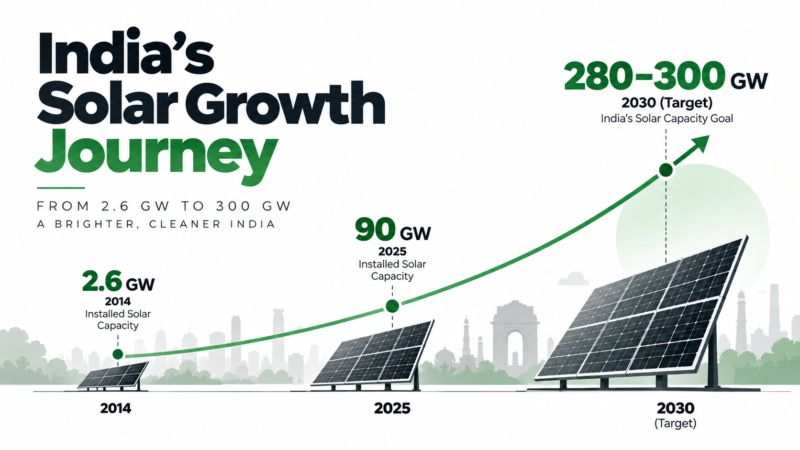
As of early 2025, India’s installed solar power capacity stands at approximately 90 GW, making it the third-largest solar market globally after China and the United States. This represents a staggering increase from just 2.6 GW in 2014 — a 34x growth in roughly a decade.
Breakdown of India’s Solar Capacity:
- Utility-scale solar parks: approximately 65 GW
- Rooftop solar installations: approximately 15 GW
- Off-grid and hybrid solar projects: approximately 10 GW
Renewable Energy Share:
Solar now contributes nearly 20% of India’s total installed power generation capacity, with renewable energy sources overall (solar, wind, hydro, biomass) accounting for over 45% of India’s total energy mix — a dramatic shift from a coal-dominated grid just a decade ago.
India's Ambitious Government Goals
National Solar Mission Origins
The foundation of the solar revolution in India traces back to the Jawaharlal Nehru National Solar Mission, launched in 2010 with an original target of just 20 GW by 2022. That target was achieved four years ahead of schedule, prompting the government to revise its ambitions dramatically upward.
The 2030 Target: 500 GW Non-Fossil Capacity
India has committed to achieving 500 GW of total non-fossil fuel energy capacity by 2030, with solar expected to contribute the lion’s share — targeted at approximately 280-300 GW. This single commitment represents one of the most aggressive clean energy transition timelines among major global economies.
PM Surya Ghar Muft Bijli Yojana
Launched in 2024, this landmark rooftop solar scheme aims to install solar panels on 1 crore (10 million) households by 2026-27, offering subsidies of up to ₹78,000 per household depending on system size. This scheme alone is projected to add over 30 GW of rooftop solar capacity while providing free electricity (up to 300 units monthly) to participating households.
Production Linked Incentive (PLI) Scheme
To reduce dependency on Chinese solar panel imports, the government launched a ₹24,000 crore PLI scheme for high-efficiency solar module manufacturing, aiming to build a fully domestic solar supply chain from polysilicon to finished panels.
Economic Impact of India's Solar Growth
The economic footprint of the solar revolution in India extends far beyond electricity generation. The renewable energy sector has attracted over $15 billion in foreign direct investment over the past five years, with major global players like SoftBank, Total Energies, and Masdar partnering with Indian companies like Adani Green Energy, Tata Power, and ReNew Power.
Job Creation:
The solar sector currently employs over 280,000 people directly in India, spanning manufacturing, installation, operations, and maintenance. Industry projections suggest this figure could exceed 1 million jobs by 2030 as domestic manufacturing scales up under the PLI scheme.
Cost Competitiveness:
Solar tariffs in India have fallen dramatically, from around ₹17 per unit in 2010 to as low as ₹2.0-2.5 per unit in recent competitive auctions — making solar cheaper than coal-based thermal power in most parts of the country. This cost advantage is a primary driver accelerating India’s broader clean energy transition.
Reduced Import Dependency:
India currently imports over 85% of its crude oil requirements, costing billions annually and exposing the economy to global price volatility. Scaling domestic renewable energy production, particularly solar, directly strengthens India’s energy security and reduces this import burden over time.
Ready to switch to Solar?
solar solutions with Anya Green Energy and discover how you can reduce your electricity bills.
Contact UsTechnological Advancements Powering Growth
Domestic Manufacturing Scale-Up
India’s solar module manufacturing capacity has grown from under 3 GW in 2014 to over 50 GW today, with government mandates like the Approved List of Models and Manufacturers (ALMM) requiring government-funded projects to use domestically manufactured panels.
Floating Solar Innovation
Given land constraints in densely populated regions, India has pioneered floating solar installations on reservoirs and water bodies. The Ramagundam Floating Solar Project in Telangana, with 100 MW capacity, exemplifies this approach, while similar projects are being planned across Kerala, Andhra Pradesh, and Madhya Pradesh.
Solar-Wind Hybrid Parks
To address solar’s intermittency, India is increasingly developing hybrid renewable parks combining solar and wind generation at single sites, optimizing land use and grid stability simultaneously. Gujarat’s Kutch region hosts some of the largest hybrid projects in the world.
Battery Storage Integration
Recognizing storage as the next frontier, India’s battery storage capacity is projected to grow from under 1 GWh currently to over 50 GWh by 2030, supported by a dedicated Viability Gap Funding scheme worth ₹3,760 crore specifically for battery storage projects paired with renewable generation.
State-Wise Leaders Driving the Revolution
Lorem ipsum dolor sit amet, consectetur adipiscing elit. Ut elit tellus, luctus nec ullamcorper mattis, pulvinar dapibus
The solar revolution in India isn’t uniform — certain states are emerging as clear frontrunners:
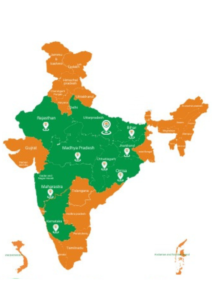
Rajasthan: Home to the Bhadla Solar Park, spanning 14,000 acres with 2,245 MW capacity, making it one of the largest solar installations on Earth. Rajasthan’s vast arid land and high solar irradiance make it India’s solar powerhouse, contributing over 18 GW of total state capacity.
Gujarat: A pioneer in solar policy, Gujarat launched India’s first solar park in Charanka back in 2012 and continues leading in rooftop solar adoption, with over 40% of India’s total rooftop solar installations located within the state.
Karnataka: Home to the Pavagada Solar Park (also called Shakti Sthala), spanning 13,000 acres with 2,050 MW capacity — notable for being built on semi-arid farmland through an innovative land-leasing model that provided steady income to local farmers.
Tamil Nadu: A leader in solar-wind hybrid capacity, leveraging its strong wind resources alongside growing solar installations, particularly in the Ramanathapuram and Tirunelveli districts.
Madhya Pradesh: Home to the Rewa Solar Park, a 750 MW installation that made headlines for supplying power directly to the Delhi Metro, showcasing innovative inter-state renewable energy transmission models.
Environmental and Climate Impact
India’s solar expansion is central to its climate commitments under the Paris Agreement, where the country pledged to reduce emissions intensity by 45% by 2030 compared to 2005 levels, and achieve net-zero emissions by 2070.
Current solar capacity of approximately 90 GW is already offsetting an estimated 100 million tonnes of CO2 emissions annually compared to equivalent coal-based generation. As capacity scales toward the 280-300 GW target by 2030, this offset could exceed 300 million tonnes annually — a substantial contribution to global emissions reduction efforts.
International Solar Alliance:
India co-founded the International Solar Alliance (ISA) alongside France in 2015, now comprising over 120 member countries working collectively to mobilize $1 trillion in solar investments globally by 2030. This positions India not just as a domestic solar leader but as a diplomatic architect of the global clean energy transition.
Real Stories Behind the Numbers
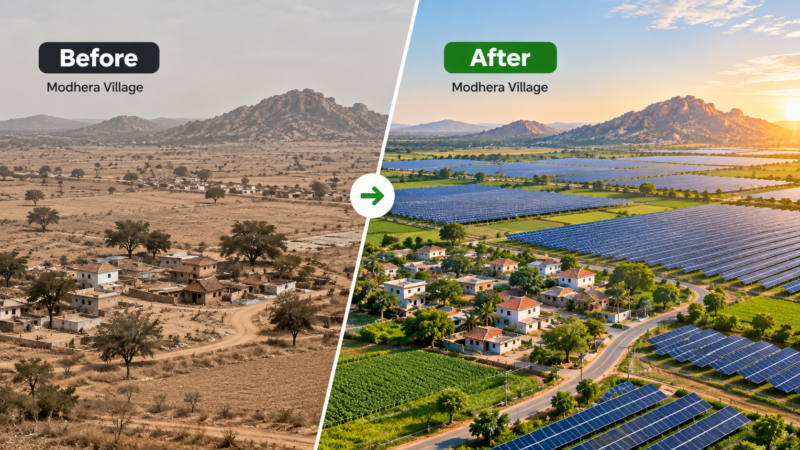
Modhera: India’s First Solar-Powered Village
Located in Gujarat, Modhera became India’s first village to be fully powered by solar energy round the clock, combining rooftop solar installations with battery storage to achieve complete energy self-sufficiency — a model being studied for replication across thousands of other villages.
Cochin International Airport
The world’s first fully solar-powered airport, Cochin International Airport in Kerala, operates entirely on solar energy generated from panels installed across its premises, saving an estimated 300,000 tonnes of carbon emissions over 25 years.
Farmers as Solar Entrepreneurs
Under the PM-KUSUM scheme, farmers across states like Maharashtra, Rajasthan, and Haryana are installing solar pumps and small solar plants on their land, simultaneously reducing diesel dependency for irrigation while earning additional income by selling surplus power back to the grid.
Challenges Facing India's Solar Expansion
Despite the impressive momentum, the solar revolution in India faces genuine obstacles:
Land Acquisition Issues: Utility-scale solar parks require vast tracts of land, often leading to disputes with local communities and competing agricultural interests, particularly in densely populated states.
Grid Infrastructure Gaps: Many high-solar-potential regions, particularly in Rajasthan and Gujarat, lack adequate transmission infrastructure to evacuate power to high-demand urban centers, causing curtailment issues.
Import Dependency on Raw Materials: Despite growing domestic manufacturing, India still imports significant quantities of polysilicon and solar wafers, primarily from China, creating supply chain vulnerabilities.
Financing Challenges for Rooftop Solar: While subsidies have improved affordability, many middle and lower-income households still struggle with upfront costs and awareness gaps regarding financing options for rooftop solar installations.
State-Level Policy Inconsistency: Solar policies, net-metering regulations, and subsidy implementation vary significantly across states, creating confusion and slowing adoption in certain regions compared to others.
As one renewable energy consultant noted in a recent industry analysis, “India has set world-class targets — the real test now is building the grid, financing, and manufacturing ecosystem robust enough to actually deliver them
What Lies Ahead: India's Solar Roadmap to 2030
Industry analysts and government projections suggest several key developments will define the next phase of the solar revolution in India:
- Domestic solar manufacturing capacity will likely exceed 100 GW by 2027, significantly reducing import dependency
- Rooftop solar installations under PM Surya Ghar could make India home to the largest residential solar program globally
- Green hydrogen production, powered substantially by surplus solar capacity, will create new demand for renewable generation beyond grid electricity
- Battery storage costs will continue falling, enabling round-the-clock renewable power supply in more regions
- Inter-state transmission corridors will expand significantly, allowing solar-rich states like Rajasthan and Gujarat to supply power to high-demand states like Delhi, Maharashtra, and Uttar Pradesh
The overarching trajectory is unmistakable: solar is transitioning from being a supplementary energy source to becoming the backbone of India’s entire power generation strategy.
Conclusion: A Revolution Still Gaining Momentum
The solar revolution in India represents one of the most remarkable clean energy transformations happening anywhere in the world today. From a near-negligible 2.6 GW in 2014 to nearly 90 GW today, and an ambitious target of 280-300 GW by 2030, India’s solar journey reflects what’s possible when abundant natural resources meet sustained policy commitment and technological innovation.
This transformation extends far beyond electricity generation — it’s creating jobs, strengthening energy security, empowering farmers, powering villages and airports entirely on sunlight, and positioning India as a global leader in the broader clean energy transition. While challenges around infrastructure, financing, and manufacturing dependency remain real, the trajectory and momentum are undeniable.
As India continues scaling its renewable energy capacity and refining policies to address existing gaps, the solar revolution isn’t just a story about panels and megawatts — it’s a story about a nation reimagining its entire energy future, one sunbeam at a time.
FAQs About the Solar Revolution in India
Q: How much solar capacity does India currently have?
A: As of early 2025, India has approximately 90 GW of installed solar capacity, making it the third-largest solar market in the world.
Q: What is India’s solar energy target for 2030?
A: India aims to achieve 280-300 GW of solar capacity as part of its broader 500 GW non-fossil fuel energy target by 2030.
Q: What is the PM Surya Ghar Yojana?
A: It’s a government scheme launched in 2024 aiming to install rooftop solar on 1 crore households by 2026-27, offering substantial subsidies and free electricity to participants.
Q: Which Indian state has the most solar capacity?
A: Rajasthan currently leads with over 18 GW of installed solar capacity, home to the massive Bhadla Solar Park.
Q: Is India reducing its dependency on solar panel imports?
A: Yes, through the PLI scheme and ALMM mandates, India is rapidly scaling domestic solar manufacturing to reduce reliance on imported panels, primarily from China.
Trusted by 50000+ Customers
Anya Green Energy is a leading solar company and Solar Energy service provider established in 2013. We are recognized by startup India and customer best choice award 2022.
Our Achievements :
Recognized by Startup India.
Purvanchal’s first solar company to operate exclusively with solar products.
Certified by well-known institutions such as MSME, IndiaMart, and Just Dial and many more.
Winner of the Best Customer Choice Award 2022.
Over 50,000 happy customers across India.