Mono PERC vs TOPCon: Which Solar Panel Technology Is Better for India?
You are comparing two solar quotations. One says Mono PERC. The other says TOPCon. Both panels look almost identical from the ground, both convert sunlight into electricity, and both are based on monocrystalline silicon.
So why is one called newer technology? Does TOPCon actually produce more electricity? Is Mono PERC still worth buying? And most importantly, which technology makes more sense for an Indian rooftop?
The answer is not simply “newer is better.”
Understanding the difference between these two technologies can help you make a smarter solar investment—whether you are installing a system at home, running a solar-powered business, planning an industrial project or comparing quotations from different installers.
This guide explains the technology, efficiency, temperature behaviour, degradation, roof-space requirements, cost considerations and practical applications so that you can understand what you are actually paying for.
Mono PERC vs TOPCon: The Quick Answer
Before going into the technical details, here is the simple version.
Mono PERC is a mature P-type monocrystalline cell technology that has been widely used in solar modules for years. It improved on older conventional cell designs by adding rear-surface passivation, helping reduce energy losses and improve efficiency.
TOPCon, or Tunnel Oxide Passivated Contact, is a newer N-type cell architecture. It uses a very thin oxide layer and passivated contact structure to reduce recombination losses and improve the way generated charge is collected.
In a Mono PERC vs TOPCon decision, TOPCon generally has the technical advantage in areas such as achievable efficiency, temperature behaviour and degradation characteristics. But that does not automatically mean every project must use TOPCon.
The right choice depends on:
- Available roof area
- Required system capacity
- Module specifications
- Local climate
- Upfront budget
- Expected operating period
- Application type
- Availability of suitable modules
- Applicable procurement or regulatory requirements
For an Indian solar buyer, the most useful question is therefore not simply “Which panel is better?”
“Which technology gives the best overall value for my particular solar system?”
What Is a Mono PERC Solar Panel?
A Mono PERC solar panel uses monocrystalline silicon cells manufactured using the PERC architecture.
PERC stands for Passivated Emitter and Rear Cell.
The important idea is the rear surface of the solar cell.
When sunlight enters a solar cell, not every photon is immediately converted into usable electrical energy. Some energy can be lost through different physical mechanisms.
PERC technology introduces a passivation layer at the rear of the cell. This helps reduce certain losses and allows some light that would otherwise be lost to interact with the cell again.
That was a major improvement over older conventional solar-cell designs.
The result was a solar technology that offered:
- Higher efficiency
- Better utilisation of available silicon
- Competitive manufacturing economics
- Mature manufacturing processes
- Broad market availability
This is why the Mono PERC solar panel became an important technology in residential, commercial and utility-scale solar.
For many years, it was the practical workhorse of the solar industry.
However, solar technology did not stop developing.
As manufacturers looked for ways to extract more electricity from the same silicon wafer and reduce electrical losses, N-type technologies such as TOPCon became increasingly important.
What Is a TOPCon Solar Panel?
TOPCon stands for Tunnel Oxide Passivated Contact.
Unlike conventional P-type PERC cells, TOPCon is generally based on an N-type silicon architecture.
The key innovation is the passivated contact structure.
A very thin tunnel oxide layer and doped polysilicon contact are used to reduce recombination at the cell contact while still allowing charge carriers to be collected efficiently.
That sounds highly technical, but the practical concept is simple:
Less unwanted electrical loss inside the cell can mean more of the sunlight absorbed by the cell becomes useful electricity.
This is one reason the TOPCon solar panel has become an important next-generation technology in the solar sector.
The technology is particularly interesting when available roof area is limited or when a project is being evaluated over a long operating period.
Mono PERC vs TOPCon: What Is the Fundamental Difference?
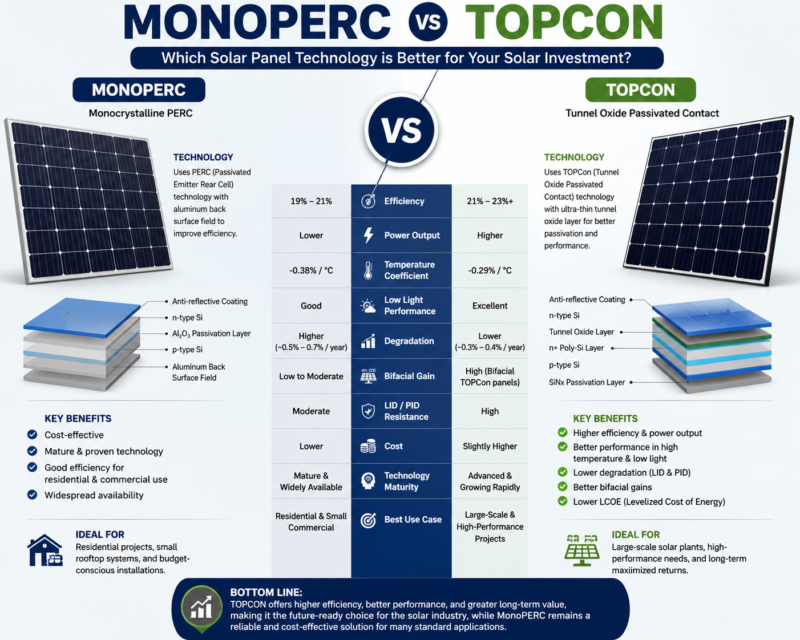
The easiest way to understand the difference is to look at the cell architecture.
| Parameter | Mono PERC | TOPCon |
|---|---|---|
| Silicon architecture | Monocrystalline | Monocrystalline |
| Typical cell type | P-type | N-type |
| Core technology | Passivated Emitter and Rear Cell | Tunnel Oxide Passivated Contact |
| Technology maturity | Highly mature | Newer-generation architecture |
| Main objective | Reduce rear-surface losses | Reduce recombination and contact losses |
| Efficiency potential | Strong | Generally higher |
| High-temperature behaviour | Good | Generally stronger |
| Long-term degradation characteristics | Depends on product | Generally favourable |
| Roof-space advantage | Good | Stronger where high power density matters |
| Best selection method | Compare complete module specifications | Compare complete module specifications |
Why Is TOPCon Considered a Newer Solar Technology?
The solar industry continuously tries to achieve one thing:
Generate more electricity from the same amount of sunlight and physical area.
Higher efficiency means more electrical output can potentially be achieved from the same roof area.
This becomes especially important in Indian cities.
Imagine two buildings with identical roof areas.
If one module technology can deliver greater power from a similar physical footprint, the installer may be able to achieve the required system capacity using fewer modules or make better use of the available roof.
That does not mean the efficiency percentage alone determines annual generation. System design, orientation, shading, temperature, soiling, inverter performance and installation quality also matter.
But cell technology remains an important part of the overall equation.
Mono PERC vs TOPCon: Efficiency Comparison
Efficiency is usually the first number buyers notice.
But it is also one of the most misunderstood numbers.
A panel’s efficiency tells you how effectively it converts the incident solar energy into electricity under defined test conditions.
Higher efficiency can be particularly valuable when roof space is limited.
For example, an urban homeowner may have only a certain usable terrace area after accounting for:
- Water tanks
- Staircases
- Parapet walls
- Shadows
- Maintenance pathways
- Existing structures
In such situations, squeezing more power into the available area becomes valuable.
This is one of the strongest arguments for TOPCon solar panel technology.
Recent Indian market comparisons commonly report higher module-efficiency ranges for TOPCon than conventional Mono PERC, although the exact figure varies significantly by manufacturer and module design. Published 2026 comparisons show the ranges are product-dependent rather than a single universal number.
Therefore, do not choose a panel simply because someone says “TOPCon is more efficient.”
Ask for the actual module datasheet.
Compare:
- Module efficiency
- Rated power
- Dimensions
- Temperature coefficient
- Operating conditions
- Degradation terms
- Warranty
- Certification
- Manufacturer
- Exact model number
That is a much more reliable way to make a solar purchasing decision.
Does Higher Efficiency Mean More Electricity?
Not automatically.
This is an important distinction.
Suppose two modules have different efficiency ratings but are installed under different conditions.
The actual electricity generated by the complete solar system depends on much more than cell efficiency.
Generation is influenced by:
Sunlight × module characteristics × temperature × orientation × shading × soiling × system losses × inverter performance × installation quality
Therefore, when conducting a solar panel technology comparison, efficiency should be treated as one parameter—not the entire decision.
A high-efficiency panel installed poorly can perform worse than a slightly lower-efficiency panel installed correctly.
This is why professional system design matters.
Add Your Heading Text HereMono PERC vs TOPCon in India's Heat
India is a particularly interesting market for solar technology because solar modules operate in demanding outdoor conditions.
A solar module is rated under standard test conditions, but real rooftops can become much hotter than the reference temperature used for rating.
As module temperature increases, electrical output generally falls.
This is where the temperature coefficient becomes important.
The temperature coefficient tells you how the electrical output changes as cell temperature moves away from the reference condition.
A less negative temperature coefficient generally indicates a smaller power reduction for each degree of temperature increase.
Recent comparisons consistently identify a temperature-performance advantage for TOPCon over conventional Mono PERC, although the exact values vary by module model and manufacturer.
For Indian conditions, this matters because solar systems are often exposed to:
- Strong summer sunlight
- High ambient temperatures
- Hot rooftop surfaces
- Dust and soiling
- Seasonal weather changes
So when comparing a Mono PERC solar panel with a TOPCon module, do not look only at the headline wattage.
Check the temperature coefficient on the actual datasheet.
Why Temperature Coefficient Matters to Solar Buyers
Consider a rooftop in Uttar Pradesh during summer.
The module is receiving excellent sunlight, but its operating temperature is much higher than the standard test condition.
If one module loses relatively more output as temperature rises, its real-world power production can be lower than the nameplate rating might suggest.
This is one reason technical buyers increasingly look beyond headline wattage.
A proper TOPCon vs PERC evaluation should therefore include temperature behaviour.
The same principle applies to:
- Rajasthan
- Uttar Pradesh
- Gujarat
- Madhya Pradesh
- Maharashtra
- Telangana
- Bihar
- Delhi-NCR
- Other regions experiencing high summer temperatures
The actual climate and installation environment should always be considered.
Add Your Heading Text HereMono PERC vs TOPCon: What About Degradation?
Solar panels are long-term assets.
They are not normally purchased with a one- or two-year mindset.
A module can continue producing electricity for many years, but its electrical output gradually changes over time.
This is known as degradation.
The exact degradation rate depends on the product, manufacturing quality, materials, operating environment and warranty terms.
TOPCon technology is generally associated with favourable degradation characteristics compared with conventional P-type PERC designs.
This is related partly to the N-type cell architecture and its lower sensitivity to certain degradation mechanisms.
But there is an important buyer lesson here:
Never assume every TOPCon panel has the same degradation rate.
Two modules using the same basic cell technology can have different warranties and performance guarantees.
Always check the manufacturer’s official datasheet and warranty document.
What Is LID and Why Should Solar Buyers Care?
One technical term you may encounter while researching solar panels is LID, or Light-Induced Degradation.
It describes an initial reduction in electrical performance that can occur after solar cells are exposed to light.
N-type technologies such as TOPCon are generally less affected by conventional boron-oxygen-related LID mechanisms associated with P-type silicon.
This can be an advantage when considering long-term module behaviour.
However, solar degradation is not controlled by one mechanism alone.
Other effects can also influence long-term performance.
Therefore, a proper TOPCon solar panel evaluation should consider the complete performance warranty—not just a marketing statement about low degradation.
TOPCon vs PERC: Which Performs Better in Low-Light Conditions?
Solar panels do not operate only at noon on a perfectly clear day.
Real systems experience:
- Morning sunlight
- Evening sunlight
- Hazy conditions
- Clouds
- Monsoon weather
- Winter fog
- Partial cloud cover
TOPCon is frequently positioned as having stronger low-light behaviour, but again, the exact result depends on the module design and manufacturer.
For an accurate TOPCon vs PERC comparison, look at the complete electrical characteristics and independent performance information where available.
Do not treat “better low-light performance” as a guarantee of a fixed percentage increase in annual generation.
Annual energy yield must be modelled for the actual
Bifacial Solar Panels and TOPCon
Another term you may encounter while researching modern solar technology is bifacial.
Bifacial modules can receive light from both the front and rear sides of the module.
This can be particularly relevant for:
- Elevated structures
- Solar sheds
- Industrial rooftops
- Ground-mounted installations
- Areas with reflective surfaces
However, bifacial performance depends heavily on the installation design.
A bifacial module does not automatically produce “double” the electricity.
Rear-side generation depends on factors such as:
- Ground reflectivity
- Module elevation
- Row spacing
- Mounting structure
- Surface conditions
- Sun position
Many modern TOPCon modules are available in bifacial formats, making the technology particularly relevant for commercial and utility-scale solar applications.
Mono PERC vs TOPCon: Frequently Asked Questions
Is TOPCon better than Mono PERC?
TOPCon generally offers advantages in efficiency potential, temperature characteristics and degradation behaviour. However, whether it is the better purchase depends on the module specifications, price difference, roof area and project requirements.
Is Mono PERC still good for solar panels?
Yes. Mono PERC is a mature and widely deployed solar-cell technology. A high-quality Mono PERC module can still be a practical choice when budget and available roof space make it suitable.
Which is better for Indian weather, TOPCon or Mono PERC?
TOPCon generally has favourable temperature characteristics compared with conventional PERC technology, which can be useful in hot Indian conditions. The actual difference depends on the specific module’s temperature coefficient and system design.
Does TOPCon produce more electricity than Mono PERC?
TOPCon can provide higher efficiency and favourable performance characteristics, but actual electricity generation depends on the complete installation, including sunlight, orientation, temperature, shading, soiling, inverter performance and system losses.
Is TOPCon worth the extra cost?
It can be, particularly where roof space is limited or long-term energy yield is important. However, the decision should be based on the actual price premium and the technical specifications of the two modules being compared.
Which solar panel technology should I choose for my home?
Start with your electricity consumption and usable roof area. Then compare module efficiency, temperature coefficient, warranties, degradation terms, manufacturer, compliance requirements and total installed cost before choosing between technologies.
Conclusion: The Smarter Solar Choice Starts With Comparison
The solar industry is moving rapidly toward higher-efficiency cell technologies, but technology names alone should never decide your investment.
Mono PERC has played an important role in making efficient monocrystalline solar technology widely accessible. TOPCon builds on newer N-type cell architecture and offers attractive performance characteristics for modern solar applications.
For an Indian rooftop, however, the best panel is the one that fits the site, budget, roof area and energy requirement.
Before installing solar, compare the complete module datasheet—not just the wattage or the word “TOPCon” printed on a quotation.
Planning a rooftop or commercial solar project? Talk to Anya Green Energy for a site-specific assessment and understand which panel technology fits your requirement before you invest.