Net Metering Application 2026: The Complete Step-by-Step Guide for Rooftop Solar Owners
Thinking about going solar but confused about the paperwork? A net metering application is the single most important document standing between your rooftop panels and a genuinely low electricity bill. Skip it, delay it, or fill it incorrectly, and your solar investment simply won’t pay you back the way it should. This guide breaks down exactly what this process involves, why it matters, and how to get yours approved without the usual back-and-forth with your DISCOM.
Search interest around rooftop solar and solar net metering has climbed steadily as government subsidy schemes have expanded, and most people searching for this topic on Google are stuck at one of three points: they don’t know what documents to arrange, they don’t understand the timeline, or their application has already been rejected once and they don’t know why. This piece is written to solve all three problems in one place, so consider it your one-stop reference for the entire net metering process.
What Is Net Metering, and Why Does the Application Matter So Much?
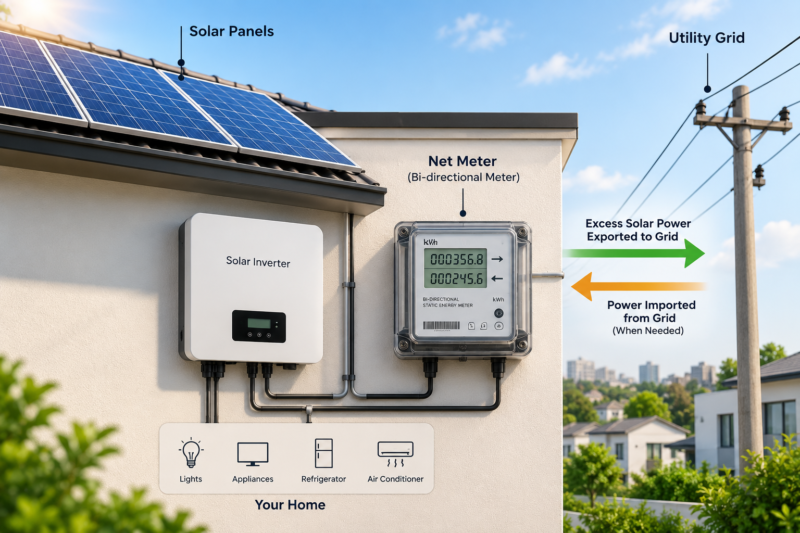
Solar net metering is the billing arrangement that lets a rooftop solar owner send unused electricity back into the grid and get credited for it. Instead of installing an expensive battery to store surplus power, the grid itself acts as your storage bank. When your panels generate more than you use, the extra units flow outward through a bi-directional meter; when your panels generate less than you need (at night, for instance), you draw power back in. At the end of the billing cycle, the utility simply nets the two figures against each other.
None of that happens automatically, though. Your solar panels can be fully installed and working perfectly, but without an approved net metering application, your electricity provider has no legal basis to credit your export or swap your old meter for a bi-directional one. In other words, this paperwork is the administrative bridge between “I have solar panels on my roof” and “I am actually saving money every month.” This is exactly why so many rooftop solar owners treat the application, not the installation, as the real bottleneck.
The Real Benefits of Filing a Net Metering Application
People often assume the benefit of solar net metering is purely financial, and while that’s true, it’s not the whole picture.
- Lower electricity bills: Once your net metering application is approved, every surplus unit you export reduces or wipes out your next bill.
- Faster payback period: A correctly filed application shortens the time it takes for your rooftop solar system to pay for itself, often by several years compared to an off-grid setup.
- Legal grid compliance: Approved solar net metering keeps your rooftop solar connection compliant with your state electricity regulator’s rules, protecting you from penalties or disconnection.
- Subsidy eligibility: Programs like PM Surya Ghar Muft Bijli Yojana require a valid net metering application on file before subsidy funds are released.
- Higher resale value: A property with a documented, approved application is more attractive to buyers who want to inherit the savings, not the paperwork headache.
Documents You Need Before Starting Your Net Metering Application
Every DISCOM has its own form, but the underlying document list for solar net metering is fairly consistent across states:
- Electricity consumer number and a copy of your last three months’ bills
- Proof of property ownership, or a rent agreement with a no-objection certificate from the owner
- A government-issued photo ID (Aadhaar, passport, or voter ID)
- Single-line diagram of the proposed solar installation
- Datasheets for the solar panels and grid-tied inverter, including safety certification numbers
- Site plan showing exactly where panels will sit on the roof
- Your installer’s electrical contractor licence details
- The DISCOM-specific application form itself
Keeping this folder ready before you even contact an installer will shave real time off your net metering process later.
Step-by-Step Net Metering Process
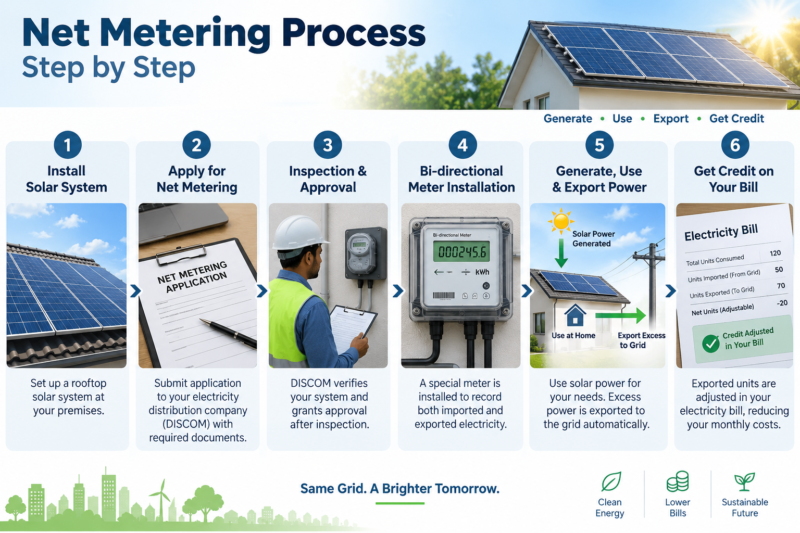
Here’s the general net metering process most Indian states follow, whether you apply directly through your DISCOM or through the national PM Surya Ghar portal.
Step 1: Feasibility Check
Before any panel goes on your roof, submit your application for a feasibility review. The DISCOM checks transformer load, feeder capacity, and whether your system fits within technical limits for your area.
Step 2: Installation
Once feasibility is cleared, have an empanelled installer set up the system. Installing before approval is one of the most common reasons an application gets rejected later, so never skip this order.
Step 3: Commissioning and Inspection Request
After installation, your installer issues a commissioning certificate, and you submit it along with an inspection request as part of the ongoing paperwork.
Step 4: DISCOM Site Inspection
An engineer visits to verify safety earthing, anti-islanding protection, and overall technical compliance before approval can move forward.
Step 5: Bi-Directional Meter Installation
Once inspection is cleared, the DISCOM swaps your existing meter for a net meter, sometimes free of cost, sometimes for a fee ranging from nothing up to a few thousand rupees depending on the state.
Step 6: Agreement and Activation
In many states this final agreement is now digital and bundled directly into the online application form, so there’s no separate paperwork trip required.
PM Surya Ghar and the Net Metering Application
If you’re applying under the PM Surya Ghar Muft Bijli Yojana scheme, your net metering application is automatically routed to your DISCOM the moment you register on the national portal. You’ll still go through consumer registration, vendor selection, installation, and a geo-tagged photo upload, but the portal removes a lot of the manual coordination that used to slow down a standalone solar net metering request. Subsidy disbursement is also tied to this same workflow, so an incomplete or rejected application can delay both your meter swap and your payout.
Typical Timelines (So You Know What “Normal” Looks Like)
Timelines vary widely by state and DISCOM workload, but here’s a rough sense of what to expect once your net metering application is submitted:
| Stage | Typical Timeline |
|---|---|
| Feasibility approval | 7–15 days |
| Installation | Depends on installer scheduling |
| Inspection after request | 7–30 days |
| Meter swap after inspection | 7–30 days |
| End-to-end (fastest states) | As little as 15 days |
| End-to-end (slower DISCOMs) | 60+ days |
If your application has been sitting untouched well beyond your state’s stated SLA, you’re entitled to escalate to the regulator’s grievance cell.
Why Net Metering Applications Get Rejected
Most rejections aren’t about eligibility, they’re about small paperwork mismatches. Common culprits include:
- Installing the system before feasibility approval came through
- Uncertified or non-ALMM-listed panels and inverters
- Mismatched names between the electricity bill, ID proof, and the solar net metering form
- Missing or blurry geo-tagged installation photos
- Site plans that don’t match the actual panel placement
Fixing these before you file, rather than after a rejection, is the single best way to move your net metering process along faster.
Net Metering vs Gross Metering: A Quick Comparison
Some states offer a gross metering option alongside the standard setup, and it’s worth knowing the difference before you file. Under gross metering, every unit you generate is sold to the grid at a fixed feed-in tariff, and you separately buy back every unit you consume at the regular retail rate. Under the arrangement most homeowners choose, only the net difference between what you generate and what you consume gets billed, which is usually more favourable for typical residential usage patterns where consumption and generation roughly overlap during the day.
For most homes and small businesses, the standard billing route works out cheaper because it avoids two separate transactions and keeps the accounting simple: one meter reading, one adjusted bill. Commercial consumers with very high daytime export and low daytime consumption sometimes find the gross option pays more, so it’s worth asking your installer to run both numbers before you decide which form to file with your DISCOM.
Frequently Asked Questions
Do I need a net metering application if I already have solar panels? Yes. Panels alone don’t entitle you to export credit; solar net metering is what formally connects your system to the billing framework.
Can I submit a net metering application without an installer? Technically some portals allow self-filing, but most documents (single-line diagrams, commissioning certificates) require an empanelled installer’s sign-off anyway.
Is there a fee for solar net metering? It depends on your state and system size. Many PM Surya Ghar applicants get the meter and agreement free, while others pay a modest one-time charge.
How long is this application valid before installation must be complete? This varies by DISCOM, but most require installation to be completed within a set window after feasibility approval, often 3 to 6 months.
Final Thoughts
A net metering application isn’t just a form, it’s the piece of paperwork that turns your solar investment into an actual monthly saving. Understand the documents, follow the sequence in order, and treat your DISCOM’s timeline as a floor, not a ceiling, and your paperwork should move through the system without drama. Whether you’re going through a state DISCOM directly or the PM Surya Ghar portal, the fundamentals of a smooth net metering process stay the same: get your paperwork right the first time, and let the grid do the rest.
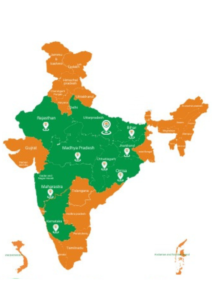
Trusted by 50000+ Customers
Anya Green Energy is a leading solar company and Solar Energy service provider established in 2013. We are recognized by startup India and customer best choice award 2022.
Our Achievements :
Recognized by Startup India.
Purvanchal’s first solar company to operate exclusively with solar products.
Certified by well-known institutions such as MSME, IndiaMart, and Just Dial and many more.
Winner of the Best Customer Choice Award 2022.
Over 50,000 happy customers across India.
Top rated products
-
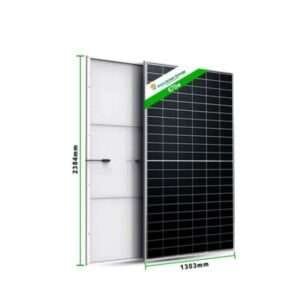 670W MONO PERC HALFCUT SOLAR PANEL
₹26,999.00Original price was: ₹26,999.00.₹23,999.00Current price is: ₹23,999.00. -
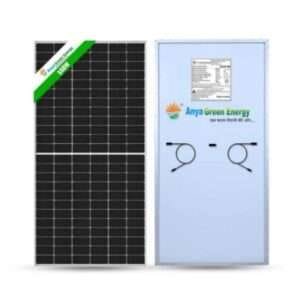 550W MONO PERC HALFCUT SOLAR MODULE
₹22,999.00Original price was: ₹22,999.00.₹19,999.00Current price is: ₹19,999.00. -
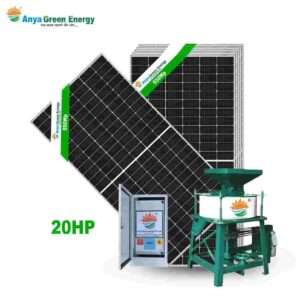 20HP Atta Chakki with Mone Perc Half cut 550W Panel
₹1,200,000.00Original price was: ₹1,200,000.00.₹1,060,000.00Current price is: ₹1,060,000.00. -
 15HP Atta Chakki with Mone Perc Half cut 670W Panel
₹900,000.00Original price was: ₹900,000.00.₹850,000.00Current price is: ₹850,000.00. -
 10HP Atta Chakki with Mone Perc Half cut 550W Panel
₹650,000.00Original price was: ₹650,000.00.₹590,000.00Current price is: ₹590,000.00.