
Solar Inverter Price in India 2026: What You'll Actually Pay by Type, Size & Brand
If you’ve spent even ten minutes researching solar inverter price in India, you already know the frustration: every website quotes a different number, and none of them agree. One page says a 5kW inverter costs ₹28,000. Another insists the same capacity costs ₹1,60,000. Both are technically correct — they’re just talking about different things: different inverter types, different capacities, different brand tiers. This guide breaks it all down so you know exactly what you should expect to pay in 2026 — before and after the PM Surya Ghar subsidy — and why the figure swings so wildly from one quote to the next.
What Actually Decides the Cost?
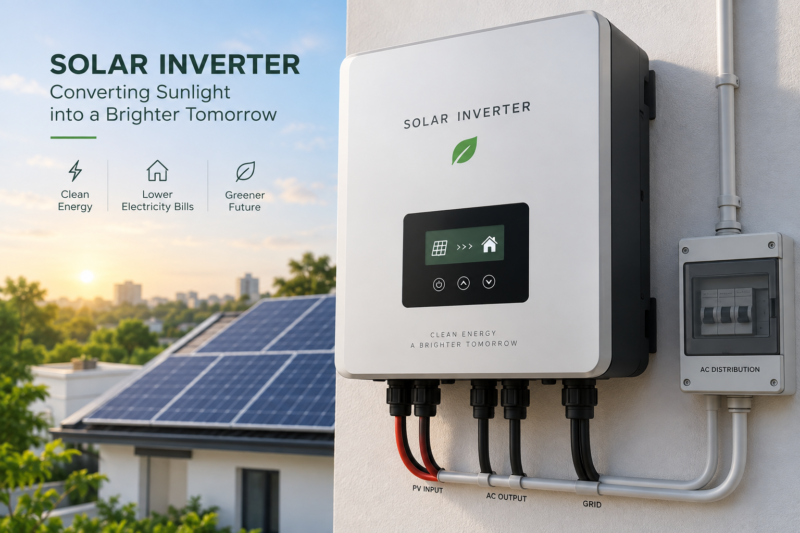
Several things move the needle: inverter type (on-grid, hybrid, or off-grid), capacity in kW, number of MPPT channels, brand tier, and warranty length — with on-grid solar inverter price typically sitting well below the other two categories. A 12% GST applies on top of every quoted number, so always ask whether a figure is inclusive or exclusive of tax before comparing two dealer quotes side by side.
Smart features are another quiet cost driver. Wi-Fi monitoring, remote diagnostics, dual MPPT tracking, and IP65 weatherproofing all add to the sticker price, but they also cut generation losses over the inverter’s lifetime — so the cheapest unit on paper isn’t always the cheapest one over 10 years.
On-Grid Solar Inverter Price: The Budget-Friendly Option
On-grid solar inverter price sits at the lowest end of the market because these units skip battery management hardware entirely — they simply sync with the utility grid and shut down automatically during a power cut for safety. For most urban Indian homes with reliable grid supply and net metering access, this is the default choice, and it’s the segment where price competition is fiercest.
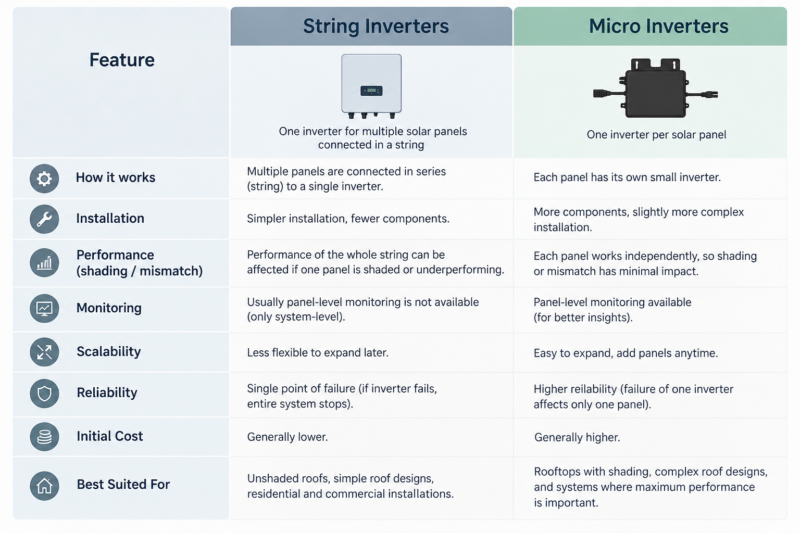
A 3kW on-grid solar inverter price typically falls between ₹18,000 and ₹35,000. A 5kW unit costs ₹17,000 to ₹50,000 depending on brand and MPPT count, while a 10kW commercial-grade unit can run from ₹65,000 up to ₹1.6 Lakh for premium models from Goodwe or Solis. Budget Chinese brands like Growatt and Sofar dominate the entry and mid-tier segments, offering strong value for homeowners who don’t need battery backup — which is exactly why this remains the benchmark most first-time buyers compare everything else against.
Hybrid Solar Inverter Price: Paying for Backup Power
Hybrid solar inverter price sits meaningfully above on-grid pricing because these units include battery charge controllers, backup output circuitry, and — in most cases — dual MPPT inputs. If your area sees frequent outages, this premium buys real peace of mind, and it’s the main reason this segment keeps climbing in search interest year over year.
A 3kW hybrid solar inverter price starts around ₹38,000 for a budget unit. A 5kW hybrid inverter costs anywhere from ₹28,000 to ₹1,60,000 depending on build quality, with basic single-MPPT models around ₹75,000–76,000 and premium dual-MPPT, IP65-rated units reaching ₹1.6 Lakh. At the top end, a 10kW hybrid solar inverter price ranges from ₹95,000 to ₹1.6 Lakh, inverter only — the battery bank is always priced separately, and LFP storage typically adds ₹22,000–28,000 per kWh on top. As a rule of thumb, expect to pay ₹20,000–40,000 above an equivalent on-grid unit at the same capacity.
Off-Grid Inverters for Rural & Backup-Heavy Homes
Off-grid inverters remain the cheapest entry point into solar, starting around ₹4,500–8,000 for small 1kW units. These work independently of the grid and rely entirely on battery storage, making them popular in areas with unreliable power supply — rural homes, shops, and small offices where a stable grid connection isn’t guaranteed. A 5kW off-grid unit generally costs ₹40,000–65,000, positioned between the on-grid and hybrid brackets.
Quick Reference: Cost by Capacity
| Capacity | On-Grid | Hybrid | Off-Grid |
|---|---|---|---|
| 1 kW | ₹8,000–₹15,000 | ₹15,000–₹22,000 | ₹4,500–₹8,000 |
| 3 kW | ₹18,000–₹35,000 | ₹38,000–₹55,000 | ₹15,000–₹25,000 |
| 5 kW | ₹17,000–₹50,000 | ₹60,000–₹1,60,000 | ₹40,000–₹65,000 |
| 10 kW | ₹65,000–₹1.6L | ₹95,000–₹1.6L | ₹1L–₹1.5L |
Solar Inverter Installation Cost: The Number Nobody Warns You About
Here’s where most homeowners get caught off guard. The solar inverter installation cost is a completely different figure from the inverter’s sticker price, and confusing the two leads to serious budget shock. The inverter is just the “box on the wall” — it converts DC to AC. Solar inverter installation cost includes panels, mounting structure, cabling, earthing, protection boxes, labour, DISCOM paperwork, and net-meter commissioning.
In 2026, this total for a full residential system runs roughly ₹52,000–68,000 per kW before subsidy. That means a 3kW system lands between ₹1.8 Lakh and ₹2.4 Lakh all-in, a 5kW system between ₹2.6 Lakh and ₹3.4 Lakh, and a 10kW system between ₹4.8 Lakh and ₹6.2 Lakh — before any subsidy is applied. The inverter itself is typically only ₹25,000 to ₹1.2 Lakh of that total. When you request quotes, always ask for an itemised breakdown that separates the unit’s cost from the rest of the solar inverter installation cost, rather than comparing a bare inverter listing against a bundled system quote. Skipping this step is the single biggest reason estimates feel so inconsistent across websites.
PM Surya Ghar Subsidy: How It Changes the Math
The good news is that the PM Surya Ghar subsidy can cut a large chunk off your effective outlay. Under the PM Surya Ghar Muft Bijli Yojana, the subsidy covers the complete rooftop system — panels and inverter together — when installed through an MNRE-empanelled vendor using ALMM-listed equipment.
Slabs under this scheme currently work out to roughly ₹30,000 for a 1–2kW system and up to ₹78,000–84,000 for a 3–5kW system, credited after installation and net-meter activation. Both on-grid and hybrid systems are eligible, provided the inverter carries ALMM certification — a detail that has become a genuine differentiator in the market since imported, non-listed budget brands lose subsidy eligibility entirely. Before finalising any purchase, confirm ALMM status with your installer, since subsidy figures are revised periodically and vary slightly by state DISCOM.
Why Quoted Numbers Vary So Much Between Websites
By now the pattern should be obvious: listings disagree because they’re measuring different things — inverter-only vs. full system, ex-GST vs. inclusive, budget brand vs. premium European brand like Fronius or SMA. India’s inverter market itself is expanding fast, with the country’s rooftop and utility-scale capacity climbing sharply through 2025–26, which is also why competition among Chinese, Indian, and European manufacturers keeps costs relatively contained despite rising raw material expenses.
Choosing the Right Inverter for Your Budget
A mediocre inverter on premium panels wastes 10–15% of the electricity you paid to generate, so the cheapest option isn’t automatically the best deal. For most Indian homes with stable grid access, an on-grid unit from Growatt, Solis, or Sofar offers the best value, and on-grid solar inverter price remains hard to beat for that use case. For homes battling frequent outages, the extra hybrid solar inverter price premium is usually worth paying. And regardless of which type you choose, always weigh the solar inverter installation cost and PM Surya Ghar subsidy eligibility together with the unit price — because the number on the box is never the number you actually pay.
Frequently Asked Questions
What is the average cost in India in 2026? It ranges from about ₹8,000 for a small 1kW off-grid unit to ₹1.8 Lakh+ for a 10kW+ hybrid or commercial inverter, with most residential 3–5kW buyers paying somewhere between ₹18,000 and ₹1,60,000 depending on type and brand.
Is on-grid or hybrid cheaper? On-grid solar inverter price is consistently lower than hybrid solar inverter price at the same capacity, since hybrid units carry extra battery-management hardware that on-grid models don’t need.
Does the quoted figure include installation? No — solar inverter installation cost is a separate, much larger number that covers panels, structure, cabling, labour, and DISCOM paperwork, not just the inverter unit itself.
Does the PM Surya Ghar subsidy cover the inverter? Yes, the PM Surya Ghar subsidy covers the complete system, inverter included, as long as installation goes through an MNRE-empanelled vendor with ALMM-listed equipment
The Bottom Line
Solar inverter price in India isn’t a single number — it’s a range shaped by type, capacity, brand, and features. On-grid pricing sits at the affordable end, hybrid pricing commands a premium for backup power, and neither number tells the full story until you add in the installation cost and check your eligibility for the government scheme. Get itemised quotes from at least two or three ALMM-listed installers before you commit, and you’ll avoid both the underbudgeting shock and the overpaying trap that catch most first-time solar buyers.

Trusted by 50000+ Customers
Anya Green Energy is a leading solar company and Solar Energy service provider established in 2013. We are recognized by startup India and customer best choice award 2022.
Our Achievements :
Recognized by Startup India.
Purvanchal’s first solar company to operate exclusively with solar products.
Certified by well-known institutions such as MSME, IndiaMart, and Just Dial and many more.
Winner of the Best Customer Choice Award 2022.
Over 50,000 happy customers across India.
Products
-
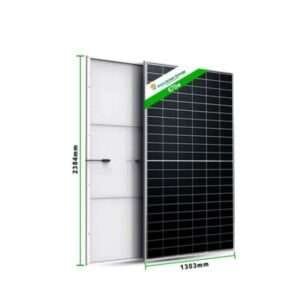 670W MONO PERC HALFCUT SOLAR PANEL
₹26,999.00Original price was: ₹26,999.00.₹23,999.00Current price is: ₹23,999.00. -
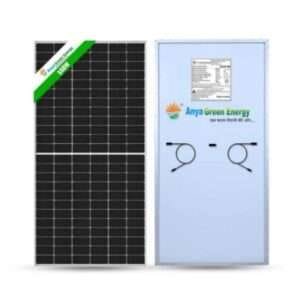 550W MONO PERC HALFCUT SOLAR MODULE
₹22,999.00Original price was: ₹22,999.00.₹19,999.00Current price is: ₹19,999.00. -
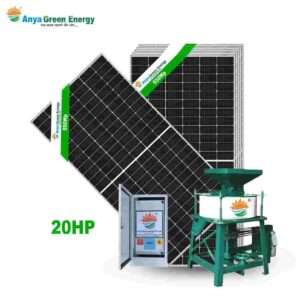 20HP Atta Chakki with Mone Perc Half cut 550W Panel
₹1,200,000.00Original price was: ₹1,200,000.00.₹1,060,000.00Current price is: ₹1,060,000.00. -
 15HP Atta Chakki with Mone Perc Half cut 670W Panel
₹900,000.00Original price was: ₹900,000.00.₹850,000.00Current price is: ₹850,000.00. -
 10HP Atta Chakki with Mone Perc Half cut 550W Panel
₹650,000.00Original price was: ₹650,000.00.₹590,000.00Current price is: ₹590,000.00.