
Waste to Energy in Indian Cities: Turning Urban Municipal Solid Waste into Clean Power
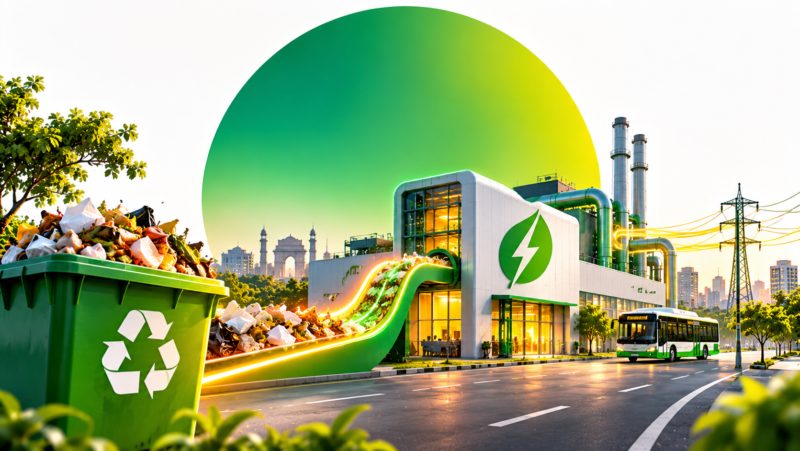
Rapid urbanization across India has created an environmental challenge that municipal corporations struggle to manage daily: the accumulation of urban municipal solid waste. Cities across the country generate thousands of tonnes of garbage every day, most of which ends up in overflowing landfills, creating severe air, soil, and groundwater pollution.
In response to this growing crisis, waste to energy technology has emerged as a promising dual-solution for municipal authorities and clean energy planners alike.
By converting untreated urban municipal solid waste into usable electricity or heat, Indian municipalities can simultaneously reduce landfill burden and generate clean power for urban grids.
Understanding how waste to energy in Indian cities works, its operational economics, and its environmental trade-offs is essential as urban centers seek sustainable waste management pathways over the coming decade.
How Modern Waste to Energy Technologies Work
At its core, waste to energy technology encompasses several distinct thermochemical and biochemical conversion processes designed to process urban municipal solid waste efficiently. The choice of technology depends heavily on the moisture content, organic composition, and calorific value of the incoming municipal solid waste.
Incineration is the most common global method, where sorted dry garbage is burned at high temperatures to produce steam, driving a turbine to generate electricity.
Gasification and pyrolysis are thermochemical alternatives that operate under limited oxygen, converting organic material into a combustible synthesis gas that can be refined into electricity or synthetic fuels.
Biomethanation, a biochemical process, relies on anaerobic digestion to convert wet organic waste into biogas, making it particularly well suited for India’s high-moisture urban waste streams.
As one municipal waste management expert noted during an urban sustainability conference, “there is no single silver-bullet technology for urban waste — the success of waste to energy technology depends entirely on matching the right processing method to the actual waste composition of the city.”
The Scope for Waste to Energy in Indian Cities
The theoretical potential for waste to energy in Indian cities is vast, given the sheer volume of urban municipal solid waste produced across Tier-1 and Tier-2 metropolitan areas every single day. Converting even a fraction of this urban waste into electricity could help cities meet local power demand while clearing decades of accumulated garbage.
Several state capitals and major industrial hubs have launched commercial plants, recognizing that waste to energy in Indian cities addresses two critical urban priorities: land preservation and municipal power generation.
Furthermore, integrating processing facilities near urban industrial zones allows municipal authorities to supply process heat or electricity directly to nearby factories, improving project economics for municipal corporations.
Ready to switch to Solar?
Solar solutions with Anya Green Energy and discover how you can reduce your electricity bills.
Contact UsKey Challenges Facing Indian Waste to Energy Plants
Despite strong policy encouragement under schemes like the Swachh Bharat Mission, operational plants face significant technical and financial hurdles that have slowed widespread adoption across urban centers.
The primary obstacle is waste segregation at source. In most Indian municipalities, dry combustible material, wet organic food waste, inert street sweepings, and construction debris are collected together in a single unsegregated stream.
Unsegregated urban municipal solid waste typically has high moisture content and low calorific value, making direct combustion in waste to energy technology plants inefficient and expensive, requiring auxiliary fossil fuels to maintain burning temperatures.
Operational challenges also include high capital expenditure, frequent plant breakdowns caused by corrosive flue gases, and public opposition regarding emissions and air quality near residential neighborhoods.
Quick Comparison: Waste to Energy Technologies for Indian Cities
| Technology | Ideal Waste Type | Primary Output | Technology Readiness in India |
|---|---|---|---|
| Direct Incineration | Dry, high-calorific dry waste | Electricity (steam turbine) | Widely deployed, struggles with wet waste |
| Biomethanation | Wet organic / food waste | Biogas / Bio-CNG | Proven, highly effective for organic waste |
| Gasification / Pyrolysis | Sorted dry plastic / RDF | Syngas / Synthetic fuel | Pilot to early-commercial stage |
| Refuse-Derived Fuel (RDF) | Segregated combustible waste | Co-processing fuel for cement | Commercialized across industrial hubs |
Policy Support and Government Initiatives
To address operational bottlenecks and improve project bankability, central and state governments have introduced targeted policy support for municipal solid waste processing.
Frameworks established by the Ministry of New and Renewable Energy provide capital subsidies and feed-in tariffs to encourage private sector participation in municipal waste projects.
Power discoms in several states are also mandated to purchase power generated from urban municipal solid waste facilities under specialized tariff structures, providing stable revenue streams for plant operators.
Furthermore, updated Solid Waste Management Rules strictly mandate source segregation by waste generators, laying the regulatory groundwork required for modern waste to energy technology processing facilities to operate efficiently over the long term
Environmental Considerations and Landfill Reduction
The primary environmental benefit of deploying waste to energy in Indian cities is the immediate reduction of land dedicated to open dumping grounds and overflowing landfills.
Legacy landfills like Ghazipur in Delhi or Deonar in Mumbai emit massive quantities of methane, a potent greenhouse gas, while posing severe fire hazards during hot summer months.
Diverting processed garbage away from landfills into controlled processing plants mitigates methane emissions and prevents toxic leachate from contaminating surrounding groundwater resources.
However, environmental advocacy groups emphasize that waste to energy in Indian cities must incorporate advanced flue-gas cleaning systems to prevent dioxin, furan, and heavy metal emissions, ensuring that air quality around urban plants remains safe for neighboring communities.
Step-by-Step Roadmap for Successful Municipal Projects
For municipal corporations and private concessionaires planning sustainable urban processing facilities, implementing a structured project roadmap is essential:
- Mandate source segregation — implement strict two-bin or three-bin collection systems across residential and commercial wards.
- Conduct detailed waste characterization — analyze seasonal moisture content and calorific value before selecting a process design.
- Select appropriate technology — deploy biomethanation for wet organic streams and RDF/incineration for high-calorific dry streams.
- Install advanced pollution controls — equip facilities with continuous emission monitoring systems and multi-stage flue-gas scrubbers.
- Secure long-term power purchase agreements — establish clear tariff structures with state discoms or local industrial consumers.
- Integrate informal waste pickers — incorporate local waste collectors into sorting and material recovery operations to improve segregation efficiency.
Frequently Asked Questions
Q1: What is the main benefit of waste to energy in Indian cities?
A1: The primary benefit is dual-impact: it reduces the severe environmental and land burden of overflowing urban landfills while simultaneously generating renewable electricity or biogas for municipal power grids.
Q2: Why do some plants struggle to operate efficiently in India?
A2: Most plants struggle because incoming garbage is unsegregated. High moisture content and low calorific value in mixed waste make combustion in waste to energy technology facilities inefficient without costly pre-processing or auxiliary fuel.
Q3: What type of waste is best suited for this technology?
A3: Dry, combustible materials like paper, plastic, packaging, and textiles are ideal for thermal conversion, while wet food and organic waste are best processed using biomethanation to produce biogas or Bio-CNG.
Q4: How does processing municipal solid waste help reduce greenhouse gas emissions?
A4: Diverting urban municipal solid waste away from landfills prevents the anaerobic decomposition that generates methane gas, while also replacing fossil-fuel-generated grid electricity with energy recovered from municipal waste streams.
Q5: Is electricity generated from municipal garbage financially viable?
A5: Financially viability depends on long-term power purchase agreements, government capital subsidies, tipping fees paid by municipal corporations, and consistent supply of segregated waste with high calorific value.
Trusted by 50000+ Customers
Anya Green Energy is a leading solar company and Solar Energy service provider established in 2013. We are recognized by startup India and customer best choice award 2022.
Our Achievements :
Recognized by Startup India.
Purvanchal’s first solar company to operate exclusively with solar products.
Certified by well-known institutions such as MSME, IndiaMart, and Just Dial and many more.
Winner of the Best Customer Choice Award 2022.
Over 50,000 happy customers across India.