Group Net Metering in 2026: How One Solar Plant Can Power Many Electricity Bills
If you live in a flat, run a business across several premises, or manage a school with multiple electricity connections, putting solar on your own roof has always had one obvious limitation — you need a roof, and you need it to be yours. This billing mechanism removes that barrier. It lets a single solar plant offset electricity bills across multiple connections belonging to the same consumer, and in 2026, more Indian states than ever are finally putting it into practice.
If you’ve come across the term while researching solar for your housing society, office, or farmland, or seen news of state regulators like Punjab’s PSERC and Gujarat’s GERC notifying new rules this year, this guide breaks down exactly what this arrangement is, how it works, and where it stands today — grounded in current 2025–2026 data.
What Is Group Net Metering?
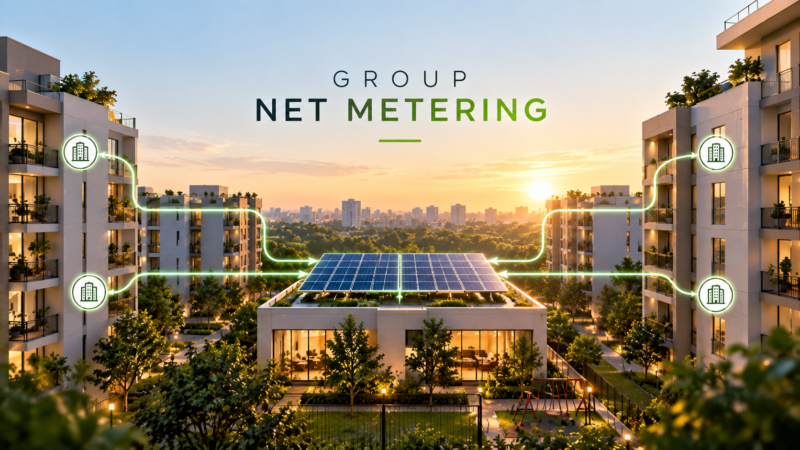
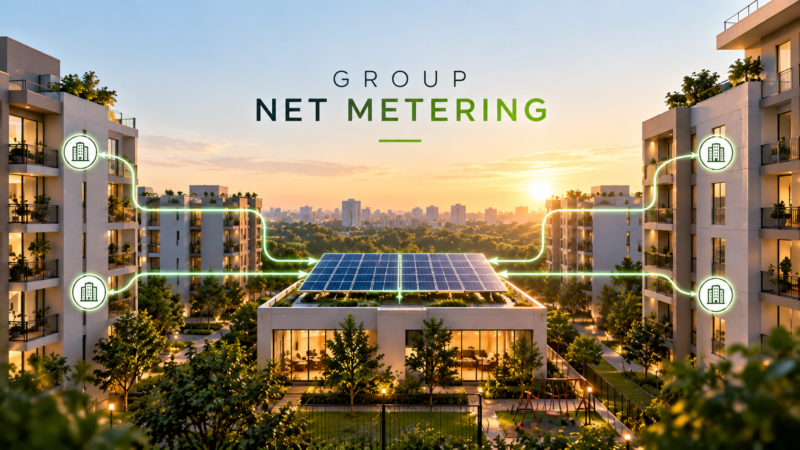
This mechanism is a billing arrangement that allows the surplus electricity generated by one clean power system to be exported to the grid through a net meter and then adjusted across more than one electricity connection — as long as all the connections belong to the same consumer and fall within the same distribution licensee’s area of supply.
In plain terms: if a single owner has a solar plant on one property but multiple electricity connections elsewhere — say a factory owner with several units, a government department with multiple offices, or a farmer with several agricultural connections — this framework lets the solar credits be shared across all of them, rather than being tied to the one meter physically connected to the plant.
It’s often mentioned alongside a related but distinct mechanism, virtual net metering, and the difference matters:
- This model — one consumer, multiple connections, energy exported and adjusted through a net meter.
- Virtual net metering — multiple different consumers (like separate flat owners in a housing society) jointly own or subscribe to one shared solar plant, and credits are notionally split among them via a gross meter, based on a pre-agreed sharing ratio.
- Both mechanisms solve the same underlying problem — not every consumer who wants renewable energy has a suitable rooftop — but they’re designed for different ownership structures.
Group Net Metering by the Numbers: Where India Stands in 2025–2026
The regulatory picture around this mechanism has moved from theory to implementation over the past few years, and 2026 has been an especially active year:
- The Ministry of New and Renewable Energy issued a unified Standard Operating Procedure (SOP) in February 2023 covering Net Metering, Gross Metering, and both shared-solar variants, giving states a common template to notify their own rules.
- As of 2026, Delhi, Odisha, Karnataka, Maharashtra, Rajasthan, Gujarat, Punjab, Jharkhand, Telangana, and Uttar Pradesh have notified or drafted regulations enabling this arrangement or its virtual counterpart, though implementation quality still varies significantly by state.
- Rajasthan’s 2026 amendment allows solar or battery storage projects larger than 1 kW and up to 1 MW to be set up under this framework, with anything above 1 MW shifting to the state’s Green Energy Open Access system.
- Gujarat’s draft DRES Regulations 2026, released by GERC in June 2026, propose expanding project size limits to up to 4 MW for both shared-solar models, compared to 1 MW for standard net metering.
- Punjab’s PSERC notified its third amendment enabling this framework in April 2026, with the mechanism coming into effect from July 1, 2026.
- Nationally, rooftop solar capacity continues to be anchored by the PM Surya Ghar Muft Bijli Yojana, which targets 10 million homes by 2027 and provides subsidies of up to ₹78,000 on a 3 kW residential renewable energy system — a scheme this billing model is increasingly being layered onto for multi-connection consumers.
The common thread across states is that this arrangement, unlike its multi-owner counterpart, is generally reserved for a single consumer with multiple meters — think large industrial houses, government departments, and educational institutions — while ownership across multiple, unrelated consumers falls under a separate framework instead.
How Group Net Metering Actually Works
Most state regulations, following the MNRE’s national SOP, structure this billing arrangement around a few consistent technical rules:
- A single solar (or other clean power) plant is installed at one location owned or leased by the consumer, sized according to the sanctioned load or a defined capacity cap.
- Surplus generation is exported to the grid through a bi-directional or net meter at that location.
- Exported units are proportionately adjusted against consumption recorded at the consumer’s other electricity connections, based on a pre-filed sharing agreement.
- All participating connections must sit within the same distribution licensee’s area, meaning a plant under one DISCOM cannot offset bills for a connection served by a different DISCOM.
- Settlement typically happens on a periodic basis — often monthly or annually — with unused credits either carried forward or lapsing at year-end, depending on the state’s specific rules.
Because this structure keeps ownership within a single consumer entity, the net metering paperwork tends to be simpler than the multi-owner model, which requires a formal beneficiary allocation agreement between multiple, legally distinct participants.
Why Group Net Metering Matters for the Clean Energy Transition
1. Unlocking Solar for Multi-Site Consumers Large consumers — factories, hospital chains, government departments, agricultural landholders — often have far more usable rooftop or land area at one site than at others. This arrangement lets them concentrate a solar investment where it makes the most technical sense while still capturing savings across all their connections.
2. Reducing Transmission and Distribution Losses Because exported renewable energy is typically consumed within the same distribution network, this arrangement can help DISCOMs reduce technical and commercial losses compared to power drawn from distant, centralised generation stations.
3. Supporting Agricultural and Rural Electrification MNRE’s early push for this mechanism specifically targeted rural households and farm connections, where installing individual solar systems on every structure isn’t practical, but a single, well-sited plant can serve many connections.
4. Improving DISCOM Finances By shifting subsidised categories like agricultural consumption toward self-generated solar power, this framework can help distribution companies reduce the financial burden of cross-subsidies over time.
5. Complementing the PM Surya Ghar Push As India’s residential rooftop solar programme scales toward its 2027 target, this arrangement gives multi-connection consumers — who don’t fit neatly into a single-rooftop, single-meter model — a practical path to participate in the same clean energy transition.
The Real Challenges Facing Group Net Metering
Despite growing state-level adoption, this mechanism hasn’t scaled as fast as policymakers initially hoped, for a few clear reasons:
- Inconsistent state implementation — because electricity distribution is regulated at the state level, rules, capacity limits, and billing procedures for this arrangement differ significantly from one State Electricity Regulatory Commission to another.
- Capacity and generation caps — many states cap plant size (often around 500 kW to 1 MW) and limit generation to roughly 90% of the consumer’s total sanctioned load, restricting how much a single plant can offset.
- DISCOM readiness and billing systems — several states, including Punjab, have delayed rollout specifically to allow billing software to catch up with the new metering categories.
- Awareness gaps — many eligible consumers, particularly smaller industrial units and farmer collectives, remain unaware that this option even exists in their state.
- Cross-subsidy and wheeling charge disputes — questions around whether cross-subsidy surcharges or wheeling charges apply to these transactions have slowed finalisation of rules in some states.
- Grid capacity constraints — connectivity is generally limited to the low-tension or high-tension network level, meaning local transformer capacity can cap how much solar a project under this arrangement can inject.
Group Net Metering and Broader Renewable Energy Goals
This mechanism fits into India’s larger rooftop solar and clean energy strategy, which forms part of the country’s broader 500 GW non-fossil fuel capacity target for 2030. While utility-scale renewable energy projects dominate the headline capacity numbers, distributed billing models like this one are what allow ordinary consumers, farmers, and small businesses to participate directly in the clean energy transition rather than only benefiting from it indirectly through the grid.
The MNRE’s continued emphasis on this framework — from its original 2022 rural draft SOP to the unified 2023 policy to ongoing state notifications through 2026 — reflects a broader policy view that decentralised clean energy adoption is just as important to national climate goals as large power plants.
Final Thoughts: Why Group Net Metering Deserves More Attention
This billing mechanism solves a genuinely practical problem that gets little attention outside solar policy circles: not everyone who wants to go solar has a rooftop that can host a system large enough to matter. By letting one well-placed plant offset electricity bills across multiple connections under the same consumer, this arrangement opens the door to industrial houses, government departments, agricultural landholders, and eventually more rural households to participate in the clean energy shift on their own terms.
As more Indian states finalise their rules through 2026 and beyond, and as capacity limits and billing systems keep improving, this billing model is quietly becoming one of the more practical tools for scaling rooftop solar beyond the single-building model most people still picture when they think about solar power.
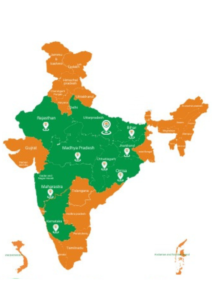
Trusted by 50000+ Customers
Anya Green Energy is a leading solar company and Solar Energy service provider established in 2013. We are recognized by startup India and customer best choice award 2022.
Our Achievements :
Recognized by Startup India.
Purvanchal’s first solar company to operate exclusively with solar products.
Certified by well-known institutions such as MSME, IndiaMart, and Just Dial and many more.
Winner of the Best Customer Choice Award 2022.
Over 50,000 happy customers across India.
Products
-
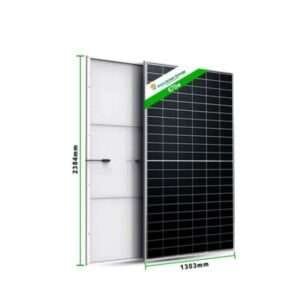 670W MONO PERC HALFCUT SOLAR PANEL
₹26,999.00Original price was: ₹26,999.00.₹23,999.00Current price is: ₹23,999.00. -
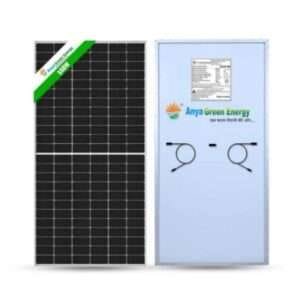 550W MONO PERC HALFCUT SOLAR MODULE
₹22,999.00Original price was: ₹22,999.00.₹19,999.00Current price is: ₹19,999.00. -
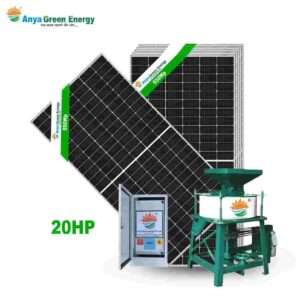 20HP Atta Chakki with Mone Perc Half cut 550W Panel
₹1,200,000.00Original price was: ₹1,200,000.00.₹1,060,000.00Current price is: ₹1,060,000.00. -
 15HP Atta Chakki with Mone Perc Half cut 670W Panel
₹900,000.00Original price was: ₹900,000.00.₹850,000.00Current price is: ₹850,000.00. -
 10HP Atta Chakki with Mone Perc Half cut 550W Panel
₹650,000.00Original price was: ₹650,000.00.₹590,000.00Current price is: ₹590,000.00.