Pumped Hydro Storage: India's Sleeping Giant
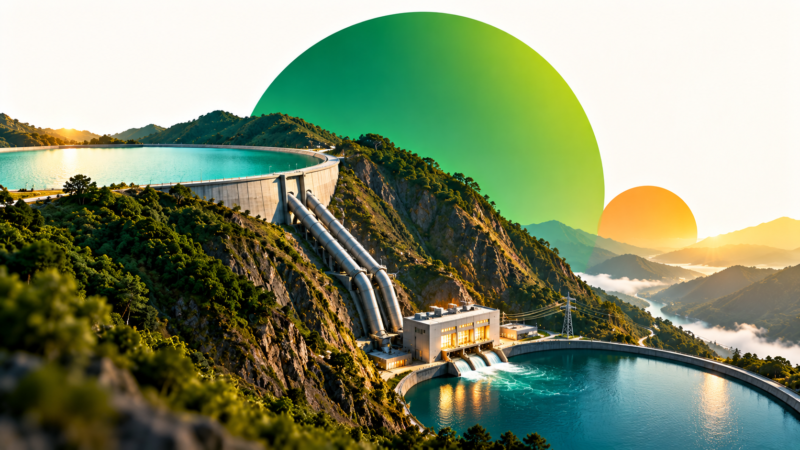
Long before lithium-ion batteries dominated the energy storage conversation, one technology was already quietly storing more energy than every battery on Earth combined: pumped hydro storage. At its simplest, pumped hydro storage works by moving water between two reservoirs at different elevations, storing energy when water is pumped uphill and releasing it when that water flows back down through turbines to generate electricity.
Despite accounting for the vast majority of the world’s installed energy storage capacity, pumped hydro storage remains oddly absent from mainstream renewable energy conversations, overshadowed by flashier battery headlines. In India specifically, pumped hydro storage represents what many engineers describe as a sleeping giant — enormous untapped potential sitting largely dormant despite decades of technical familiarity with the underlying technology.
How Pumped Storage Hydropower Works
Pumped storage hydropower operates on a deceptively simple principle: during periods of low electricity demand or excess renewable generation, water is pumped from a lower reservoir up to a higher one, effectively storing energy as gravitational potential. When demand rises, or when solar and wind generation drops, that stored water is released back downhill through turbines, generating electricity much like a conventional hydropower plant.
What makes pumped storage hydropower particularly valuable is its ability to respond within minutes, offering exactly the kind of fast, flexible balancing power that grids increasingly need as they absorb more variable renewable sources. Unlike thermal power plants, which can take hours to ramp up, pumped hydro storage facilities can go from standstill to full output remarkably quickly.
As one hydropower engineer put it in a recent grid-modernization panel, “pumped hydro storage is really just a very large, very efficient mechanical battery that we’ve been building for over a century — we just stopped paying attention to it.” That framing captures why interest in pumped storage hydropower is resurging alongside the broader renewable energy boom.
Closed-Loop vs Open-Loop Pumped Hydro
Not all pumped hydro storage projects are built the same way. Closed-loop pumped hydro systems use two artificially constructed reservoirs not connected to a natural flowing river, minimizing environmental disruption to existing aquatic ecosystems. Open-loop systems, by contrast, maintain a continuous connection to a natural river, which can offer siting advantages but typically carries greater environmental review complexity.
For new pumped hydro storage development in India, closed-loop pumped hydro configurations are increasingly favored, largely because they reduce the environmental approval hurdles that have historically slowed large hydropower projects while still delivering the same core storage benefits as conventional pumped hydro storage installations.
Ready to switch to Solar?
Solar solutions with Anya Green Energy and discover how you can reduce your electricity bills.
Contact UsWhy India Calls This a Sleeping Giant
India’s mountainous and hilly terrain — particularly across the Western Ghats, the Himalayan foothills, and parts of central India — offers substantial geographic potential for pumped hydro storage development. Government surveys have identified a large number of technically feasible sites over the years, yet only a small fraction of this potential has actually been developed into operational pumped hydro storage capacity.
This gap between technical potential and installed capacity is exactly why pumped hydro storage is so often described as India’s sleeping giant — a resource hiding in plain sight, well understood by engineers for decades, yet consistently underutilized relative to its scale and grid value.
Grid Scale Energy Storage and the Renewable Integration Challenge
As India adds increasing amounts of solar and wind capacity, the need for reliable grid scale energy storage has grown correspondingly urgent. Batteries have captured most of the public attention in this space, but pumped hydro storage remains the dominant form of grid scale energy storage worldwide by an enormous margin, owing to its long operational lifespan, large capacity, and relatively low cost per unit of stored energy over time.
Unlike lithium-ion batteries, which excel at short-duration, fast-response applications, pumped hydro storage is particularly well suited to longer-duration needs, often capable of discharging steadily for six, eight, or even twelve hours — making it a natural complement to battery storage rather than a direct competitor.
Pumped Storage Projects in India: Current Landscape
India already operates several pumped storage projects in India, though overall installed capacity remains modest relative to the country’s estimated technical potential. Government agencies have in recent years signaled renewed interest in accelerating pumped storage projects in India, recognizing that this long-duration storage capability will become increasingly critical as renewable penetration rises.
Several new pumped storage projects in India have moved through various stages of planning and approval, particularly in states with favorable topography such as Maharashtra, Andhra Pradesh, Telangana, and Karnataka. However, pumped hydro storage development timelines remain considerably longer than solar or battery projects, often requiring seven to ten years from conception to commissioning due to the scale of civil engineering work involved.
Quick Comparison: Pumped Hydro vs Battery Storage
| Factor | Pumped Hydro Storage | Battery Storage (Li-ion) |
|---|---|---|
| Typical discharge duration | 6–12+ hours | 1–4 hours |
| Operational lifespan | 40–80 years | 10–15 years |
| Capital cost pattern | High upfront, low lifetime cost | Lower upfront, periodic replacement |
| Siting requirement | Specific topography needed | Flexible, modular |
| Response time | Minutes | Seconds |
Advantages of Pumped Hydro Storage
Several structural advantages explain why pumped hydro storage continues to dominate global storage capacity despite the battery boom:
- Unmatched duration — pumped hydro storage can discharge for many hours, far longer than most battery systems.
- Exceptional lifespan — well-built pumped hydro storage facilities can operate productively for many decades.
- Low lifetime cost — despite high upfront capital needs for both closed-loop pumped hydro and open-loop designs, long-term costs per unit of stored energy remain very competitive.
- Grid stability services — rapid response capability helps balance frequency and demand fluctuations.
- Complementary to batteries — pumped hydro storage and lithium-ion systems serve different duration needs rather than competing directly.
- Proven, mature technology — decades of global operating experience reduce technology risk compared to newer storage chemistries.
Challenges Facing Pumped Hydro Storage Development
Despite its advantages, pumped hydro storage development faces real headwinds. Long construction timelines, high upfront capital requirements, and the need for very specific topography — two suitable reservoir sites at different elevations, reasonably close together — all limit where new projects can realistically be built.
Environmental and social considerations add further complexity, particularly around land acquisition, community displacement, and ecological impact assessments for larger open-loop projects. Securing financing for projects with such long construction and payback periods can also prove more difficult than financing shorter-cycle battery storage investments.
Policy and Investment Outlook
Recognizing its strategic importance, Indian policymakers have begun introducing measures aimed at improving project bankability, including streamlined clearance processes and revised tariff structures designed specifically for long-duration storage assets. Some recent tenders have also started favoring closed-loop pumped hydro designs due to comparatively faster environmental clearance timelines. These efforts reflect growing recognition that pumped hydro storage deserves dedicated policy attention rather than being treated as a generic hydropower category.
Continued investment in grid scale energy storage planning, combined with clearer long-term revenue visibility for developers, will likely determine how quickly pumped hydro storage moves from its current underutilized state toward fuller realization of its technical potential.
Looking Ahead
As renewable capacity additions continue accelerating across India, analysts increasingly expect pumped hydro storage to receive renewed attention as a critical, if unglamorous, enabler of grid reliability. Unlike newer storage technologies still proving themselves at scale, pumped storage hydropower offers a century of proven operating experience combined with genuinely vast untapped Indian potential. Many analysts also expect the next wave of development to lean toward closed-loop pumped hydro configurations rather than traditional open-loop designs, given their comparatively smoother approval pathways.
Whether pumped storage projects in India can move from planning stages to commissioned capacity at the pace required will significantly influence how reliably the broader grid can absorb rising shares of variable solar and wind generation over the next decade.
Frequently Asked Questions
Q1: What exactly is pumped hydro storage?
A1: It’s a form of energy storage that moves water between two reservoirs at different elevations — pumping it uphill to store energy, then releasing it downhill through turbines to generate electricity when needed, functioning essentially as a large mechanical battery.
Q2: How much of this potential has India actually developed?
A2: Only a modest fraction. Pumped storage projects in India remain limited in number relative to the country’s estimated technical potential, which is precisely why the sector is often described as a sleeping giant.
Q3: What’s the difference between closed-loop and open-loop systems?
A3: Closed-loop pumped hydro systems use two constructed reservoirs isolated from natural rivers, reducing ecological disruption, while open-loop systems maintain a connection to an existing river, offering siting flexibility but facing more complex environmental review.
Q4: How does this compare to battery storage?
A4: This technology typically offers much longer discharge durations and a far longer operational lifespan than lithium-ion batteries, making it a critical component of grid scale energy storage strategies for longer-duration balancing needs, while batteries remain better suited to short, fast-response applications.
Q5: Why hasn’t India developed more of this capacity already?
A5: Long construction timelines, high upfront capital requirements, specific topographic needs, and complex environmental approvals have all slowed development, despite strong underlying technical potential and growing policy interest.
Trusted by 50000+ Customers
Anya Green Energy is a leading solar company and Solar Energy service provider established in 2013. We are recognized by startup India and customer best choice award 2022.
Our Achievements :
Recognized by Startup India.
Purvanchal’s first solar company to operate exclusively with solar products.
Certified by well-known institutions such as MSME, IndiaMart, and Just Dial and many more.
Winner of the Best Customer Choice Award 2022.
Over 50,000 happy customers across India.