
Carbon Credit Scheme: How India Is Pricing Carbon to Drive Climate Action

A carbon credit scheme is a market-based mechanism designed to put a price on carbon emissions, allowing companies to buy, sell, or trade the right to emit a certain amount of greenhouse gases.
At its core, a carbon credit scheme works by issuing tradable certificates — each representing one tonne of carbon dioxide either avoided, reduced, or removed from the atmosphere. Companies that emit less than their allocated limit can sell surplus credits, while those exceeding their limit must buy credits to stay compliant.
The specific rules governing how a carbon credit scheme operates can vary considerably between countries and sectors, but the underlying goal remains the same: making emissions reduction financially rewarding rather than purely a regulatory burden.
How Carbon Credit Trading Mechanisms Work
Once credits are issued under a carbon credit scheme, carbon credit trading is what gives them real economic value. Companies with excess credits can sell them on dedicated exchanges, while companies needing additional allowances purchase credits to cover their emissions gap.
Carbon credit trading typically happens through two broad structures: cap-and-trade systems, where a regulator sets a total emissions cap and issues credits accordingly, and baseline-and-credit systems, where credits are earned by outperforming a set emissions benchmark.
As one climate policy economist explained in a recent panel discussion, “carbon credit trading only works if the credits actually represent real, verified emissions impact — otherwise you’re just trading paper, not carbon.” This observation underscores why credit verification standards matter as much as the trading mechanism itself.
The Carbon Offset Market: Compliance vs Voluntary
Within the broader carbon credit scheme landscape, the carbon offset market splits into two distinct categories that are often confused with one another. The compliance carbon offset market is government-mandated, legally binding companies in regulated sectors to participate.
The voluntary carbon offset market, by contrast, allows companies to purchase credits beyond any legal requirement, typically to support corporate sustainability goals or net-zero commitments made publicly to shareholders and customers.
Ready to switch to Solar?
Solar solutions with Anya Green Energy and discover how you can reduce your electricity bills.
Contact UsCarbon Trading in India: The Emerging Framework
India has been steadily building its own regulatory architecture for carbon trading in India, anchored by the Carbon Credit Trading Scheme notified under the Energy Conservation Act. This framework establishes the legal basis for a formal, compliance-driven carbon credit scheme within the country.
Carbon trading in India currently focuses heavily on energy-intensive sectors already covered under the Perform, Achieve and Trade scheme, gradually transitioning those sectors toward a broader, more comprehensive carbon credit scheme over the coming years.
The Voluntary Carbon Market: A Parallel Pathway
Separate from India’s compliance framework, the voluntary carbon market offers companies an additional route to offset emissions outside mandatory obligations. Indian companies pursuing ambitious net-zero targets increasingly participate in the voluntary carbon market to supplement their internal emissions reduction efforts.
The voluntary carbon market has faced growing scrutiny globally over credit quality, with concerns that some voluntary carbon market projects overstate their actual emissions impact. This has pushed demand toward higher-integrity, third-party-verified credits within the voluntary carbon market specifically.
Quick Comparison: Compliance vs Voluntary Carbon Markets
| Factor | Compliance Market | Voluntary Carbon Market |
|---|---|---|
| Participation | Legally mandated | Optional, business-driven |
| Oversight | Government regulator | Third-party standards bodies |
| Price stability | More regulated, stable | More variable |
| India example | Carbon Credit Trading Scheme | Project-based voluntary credits |
| Primary driver | Regulatory compliance | Corporate sustainability goals |
Advantages of a Well-Designed Carbon Credit Scheme
- Cost-effective emissions reduction — a carbon credit scheme lets reductions happen wherever they’re cheapest, rather than mandating identical cuts everywhere.
- Market liquidity — active carbon credit trading creates price signals that guide long-term corporate investment decisions.
- Flexibility for business — a functioning carbon offset market gives companies multiple pathways to meet climate commitments.
- National policy alignment — a mature framework for carbon trading in India supports the country’s broader climate and energy goals.
- Private capital mobilization — the voluntary carbon market channels corporate funding toward emissions reduction projects that might otherwise lack financing.
- Measurable accountability — tradable credits create a transparent, trackable unit for measuring real-world climate progress.
Challenges Facing Carbon Credit Schemes
Despite its promise, a carbon credit scheme is only as credible as its underlying verification standards. Poorly monitored projects can lead to credits that don’t represent genuine emissions reductions, undermining trust in carbon credit trading broadly.
Price volatility is another persistent issue — a carbon offset market with weak demand or oversupply can see prices collapse, reducing the financial incentive for companies to invest in emissions reduction in the first place.
For developing economies, building robust measurement, reporting, and verification infrastructure fast enough to support a credible national carbon credit scheme remains a significant institutional and technical challenge.
Global Context: How Other Markets Compare
The European Union’s Emissions Trading System remains the world’s largest and most mature carbon credit scheme, often cited as the benchmark other countries study when designing their own frameworks. China has also launched a national carbon credit scheme covering its power sector, now one of the largest by volume globally.
Compared to these mature systems, the voluntary carbon market in many countries remains less standardized, though international efforts are underway to harmonize quality standards and improve comparability across different credit types and project methodologies.
Looking Ahead
As India’s carbon credit scheme matures beyond its initial sectors, analysts expect broader coverage across more industries, tighter verification standards, and deeper integration with international carbon markets over time.
Continued refinement of carbon trading in India, alongside growing corporate participation in both compliance and voluntary channels, will likely determine how effectively this mechanism contributes to the country’s broader emissions reduction and clean energy transition goals.
Frequently Asked Questions
Q1: What exactly is a carbon credit scheme?
A1: A carbon credit scheme is a market mechanism that assigns a tradable value to emissions reductions, allowing companies to buy or sell credits based on whether they emit more or less than their allocated limit.
Q2: How does carbon credit trading actually generate value?
A2: Carbon credit trading allows companies with surplus credits to sell them to companies that need additional allowances, creating a price signal that rewards emissions reduction and penalizes excess emissions.
Q3: What’s the difference between compliance and voluntary carbon markets?
A3: The compliance carbon offset market is legally mandated for regulated sectors, while the voluntary version allows companies to purchase credits beyond legal requirements, typically to support corporate sustainability commitments.
Q4: What does India’s framework for this look like?
A4: Carbon trading in India is anchored by the Carbon Credit Trading Scheme notified under the Energy Conservation Act, currently focused on energy-intensive sectors with plans for broader coverage over time.
Q5: Are voluntary carbon credits reliable?
A5: Quality varies significantly across projects within the voluntary carbon market, which has led to growing demand for third-party-verified, higher-integrity credits as scrutiny of this space increases globally.
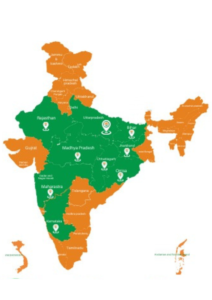
Trusted by 50000+ Customers
Anya Green Energy is a leading solar company and Solar Energy service provider established in 2013. We are recognized by startup India and customer best choice award 2022.
Our Achievements :
Recognized by Startup India.
Purvanchal’s first solar company to operate exclusively with solar products.
Certified by well-known institutions such as MSME, IndiaMart, and Just Dial and many more.
Winner of the Best Customer Choice Award 2022.
Over 50,000 happy customers across India.