A Complete Guide to Choosing the Right Home Solar Panel System for Long-Term Savings
Switching to solar energy is no longer just an environmental statement; it is one of the smartest financial investments a homeowner can make. With utility rates consistently rising, installing a home solar panel system locks in predictable energy costs and delivers substantial long-term savings. However, navigating panel types, inverter technology, and system sizing can feel overwhelming.
This comprehensive guide Solar panel system breaks down everything you need to know to choose the right home solar panel system for maximum performance and lifetime return on investment.
1. Calculate Your Current & Future Energy Needs
Before shopping for components, you must determine how much electricity your system needs to generate.
-
Analyze 12 Months of Electric Bills: Look at your total kilowatt-hour (kWh) usage across all four seasons. Energy consumption usually peaks during summer (air conditioning) and winter (heating).
-
Account for Future Needs: Are you planning to purchase an electric vehicle (EV), install a heat pump, or add a swimming pool? Sizing your system slightly larger now is far more cost-effective than expanding it later.
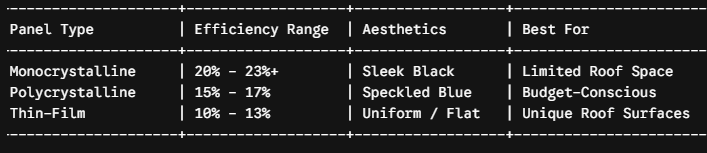
Solar panels are not all created equal. The three main panel types vary in efficiency, aesthetics, and price
-
Monocrystalline Panels: Made from single-crystal silicon, these offer the highest efficiency and sleekest look. They perform Solar panel system exceptionally well in warm climates and low-light conditions, making them the gold standard for residential roofs.
-
Polycrystalline Panels: Made from melted silicon fragments, these are cheaper to produce but less efficient. They require Solar panel system more roof space to produce the same power as monocrystalline systems.
-
N-Type (TOPCon & HJT): Next-generation panel Solar panel system technologies offering lower degradation rates (under 0.4% per year) and higher efficiency, maximizing long-term yields over a 25-to-30-year lifespan.
3. Select the Ideal Inverter System
he inverter converts the Direct Current (DC) produced by your solar panels into usable Alternating Current (AC) for your Solar panel system home appliances. Your inverter choice impacts both performance and shading tolerance.
String Inverters
-
Mechanism: Panels are wired together in series (“strings”) connected to one central inverter.
-
Pros: Most affordable option; easy to maintain.
-
Cons: If one panel gets shaded or dirty, the output of the entire string drops to match that weakest panel.
Microinverters
-
Mechanism: A small inverter is attached directly behind every individual panel.
-
Pros: Panel-level optimization—shading on one panel does not affect the rest. Easy to expand system size in the future.
-
Cons: Higher upfront equipment and installation costs.
Hybrid Inverters
-
Mechanism: Handles both solar generation and battery storage management in a single unit.
-
Pros: Ideal if you plan to add energy storage (batteries) now or in the near future.
4. Evaluate Battery Storage (Solar + Storage)
While not strictly required for a Solar panel system to function, adding a lithium-iron-phosphate (LFP) solar battery unlocks significant benefits:
-
Backup Power During Outages: Standard grid-tied solar systems shut down during power outages for safety reasons unless backed by a battery.
-
Time-of-Use (TOU) Optimization: If your utility company charges higher rates during peak evening hours, a battery allows you to power your home using stored daytime solar energy instead of buying expensive grid power.
5. Assess Warranties and Degradation Rates
Long-term savings depend directly on Solar panel system equipment longevity. Always review the three critical warranties before signing a contract:
-
Equipment/Product Warranty (12 to 25 Years): Covers physical defects, manufacturing issues, and premature hardware failure.
-
Performance/Power Warranty (25 to 30 Years): Guarantees that panels will retain a specific percentage of their original output capacity over time (typically > 85% at year 25).
-
Workmanship Warranty (10 to 25 Years): Provided by the installer to cover roof penetrations, wiring issues, and installation quality.
6. Maximize Financial Incentives & ROI
To achieve the shortest payback period and highest lifetime savings:
-
Government Tax Credits & Rebates: Take advantage of national solar incentives, federal tax credits, and state/local rebates that reduce net installation costs substantially.
-
Net Metering (NEM): Understand how your local utility credits you for excess solar energy exported back to the grid.
-
Quality Installation: Choose an installer certified by recognized industry bodies (such as NABCEP). Proper pitch, direction (south or west facing), and shading mitigation ensure maximum daily production.
Summary Checklist
-
Calculate your annual kWh consumption and account for future Solar panel system electric additions.
-
Prioritize Monocrystalline (N-Type) panels for limited roof space and maximum output.
-
Opt for microinverters or optimizers if your roof experiences partial shading.
-
Compare warranties and performance degradation rates across quotes.
-
Work with a certified, top-rated local installer to claim all available subsidies.
Investing in the right solar panel system turns your roof into a reliable, income-generating energy asset for decades to come.