What Is BESS? The Battery Technology Powering India's Solar Future (PM Surya Ghar Guide 2026)
Here’s a strange fact about solar power that almost nobody mentions when they’re pitching you a rooftop system: your panels work hardest exactly when you need electricity the least. Peak sunlight hits around noon, when most homes are empty. Peak electricity demand hits in the evening, right when the sun has already clocked out for the day. Energy planners call this mismatch the “duck curve,” and it’s arguably the single biggest problem facing solar power today. The answer to it has a name: BESS.
If you’ve been following India’s rooftop solar push under the government’s flagship solar subsidy scheme, or you’ve simply seen the acronym pop up in the news lately — SECI’s storage tenders, MNRE’s new guidelines, a new battery factory in Gujarat — this guide is for you. We’ll explain exactly what BESS is, how it fits into a solar energy storage setup, why the government is now folding it directly into its flagship solar subsidy scheme, and what it could realistically mean for your own electricity bill.
What Is BESS?
BESS stands for Battery Energy Storage System — a setup that captures electricity when it’s abundant and releases it later, exactly when it’s needed. Unlike a basic inverter or a UPS, which mostly just switches on when the grid fails, this kind of storage setup is genuinely intelligent: it can charge from solar panels during the day, discharge during the evening peak, respond to grid signals, and even help stabilize frequency across an entire electricity network.
In the simplest terms, think of battery storage as a rechargeable bank sitting between your solar panels (or the grid) and the devices that consume power. It doesn’t generate electricity itself — it stores electricity that’s already been generated, and releases it precisely when that electricity is most valuable
Why This Matters So Much for the Solar Sector
Solar power is intermittent by nature. It’s abundant at noon and completely absent at night, and it fluctuates with cloud cover in between. This is exactly why solar energy storage has become the missing piece of the renewable energy puzzle rather than just a nice-to-have add-on.
Without a battery bank, any electricity your solar panels generate that you don’t use immediately either gets exported to the grid at a lower rate or, in an off-grid setup, is simply wasted. With storage in place, that same electricity gets banked and used later — during the evening peak, during a grid outage, or during a cloudy stretch when panel output drops. This single shift is what allows solar energy storage to turn a daytime-only power source into something far closer to round-the-clock electricity.
At a national level, this matters even more. As India adds gigawatts of new solar capacity every year, the gap between when solar generates and when the country actually needs power keeps widening rather than closing. Storage is the technology that converts that growing renewable capacity into genuinely usable, dispatchable electricity — which is exactly why this technology has moved from a technical footnote to a central pillar of India’s energy transition, rather than staying a niche engineering top
How Battery Storage Actually Works
A typical storage setup has four core components working together:
- Battery cells — usually lithium-ion today, though sodium-ion and flow batteries are emerging as lower-cost alternatives for large installations.
- A Battery Management System (BMS) — the “brain” that monitors charge levels, temperature, and safety, and prevents overcharging or overheating.
- An inverter/converter — converts stored DC electricity into usable AC power for your home or the grid, and converts incoming AC back to DC for charging.
- Software and controls — schedules when to charge and discharge based on solar output, tariff rates, and household or grid demand.
When paired with rooftop solar, the flow looks like this: your panels generate DC electricity during the day, a portion powers your home directly, the surplus charges the battery bank, and once the sun goes down, the stored electricity discharges to cover your evening usage instead of pulling expensive power from the grid. That handoff — sun to panel to battery to socket — is the entire point of pairing storage with a solar system.
Battery Storage vs Traditional Inverters and UPS Systems
A lot of homeowners assume the battery backup they already own is basically the same thing as a modern storage system. It isn’t. A standard inverter or UPS exists purely for emergency backup — it switches on when the grid fails and switches off once it’s restored, with no real intelligence behind when or how it charges.
A Battery Energy Storage System, by contrast, is a full energy management system, not a passive backup box. It can be programmed to charge only from solar (avoiding grid electricity entirely), discharge strategically during high-tariff evening hours, and even feed power back to the grid during demand peaks in markets that allow it.
| Factor | Standard Inverter/UPS | BESS |
|---|---|---|
| Purpose | Emergency backup only | Active energy management |
| Charging logic | Basic, reactive | Scheduled, intelligent |
| Solar integration | Limited or none | Deep integration with solar output |
| Grid interaction | One-way (backup only) | Can charge, discharge, and export |
| Monitoring | Minimal | Real-time app/software monitoring |
| Typical use case | Power cuts | Daily energy shifting + backup |
That difference — passive backup versus active energy management — is exactly why battery storage is increasingly treated as core infrastructure rather than a household accessory.
BESS and PM Surya Ghar: How the Two Are Now Connected
PM Surya Ghar: Muft Bijli Yojana, launched in February 2024, is the Government of India’s flagship solar subsidy scheme, targeting free electricity for one crore households through subsidised solar installations. Under the scheme, households can receive a subsidy of up to ₹78,000 depending on system size — ₹30,000 per kW for the first 2kW and ₹18,000 per kW for the next 1kW — along with benefits of up to 300 units of free electricity per month, applied for entirely through the official government portal at pmsuryaghar.gov.in.
Here’s where it gets directly relevant to storage: the Ministry of New and Renewable Energy (MNRE) has recently expanded how the scheme’s incentive funds can be used, allowing DISCOMs to direct balance incentive money toward BESS, grid upgrades, and monitoring infrastructure — not just panel installations. There’s also active discussion around a next-generation structure that could tie financial support to actual generation performance and storage capability, rather than installed panel capacity alone.
I
Eligibility and How the Scheme Works, in Brief
For context, since the two topics are increasingly linked: to qualify, applicants generally need to be Indian citizens who own a residential property with a suitable roof, hold a valid and active electricity connection in their own name, and not have previously availed a subsidy for a solar installation under another scheme. The process runs through the official portal — registering with your state and electricity distribution company, receiving feasibility approval, having the system installed by a registered vendor, and finally receiving the subsidy directly into your bank account after inspection and net-meter commissioning. As storage becomes more tightly linked to the scheme, expect future applications to include an option to size and quote for a battery storage add-on alongside the standard panel capacity.
The proposed move toward solar plus storage is particularly important because renewable generation does not always match electricity demand. A modern battery energy storage system can help bridge this gap, while solar battery storage can improve the utilization of clean electricity. As BESS in India expands, developers and businesses are likely to explore more efficient solar plus storage solutions.
India's Bigger Battery Storage Push: Beyond Rooftops
The rooftop and household angle is only one part of the picture. India is investing heavily in utility-scale battery storage as well, and the pace of announcements has picked up sharply through 2025 and 2026.
Some notable developments:
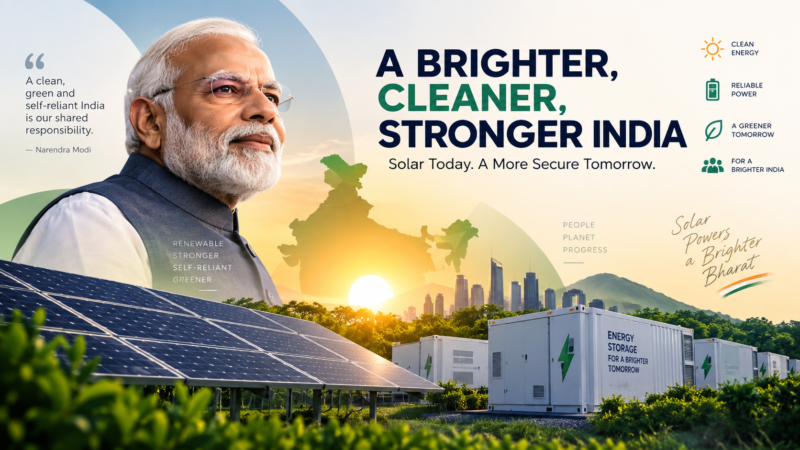
- In February 2024, the Prime Minister dedicated India’s largest solar-powered battery storage project to the nation — a 40 MW/120 MWh facility paired with a solar plant in Rajnandgaon, Chhattisgarh, developed by the Solar Energy Corporation of India (SECI).
- The government approved thousands of crores in viability gap funding to support several gigawatt-hours of new battery storage capacity nationwide, aimed squarely at closing the solar-to-demand timing gap.
- State agencies like Rajasthan’s RRECL have drafted standard operating procedures making storage integration effectively mandatory alongside new renewable energy projects, reflecting how central this technology has become to grid planning.
- Private manufacturers are scaling up domestic battery production, including new multi-gigawatt-hour assembly facilities in states like Gujarat, to reduce India’s reliance on imported storage technology.
- SECI has floated fresh tenders pairing solar generation directly with storage capacity — for instance, a 100 MW solar project bundled with a 40 MW/120 MWh battery storage unit in Chhattisgarh, reinforcing how standard this pairing is becoming for new utility projects.
Together, these moves point toward a clear national direction: storage is no longer treated as optional infrastructure bolted onto renewable projects after the fact — it’s being planned in from day one, at both the household and utility scale.
Types of Battery Technology Used in Battery Storage Systems
Not all batteries inside a storage setup are the same. The chemistry you choose affects cost, lifespan, safety, and how well the system performs in Indian climate conditions.
- Lithium-ion (LFP) — currently the most widely used chemistry in residential and commercial storage systems, valued for its safety profile, longer cycle life, and steadily falling costs.
- Sodium-ion — an emerging, lower-cost alternative that avoids some of the raw-material constraints of lithium, increasingly discussed for large grid-scale projects.
- Flow batteries — better suited to very large, long-duration storage needs, though currently more expensive and less common in residential setups.
- Lead-acid — the oldest and cheapest option, still used in some basic setups but generally being phased out in favor of lithium-based systems due to shorter lifespan and lower round-trip efficiency.
For most homeowners considering solar energy storage today, lithium-ion remains the practical default, balancing cost, safety, and performance for a typical residential system size.
Sizing a Battery System for a Typical Indian Home
One of the most common questions homeowners ask is how large a battery system they actually need alongside their rooftop installation. The honest answer is: it depends on your evening consumption pattern, not just your panel capacity. A household consuming 150-300 units a month, which is the range the scheme’s 2-3kW subsidy slab is built around, typically needs enough stored capacity to cover 3-5 hours of evening usage — lighting, fans, a refrigerator, a television, and similar essential loads — rather than the household’s entire daily consumption. Oversizing a battery bank adds cost without a proportional benefit, while undersizing it means falling back on grid electricity earlier than planned each evening. Most installers now run a load audit alongside the standard feasibility check specifically to right-size any battery storage add-on.
Benefits of Adding BESS to a Rooftop Solar System
- Backup power during outages — unlike a standard grid-tied solar system, which typically shuts off during a power cut for safety reasons, a solar-plus-storage setup can keep essential loads running.
- Lower electricity bills — by shifting stored solar power to evening peak hours instead of pulling from the grid at higher tariffs, households can meaningfully cut their monthly bill beyond what rooftop solar alone delivers.
- Energy independence — a well-sized battery system reduces dependence on grid electricity and DISCOM tariff hikes over the long run.
- Grid support at scale — collectively, distributed battery systems can help flatten demand peaks and improve grid stability, a benefit that compounds as more households adopt solar energy storage alongside their panels.
- Future-proofing — as schemes like this one evolve to reward generation and storage performance rather than installed capacity alone, having battery storage already in place could position households to benefit from future incentive structures.
Challenges Facing Battery Storage Adoption in India
It’s worth being honest about the friction points too. Storage still adds meaningful upfront cost to a solar installation, and for many households, the payback period without a dedicated subsidy remains longer than the solar panels themselves. Battery degradation over time, safety considerations around thermal management, and the need for skilled installation and maintenance are all real factors that need proper planning rather than being glossed over.
There’s also the broader question of supply chains. India currently imports a significant share of battery cells, which is precisely why domestic manufacturing incentives and gigafactory investments have become such a policy priority alongside the storage rollout itself. Recycling and end-of-life disposal of battery packs is another area regulators are actively working to standardize as adoption scales up nationally.
Common Myths About Battery Storage
Myth: BESS is the same as a regular home inverter. Not true. A regular inverter or UPS just switches on during an outage. A Battery Energy Storage System actively manages when to charge, discharge, and even export power based on solar output and demand patterns.
Myth: You need a battery from day one to benefit from the scheme. Not currently required. Most PM Surya Ghar installations today are grid-tied solar without a battery, and the subsidy structure is built primarily around panel capacity. However, storage can typically be added later as a retrofit without redoing the entire system.
Myth: Battery storage is only relevant for large utility-scale projects. Residential and commercial adoption is growing quickly precisely because storage adds real value at every scale — from a single home’s evening backup to a state-wide grid stability program.
Myth: Bigger is always better when sizing a battery. As covered above, oversizing adds cost without matching benefit. The right size depends on your actual evening consumption, not your total daily generatION
Frequently Asked Questions
What does BESS stand for? BESS stands for Battery Energy Storage System — a rechargeable setup that stores electricity for use later, commonly paired with solar power.
Is battery storage covered under the PM Surya Ghar subsidy? The core scheme subsidy is currently structured around solar panel capacity rather than batteries directly, though MNRE has expanded how scheme incentive funds can be used to support storage and grid infrastructure, and future scheme revisions may tie support more closely to it.
Can I add a battery system to my existing rooftop solar system? In most cases, yes. Many modern inverters and system designs support retrofitting a battery storage setup onto an existing solar installation with relatively minor adjustments.
How much does a home battery storage setup typically cost in India? Costs vary by battery chemistry and storage capacity, but a residential lithium-ion setup sized for a few hours of evening backup generally represents a significant additional investment on top of the solar panels themselves — worth budgeting for separately from your solar installation quote rather than assuming it’s included.
Why is battery storage considered so important for India’s solar sector right now? Because India’s solar capacity is growing faster than its ability to use that power exactly when it’s generated. Storage closes that timing gap, turning solar from a daytime-only resource into something usable around the clock, which is why BESS is central to national energy planning connected to India’s solar push and utility-scale renewable projects alike.
The Bottom Line
BESS isn’t a futuristic add-on anymore — it’s quickly becoming the backbone that makes solar power actually reliable, both for individual households and for the national grid. As PM Surya Ghar evolves and India pushes harder toward round-the-clock renewable electricity, understanding this technology now puts you ahead of a shift that’s already well underway. Whether you’re weighing a rooftop solar installation today or just trying to make sense of the acronyms in the news, the core idea is simple: solar generates power when the sun is out, and battery storage is what makes sure that power is still there when you actually need it.
Trusted by 50000+ Customers
Anya Green Energy is a leading solar company and Solar Energy service provider established in 2013. We are recognized by startup India and customer best choice award 2022.
Our Achievements :
Recognized by Startup India.
Purvanchal’s first solar company to operate exclusively with solar products.
Certified by well-known institutions such as MSME, IndiaMart, and Just Dial and many more.
Winner of the Best Customer Choice Award 2022.
Over 50,000 happy customers across India.