AC vs DC Electricity in Solar Power: The Complete 2026 Guide
If you’ve ever stared at a solar quote full of jargon and wondered why nobody just explains it in plain English — welcome. This is that explainer. And if the only thing “AC/DC” has ever meant to you is a rock band from the 1970s, don’t worry, you’re about to become the person at dinner parties who actually understands how the sun ends up powering your fridge.
Understanding AC vs DC electricity isn’t just trivia. It’s the single concept that explains why solar systems need inverters, why some batteries cost more than others, why your installer keeps mentioning “conversion losses,” and why the next generation of homes might skip one of these currents almost entirely. Whether you’re a homeowner comparing quotes, a student prepping for an exam, or someone just getting curious about renewable energy, this guide breaks down AC vs DC electricity from first principles — and ties every single concept back to how it plays out inside a real solar power system.
By the end, you’ll know exactly what happens to a photon from the moment it hits a solar panel to the moment it lights up your bulb, and you’ll understand why that journey is basically the whole story of modern solar engineering.
What Is Electricity, Really?
Before comparing AC vs DC electricity, it helps to zoom out. Electricity is simply the organized movement of electrons through a conductor — think of it like water flowing through a pipe. What differs between AC and DC isn’t the “stuff” that’s flowing, but the pattern in which it moves.
That one distinction — pattern of flow — decides almost everything about how electricity is generated, transmitted, stored, and finally used in your home. And nowhere is this more visible, or more important, than in solar energy, where electricity literally changes form multiple times between the rooftop and the wall socket.
What Is Direct Current (DC)?
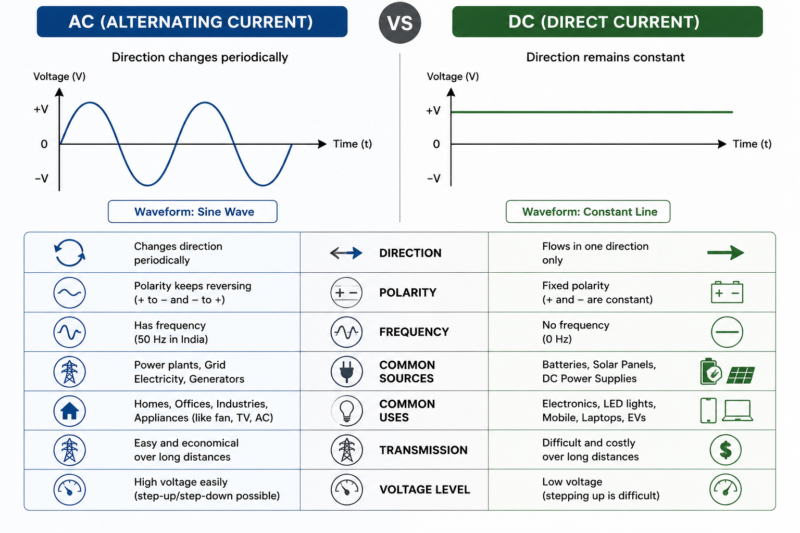
Direct Current, or DC, is electricity that flows in a single, constant direction — always from negative to positive, never reversing. If you were to plot it on a graph, it would look like a flat, steady line.
DC is the natural output of a few very specific sources:
- Batteries (your phone, car battery, power bank)
- Solar panels (via the photovoltaic effect)
- Fuel cells
When sunlight strikes the silicon cells inside a solar panel, it knocks electrons loose and pushes them in one direction. That’s it — that’s DC electricity being born in real time on your roof. Every solar power system in the world starts its life exactly this way, whether it’s a 3kW rooftop setup or a 500MW solar farm.
What Is Alternating Current (AC)?
Alternating Current, or AC, periodically reverses direction — in most countries, 50 or 60 times every second. Graphed, it looks like a smooth, repeating wave rather than a flat line.
AC is the standard for:
- National electricity grids
- Home wiring and wall sockets
- Almost every large appliance you own — fridges, ACs (the cooling kind, not the current kind), washing machines, TVs
AC won out as the global grid standard over a century ago mainly because it can be stepped up and down in voltage very efficiently using transformers, which makes it far better suited for transmitting electricity across long distances with minimal loss. That single advantage is why the electricity that reaches your home today, whether from a coal plant or a solar farm, ultimately arrives as AC.
AC vs DC Electricity: The Core Differences
Here’s the side-by-side comparison that most people are actually searching for:
| Feature | Direct Current (DC) | Alternating Current (AC) |
|---|---|---|
| Direction of flow | Constant, one direction | Reverses periodically (50/60 Hz) |
| Graph shape | Flat line | Sine wave |
| Common sources | Solar panels, batteries, fuel cells | Power grid, generators, alternators |
| Transmission distance | Loses voltage over long distances | Travels efficiently over long distances |
| Typical use | Electronics, EV batteries, solar panels | Homes, factories, appliances |
| Safety perception | Generally considered lower shock risk | Considered higher shock risk at same voltage |
| Conversion need | Needs an inverter to become usable AC | Needs a rectifier to become DC |
Why Solar Panels Only Produce DC (and Why That's a Problem)
Here’s the twist that surprises a lot of newcomers to solar: your solar panels never produce AC at all. Not even a little. They are, by design, DC generators. The photovoltaic effect physically cannot produce a wave-like alternating output — it only pushes electrons one way.
That creates an immediate mismatch. Your home’s wiring, your appliances, and the national grid all run on AC. So the DC electricity flowing out of your DC solar panels is, on its own, completely useless to your toaster. This mismatch is the entire reason a device called an inverter exists in the first place, and it’s the crux of every conversation around AC vs DC electricity in the renewable energy space.
The Solar Inverter: The Real Hero of the Story
If solar panels are the “generators,” the solar inverter is the translator. Its one job is to take the raw DC electricity produced on your roof and convert it into clean, grid-compatible AC electricity that your home can actually use.
There are three broad approaches to inverting DC to AC inside a modern solar power system:
- String inverters — A single central inverter connects to a “string” of panels wired together. It’s the most common, most affordable setup for residential solar, converting DC electricity in one place before it enters your home’s AC circuit.
- Microinverters — A small solar inverter is attached to the back of each individual panel, converting DC to AC right at the source. This is the basis of what’s marketed as “DC solar panels with AC output,” or more accurately, AC solar panels.
- Power optimizers — A hybrid approach: DC electricity is optimized panel-by-panel but still sent to one central inverter for the final conversion to AC.
Every one of these designs exists purely to manage the AC vs DC electricity handoff as efficiently as possible, because every conversion step — DC to AC, or AC to DC — costs you a small percentage of energy as heat. A well-designed solar setup is, in many ways, just an exercise in minimizing how many times electricity has to change form.
DC Solar Panels vs AC Solar Panels: What's Actually Different
You’ll often see the phrase “AC solar panels” used in marketing, and it’s worth clarifying what it really means, because technically, every panel produces DC.
Standard DC solar panels send raw DC electricity down to one central solar inverter, which converts everything at once before it reaches your home. This is the traditional, most widely installed setup worldwide.
“AC” panels are really just standard DC solar panels with a microinverter bolted onto the back of each one. The panel itself still generates DC — but the conversion to AC happens immediately, panel by panel, instead of centrally.
| Factor | DC Solar Panels + String Inverter | Panels with Microinverters |
|---|---|---|
| Where DC becomes AC | Centrally, at one inverter | At each individual panel |
| Cost | Lower upfront cost | Higher upfront cost |
| Shading tolerance | One shaded panel can affect the whole string | Each panel performs independently |
| Monitoring | System-level | Panel-level |
| Best for | Simple roofs, budget installs | Complex roofs, partial shading |
Neither option “wins” outright in the broader AC vs DC electricity conversation — the right choice depends entirely on your roof layout, budget, and whether you’re planning to expand your solar system later.
Battery Storage: Where AC vs DC Electricity Gets Complicated
This is where most homeowners’ eyes glaze over — and where the AC vs DC electricity decision has the biggest financial impact. If you’re adding battery storage to your solar setup, you’ll have to choose between DC-coupled and AC-coupled architecture.
DC-Coupled Battery Storage
In a DC-coupled system, the DC electricity from your solar panels goes almost straight into the battery, bypassing an extra conversion step. Only once — when the power actually needs to be used in your home — does it get converted to AC. Because there’s only one conversion instead of two or three, DC-coupled battery storage is generally more efficient, especially for new installations built from scratch.
AC-Coupled Battery Storage
In an AC-coupled system, your existing solar inverter first converts panel output to AC, which then gets converted back to DC to be stored in the battery, and converted to AC again when you draw power. That’s up to three conversions instead of one. It sounds wasteful, and there is some efficiency loss — but AC-coupled storage is far easier to retrofit onto an existing setup, since you don’t need to rip out your current inverter.
| Factor | DC-Coupled Battery Storage | AC-Coupled Battery Storage |
|---|---|---|
| Conversions required | Just once (DC to AC) | Up to three times |
| Efficiency | Slightly higher | Slightly lower |
| Best for | New-build solar + storage systems | Retrofitting storage onto existing solar |
| Installation complexity | Higher (specialized hybrid inverter) | Lower (works with existing setup) |
Whichever direction you go, the underlying question is always the same: how many times does your electricity need to flip between AC and DC before it reaches your fridge — and what does each flip cost you in efficiency and equipment?
Safety: Does the Type of Current Matter Here Too
Yes, and it’s more than folklore. DC is generally considered to carry a lower shock risk than AC at the same voltage, largely because DC doesn’t cause the same muscle-gripping reaction that AC’s constant direction-reversal can trigger. This is part of why solar installers treat rooftop DC wiring with such caution — DC arcs can be harder to extinguish than AC arcs, which is actually one of the trickier fire-safety challenges in solar design, not an easier one.
Meanwhile, AC’s ability to be stepped up to very high voltages for transmission is precisely why grid electricity, despite reaching your home at “only” 220-240V (or 110-120V in North America), is treated with such strict safety codes.
Neither current is inherently “safe” — both demand respect, proper insulation, and correctly rated equipment throughout any solar system.
Why the Grid Chose AC (and Why Solar Is Bringing DC Back)
Over a century ago, Thomas Edison championed DC while Nikola Tesla and George Westinghouse pushed for AC. Edison lost that argument mainly because AC transformers could step voltage up for long-distance transmission and back down for safe household use — something DC couldn’t do efficiently with the technology of that era.
That single historical decision is why your grid runs on AC today. But solar power, electric vehicles, LED lighting, and most modern electronics all run natively on DC — which is quietly reigniting an old debate about which current actually makes more sense. Data centers, EV charging hubs, and even some experimental “DC homes” are starting to ask a genuinely interesting question: if most of what we use is DC anyway, are we losing efficiency by converting to AC and back again unnecessarily?
Common Myths About Current Types in Solar
Myth: DC is always more efficient than AC. Not universally true. DC avoids some conversion losses, but AC remains dramatically more efficient for long-distance transmission. Efficiency depends entirely on the specific stage of the solar setup you’re looking at.
Myth: You can skip the inverter if you only use DC appliances. Technically possible for a small off-grid setup, but almost no home is wired for it, and most storage systems and grid-tied setups still require an inverter for compliance and compatibility.
Myth: AC solar panels don’t produce DC at all. As covered above, every solar panel produces DC — “AC panels” simply convert it immediately via an integrated microinverter.
How to Choose the Right Setup for Your Solar Power System
If you’re actually planning an installation, here’s how the AC vs DC electricity question should shape your decisions:
- Simple, unshaded roof, tight budget: A central inverter with standard solar panels is usually the most cost-effective.
- Complex roof with partial shade, multiple angles: Microinverters or power optimizers reduce the impact of shading on the whole system.
- Adding storage to a new build: DC-coupled storage is typically more efficient long-term.
- Adding storage to an existing setup: AC-coupled storage is usually simpler and cheaper to retrofit.
- Off-grid or remote setups: More components may stay in DC form longer, reducing unnecessary conversions.
There’s no universal “best” answer here — only the setup that minimizes conversions and cost for your specific roof, budget, and goals.
Frequently Asked Questions
Do solar panels produce AC or DC electricity? Solar panels always produce DC electricity. A separate inverter converts it to AC so it can be used in your home or sent to the grid.
Is DC or AC better for solar battery storage? DC-coupled storage is generally more efficient because it involves fewer conversions, but AC-coupled systems are easier to add to an existing solar power system.
Why can’t we just use DC electricity everywhere and skip the conversion? Because national grids, most home wiring, and the vast majority of existing appliances were built around AC over the last century. Switching entirely to DC would require rebuilding enormous amounts of infrastructure.
Is DC electricity dangerous? Both AC and DC can be dangerous at sufficient voltage and current. DC is generally considered to have a lower shock risk than AC at the same voltage, but DC arc faults can be more difficult to extinguish, which is a serious consideration in solar system design.
The Bottom Line
At its core, the AC vs DC electricity story in solar power is really a story about translation. Your solar panels speak DC. Your home speaks AC. Somewhere between the roof and the wall socket, that translation has to happen — through an inverter, through storage architecture, through every wire and connector in your setup. Understanding that single handoff is the key to understanding almost everything else about how solar power actually works, from why installers recommend certain equipment to why your electricity bill drops the way it does.
The next time someone mentions AC vs DC electricity, you won’t just think of a rock band — you’ll picture the exact journey your electricity takes, from sunlight to socket.



Trusted by 50000+ Customers
Anya Green Energy is a leading solar company and Solar Energy service provider established in 2013. We are recognized by startup India and customer best choice award 2022.
Our Achievements :
Recognized by Startup India.
Purvanchal’s first solar company to operate exclusively with solar products.
Certified by well-known institutions such as MSME, IndiaMart, and Just Dial and many more.
Winner of the Best Customer Choice Award 2022.
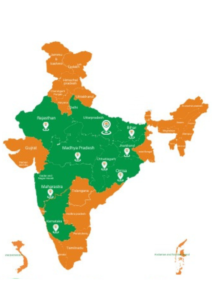
Over 50,000 happy customers across India.