Floating Solar in India: How Reservoirs Could Become the Country's Next Big Solar Farms
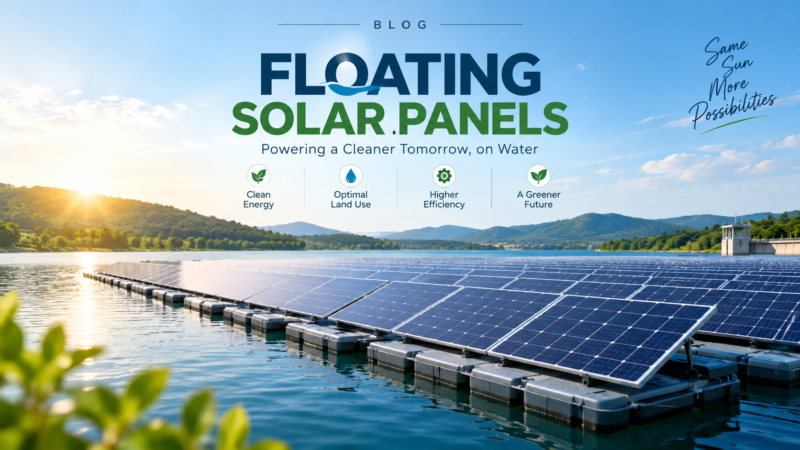
India has a land problem, not a sunlight problem. The country sits on some of the best solar irradiance in the world, yet every large ground-mounted solar park competes with farmland, forests, grazing land, or someone’s home for space. Floating solar panels in India offer a way around that fight entirely: instead of clearing land, developers simply anchor solar panels on the surface of a reservoir, canal, or industrial pond that’s already sitting unused. In August 2026, the Union Cabinet made this approach a national priority by approving the Pradhan Mantri Surya Sarovar Yojana, a ₹5,070 crore scheme built specifically to scale up floating solar capacity from its current, modest base to 5,000 additional megawatts. This piece walks through what floating solar actually is, why India is betting on it now, and what the road ahead looks like.
Key takeaways
- Floating solar capacity in India currently stands at roughly 700 MW installed, against a technical potential of about 102 GW estimated by the National Institute of Solar Energy.
- The Pradhan Mantri Surya Sarovar Yojana (PM-SSY) adds a ₹5,070 crore push for 5,000 MW of new floating solar panels bundled with 10,000 MWh of battery storage.
- Floating PV can cut reservoir evaporation by anywhere from roughly 40% to over 90% depending on climate and coverage, making it a water-security tool as much as an energy one.
- Government estimates put floating solar projects at around 25% more expensive to build than ground-mounted solar, a gap the new scheme’s financial assistance is designed to narrow over time.
- India’s largest operating and under-construction sites include NTPC’s 100 MW Ramagundam plant and the 600 MW Omkareshwar project on the Narmada river.
What Is Floating Solar?
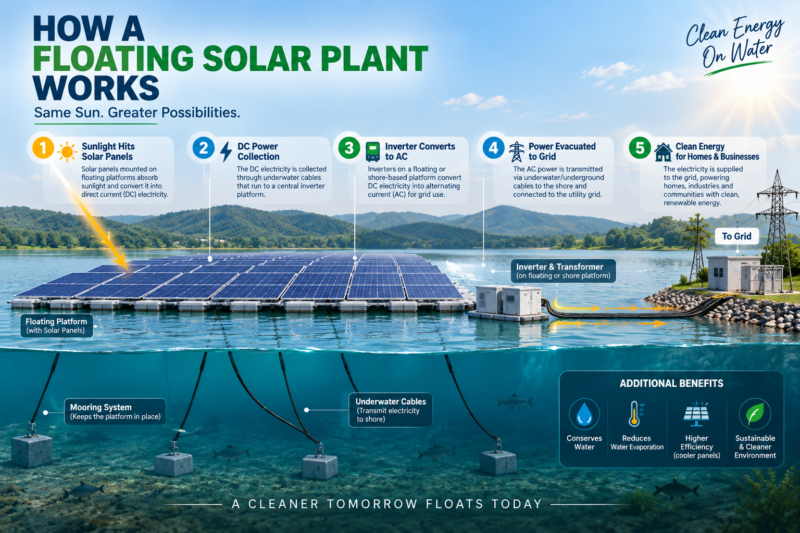
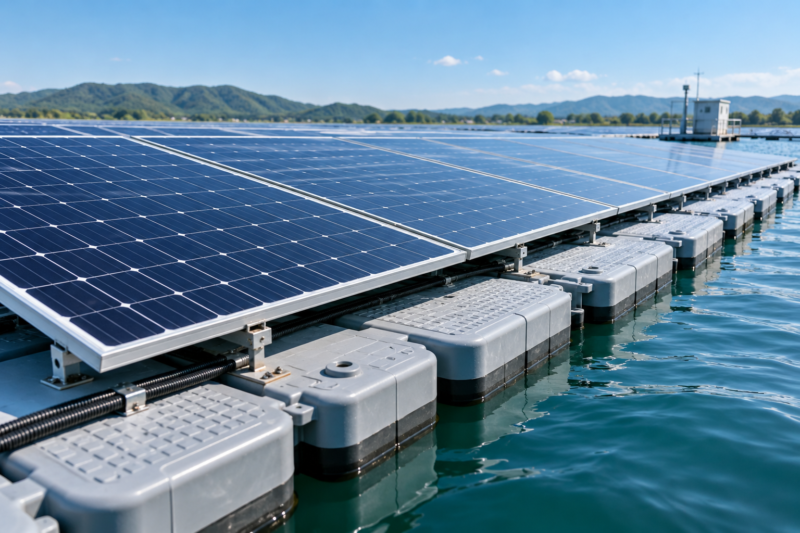
Floating solar, sometimes called floating photovoltaics, FPV, or “floatovoltaics,” is exactly what it sounds like: solar panels mounted on a buoyant platform that sits on the surface of a water body instead of on the ground or a rooftop. The panels are fixed to pontoons, typically made of high-density polyethylene, which are chained together into a floating platform and held in place with an anchoring system tethered to the reservoir bed or bank. Cabling runs from the array to an onshore inverter station and then into the grid, much like any grid-connected solar plant.
The core idea behind floating solar panels in India, and everywhere else it’s being deployed, is simple: water bodies that are already being used for irrigation, drinking water storage, or hydropower generation have a surface that does almost nothing except evaporate and reflect sunlight. Turning that surface into a solar farm doesn’t compete with a single other use of the land, because there was no land involved in the first place.
How Floating PV Actually Works
A floating PV installation has a handful of distinct components that don’t exist in a standard ground-mounted plant. The floatation structure is the most obvious one: modular pontoons, usually UV-stabilised and corrosion-resistant, form the base on which solar panels sit at a fixed tilt angle. The mooring system anchors this entire platform against wind, waves, and water-level fluctuation, which matters enormously in a reservoir that might rise or fall by several metres between monsoon and summer.
Beneath the platform, cabling is routed through waterproof conduits to a floating or onshore transformer and inverter setup, and from there the power is exported to the grid exactly as it would be from a rooftop solar or ground-mounted system. Some floating solar projects in India are also being designed as hybrid renewable energy installations, sharing existing hydropower transmission infrastructure so that the same substation and grid connection serves both the dam’s turbines and the new solar array sitting on its backwaters.
Floating Solar vs Rooftop vs Ground-Mounted Solar
It helps to see floating solar next to the two technologies most people already know, since each has a different role to play in the country’s overall capacity addition targets.
| Factor | Rooftop Solar | Ground-Mounted Solar | Floating Solar |
|---|---|---|---|
| Land requirement | None (uses existing roof) | High (4-5 acres per MW) | None (uses water surface) |
| Typical scale per project | Kilowatts to low megawatts | Tens to hundreds of MW | Tens to hundreds of MW |
| Module efficiency | Standard, heat-affected | Standard, heat-affected | Boosted by natural cooling effect |
| Build cost vs ground-mounted | Comparable to slightly higher | Baseline | Roughly 25% higher |
| Grid connection | Often low-voltage, distributed | Requires dedicated substation | Can reuse hydropower or industrial grid connection |
| Added co-benefit | None specific | None specific | Evaporation reduction, dual land-water use |
Rooftop solar scales one household or factory roof at a time, ground-mounted solar delivers the largest single blocks of capacity but consumes the most land, and floating solar panels sit in between: project sizes comparable to ground-mounted solar, but built on water bodies that were never going to be used for anything else. None of the three technologies is a substitute for the others; India’s clean energy transition needs all three growing in parallel, and floating solar is simply the piece of that puzzle built specifically for water-rich, land-scarce geographies.
Floating Solar Beyond India: A Quick Global Comparison
India isn’t pioneering floating solar from scratch, it’s catching up to and, in some cases, overtaking a global trend that started elsewhere. China currently operates the largest fleet of floating PV installations in the world, much of it built on flooded former coal-mining subsidence areas that had no other productive use. South Korea has built large floating solar arrays on its Saemangeum tidal reclamation area and on reservoirs used for agriculture, treating the technology as a way to hit renewable targets without touching farmland in a country where arable land is extremely limited. The Netherlands has focused on smaller-scale floating solar on inland lakes and former sand-extraction pits, often paired with recreational or ecological co-uses of the same water body. Singapore, despite its tiny land area, has built one of the largest floating solar systems in Southeast Asia on the Tengeh Reservoir, directly mirroring the land-scarcity logic that’s now driving floating solar deployment in India.
Why India Needs Floating Solar Right Now
India’s renewable energy targets are enormous, and land is the single biggest bottleneck standing in the way of them. The country is chasing 500 GW of non-fossil fuel electricity capacity, and every gigawatt of conventional solar needs roughly 4 to 5 acres of land. Multiply that across hundreds of gigawatts and you start running into farmland, forest cover, and land-ownership disputes at a scale that slows projects down for years.
This is precisely why floating solar panels in India have moved from a pilot-stage curiosity to a national policy priority. According to the National Institute of Solar Energy, India’s reservoirs and other inland water bodies could theoretically support around 102 GW of floating solar capacity. Against that backdrop, the country’s installed floating solar PV capacity currently sits at only around 700 MW, a tiny fraction of what’s technically possible. The Surya Sarovar Yojana is designed to close that gap by pushing floating solar capacity toward 5,700 MW within a few years, and by treating reservoirs as a genuine parallel track to rooftop and ground-mounted solar rather than a niche experiment.
Solving the Land Scarcity Problem
Land scarcity is the single most-cited reason developers and policymakers give for pursuing floating solar panels in India. A large ground-mounted solar park can take years to develop simply because of the legal and social process of acquiring land, especially in densely populated states where every acre already has an agricultural or residential use attached to it. Floating solar sidesteps this entirely by using surface area that belongs to a dam, irrigation department, or industrial facility and isn’t allocated to farming, housing, or grazing in the first place.
This matters most in exactly the states where land is scarcest and demand for power is highest. States with limited land availability but abundant reservoir surface area, such as parts of southern and western India, are natural candidates for floating solar because they can add renewable capacity without touching a single acre of usable land. It also sidesteps a slower-moving but equally real problem: rooftop solar alone cannot scale to gigawatt levels quickly because it depends on millions of individual roof owners making individual decisions, while a floating solar project on a single large reservoir can add hundreds of megawatts in one sanctioned scheme.
The Evaporation Reduction Benefit
Perhaps the most underrated advantage of floating solar panels in India is what it does for water, not just power. Covering a portion of a reservoir’s surface with solar panels blocks direct sunlight and wind from reaching the water underneath, which measurably slows the rate at which that water evaporates.
The numbers here are striking. Research modelling floating PV on the Aswan High Dam reservoir estimated evaporation could drop by close to 50% at high coverage levels, saving billions of cubic metres of water annually. A global study published in Nature Sustainability found that covering 30% of the world’s reservoirs with floating solar could cut annual evaporation by more than 100 cubic kilometres of water. Studies focused on Indian conditions, including modelling done on a Tamil Nadu reservoir, found that a floating PV array covering even a modest share of the water surface could meaningfully cut evaporation losses while also boosting the output of an adjoining hydropower plant. For a country where water stress affects hundreds of millions of people and irrigation depends heavily on reservoir storage, evaporation reduction turns this technology into a water-security tool as much as an energy one.
Floating Solar and Hydropower: A Natural Pairing
Some of India’s most ambitious floating solar projects are being built directly on hydropower reservoirs, and that pairing is not a coincidence. A hydropower dam already has grid connectivity, transmission infrastructure, and trained operations staff on site, which dramatically cuts the cost and time needed to connect a new solar array. The Omkareshwar project, developed jointly by NHPC’s subsidiary and the Madhya Pradesh government on the Narmada river’s backwaters, is the clearest example: it shares existing dam infrastructure and is being built in phases, with an initial 90 MW tranche commissioned in 2024 as part of an eventual 600 MW build-out that would make it one of the largest floating solar parks anywhere in Asia.
There’s also a generation-side benefit. Hydropower output depends on water levels, which drop through dry months. Because floating solar reduces evaporation, the water saved can, in principle, be released later through the same turbines, adding incremental hydropower generation on top of whatever the floating panels themselves produce. Combining solar and hydropower on the same reservoir also smooths out daily generation: solar peaks during the day while hydropower can be dispatched flexibly in the evening, giving grid operators a more predictable, complementary output profile than either source alone.
Floating Solar Plus Battery Storage (BESS)
The PM-SSY’s most significant design choice is that it doesn’t fund floating solar panels as a standalone technology; it mandates co-located battery energy storage systems, or BESS, with a minimum of two hours of storage for every project. That translates to 10,000 MWh of new storage capacity riding alongside the scheme’s 5,000 MW of floating solar.
Pairing floating solar with BESS solves one of solar power’s oldest problems: it only generates during daylight hours, right when demand isn’t always at its peak. Storing surplus midday generation and dispatching it during the evening demand peak reduces curtailment, meaning less clean power gets wasted because the grid can’t absorb it in real time. It also gives grid operators a more dispatchable resource, which is especially valuable as India’s overall renewable energy share climbs and grid stability becomes harder to manage with intermittent generation alone. For a reservoir-based solar farm specifically, co-located storage also means the project can function almost like a mini hybrid power plant, generating, storing, and releasing electricity on a schedule the grid actually needs rather than one dictated purely by the sun.
Environmental Concerns Worth Taking Seriously
Floating solar isn’t without its environmental trade-offs, and a fair account of the technology has to address them rather than gloss over them. Covering large sections of a reservoir surface reduces sunlight penetration into the water column, which can affect phytoplankton growth and, in turn, the aquatic ecosystem that depends on it. Reduced sunlight can also alter oxygen levels in the water, with knock-on effects for fish populations if a project is not carefully sized relative to the size of the water body.
There are also concerns about the durability of pontoon and anchoring materials over decades of exposure to water, sun, and, in some regions, brackish or contaminated conditions, along with the possibility of leaching from lower-quality floats degrading water quality over time. Bird activity around large reservoirs can also be affected, since floating platforms change the open-water habitat that many migratory and resident species rely on. None of these concerns are dealbreakers, but they are reasons why serious floating solar projects in India now include environmental studies, hydrography, and bathymetry assessments as a mandatory part of the approval process, exactly the kind of preparatory work the Surya Sarovar Yojana explicitly funds through its feasibility-study grant.
Installation and Maintenance: What's Actually Different
Building a floating solar plant looks similar to a ground-mounted one on paper, but the execution is meaningfully different. Instead of civil foundation work, crews assemble modular floats onshore or on barges, mount panels onto them, and then tow completed sections into position on the water before locking them into the wider array and securing the mooring system to the reservoir bed or bank.
Maintenance carries its own quirks too. Technicians typically need boats or walkways integrated into the floating platform to reach individual panel strings, and cleaning schedules have to account for algae growth, bird droppings, and debris that accumulate differently on water than on land. On the positive side, a reservoir-based solar farm benefits from the same water proximity that helps with panel cooling: some operators use the reservoir itself as a source for panel-washing water, cutting down on one of the recurring costs of a conventional ground-mounted farm. Water-level fluctuation is the trickiest ongoing challenge, since anchoring systems have to accommodate seasonal swings without putting stress on cabling or panel connections, which is why bathymetry studies (mapping the depth and contours of the reservoir bed) are treated as a non-negotiable step before construction begins.
The Cost Question
Floating solar panels in India currently cost more to build than an equivalent ground-mounted solar farm, and it’s worth being upfront about that rather than glossing over it. Government estimates cited alongside the Surya Sarovar Yojana put floating solar costs at roughly 25% higher than ground-mounted projects, driven by the extra cost of pontoons, anchoring systems, marine-grade cabling, and the specialised barges and equipment needed for installation.
That’s exactly why the new scheme offers direct Central Financial Assistance of ₹1 crore per megawatt after a project is commissioned, alongside up to ₹50 lakh per project for feasibility studies covering bathymetry, hydrography, and environmental assessments. Officials describe this support as a deliberate “nudge,” not a full subsidy of the cost gap, intended to get enough floating solar capacity built at scale that costs fall the way ground-mounted solar costs fell over the past decade as manufacturing and installation know-how matured. The scheme is also expected to generate an estimated 16,000 full-time equivalent jobs and to encourage domestic manufacturing of floats, anchoring hardware, and other specialised components in line with the broader Aatmanirbhar Bharat push for local manufacturing.
Existing Floating Solar Projects in India
India already has a working track record with floating solar, even before the new scheme was announced. NTPC’s 100 MW plant at Ramagundam in Telangana, built on the Sri Ram Sagar reservoir that feeds its thermal power station, was for years described as the country’s largest single-site floating solar plant, spread across roughly 450 acres of water surface and built at a cost of around ₹430 crore. NTPC also operates a 92 MW floating unit at its Kayamkulam gas plant in Kerala and a 25 MW installation at Simhadri near Visakhapatnam, part of a broader push by the Maharatna company to add floating solar wherever it already runs a thermal or gas plant with an adjoining reservoir.
The most ambitious project by far is at Omkareshwar Dam on the Narmada river in Madhya Pradesh’s Khandwa district, a joint effort involving NHPC’s subsidiary NHDC, SJVN, the Madhya Pradesh government, and private developers. Once complete, the 600 MW facility is expected to rank among the largest floating solar parks in Asia, and its first 90 MW phase was already commissioned in 2024, illustrating that floating solar panels in India have moved well past the demonstration stage into genuine gigawatt-scale territory. Beyond these flagship sites, smaller floating installations have been built or planned on irrigation reservoirs and industrial ponds across states including Gujarat, Andhra Pradesh, and Rajasthan, each adding to the operational experience that the Surya Sarovar Yojana can now build on.
Who Is Building Floating Solar Panels in India
A mix of public-sector giants and private developers is driving reservoir-based solar forward across the country. NTPC remains the most active public developer, running or building floating solar panels at its own thermal and gas plant reservoirs at Ramagundam, Kayamkulam, and Simhadri, treating spare reservoir capacity at its existing fossil-fuel sites as a built-in expansion opportunity. NHPC, through its subsidiary NHDC, has partnered with the Madhya Pradesh government and private players including SJVN on the flagship Omkareshwar project, pairing floating solar directly with existing hydropower infrastructure.
On the private side, companies including Tata Power, Adani Green Energy, ACME Solar, and Waaree Energies have all executed or bid for floating solar projects on irrigation reservoirs and industrial ponds, often as part of broader renewable energy portfolios that also include rooftop solar and ground-mounted solar. State power utilities and irrigation departments are also emerging as project sponsors in their own right, since many of the reservoirs best suited to floating solar sit under state, not central, ownership. As the PM-SSY’s Central Financial Assistance becomes available, expect more state electricity boards to tender their own reservoir sites directly rather than waiting for central public-sector units to lead the way.
State-Wise Potential for Floating Solar Panels in India
Floating solar potential tracks reservoir surface area, so it isn’t evenly distributed across the country. States with extensive irrigation and hydropower reservoir networks are best positioned to benefit from the new scheme.
| State | Why It’s Well-Suited |
|---|---|
| Madhya Pradesh | Home to the Omkareshwar reservoir and several other Narmada-basin dams with large surface areas |
| Telangana & Andhra Pradesh | Existing NTPC floating solar projects and numerous irrigation reservoirs across the Godavari and Krishna basins |
| Kerala | Backwaters and reservoirs already hosting operational floating solar panels, plus limited flat land for ground-mounted solar |
| Gujarat & Rajasthan | Extensive irrigation canal networks suited to smaller floating and canal-top solar installations |
| Maharashtra & Karnataka | Numerous mid-sized irrigation and hydropower reservoirs with strong grid connectivity nearby |
Because the scheme is explicitly designed to diversify capacity addition geographically, states that have historically lagged in renewable energy deployment due to land constraints, rather than solar irradiance, stand to gain the most from its reservoir-first approach.
Policy and Regulatory Framework
Floating solar panels in India sit at the intersection of several existing regulatory frameworks rather than a single dedicated law. The Ministry of New and Renewable Energy has issued technical guidelines covering float design, anchoring, and grid-connection standards for floating solar, while the Central Electricity Authority’s broader solar and grid-code norms apply once a floating solar project is ready to export power. Environmental clearance requirements vary depending on the water body, its ownership (irrigation department, hydropower utility, or industrial site), and the scale of the project, which is exactly why the Surya Sarovar Yojana’s feasibility-study funding for bathymetry, hydrography, and environmental studies matters so much in practice.
The scheme itself operates as a Central Sector Scheme, meaning the funding and target-setting come directly from the central government rather than being routed through state budgets, while implementation on the ground still depends on state utilities, irrigation departments, and public-sector developers actually identifying and offering up suitable reservoirs. This division of responsibility, central financing paired with state-level site identification, mirrors how India’s broader solar and rooftop solar programs have been structured, and is likely to determine how quickly this scheme actually scales toward its 5,700 MW near-term target.
PM Surya Sarovar Yojana: The Details
The Pradhan Mantri Surya Sarovar Yojana, approved by the Union Cabinet on July 31, 2026, is India’s first dedicated national scheme for floating solar. Its headline numbers: a total outlay of ₹5,070 crore, a target of 5,000 MW of new floating solar capacity, and a mandatory co-located battery storage requirement of at least 10,000 MWh across all sanctioned projects.

The Future Potential of Floating Solar Panels in India
The long-term case for floating solar panels in India goes well beyond the current 5,700 MW target. The National Institute of Solar Energy’s estimate of 102 GW of technical potential across the country’s reservoirs and inland water bodies suggests that today’s scheme is closer to a starting point than an endpoint. As battery costs continue falling and grid operators get more comfortable dispatching hybrid solar-storage-hydropower assets, it’s reasonable to expect follow-on schemes that push well past the initial 5 GW target.
Jobs and the Domestic Manufacturing Angle
Beyond megawatts and water savings, the Surya Sarovar Yojana is also being pitched as an economic development lever. Government projections tied to the scheme estimate around 16,000 full-time equivalent jobs across engineering, float manufacturing, installation, and long-term operations and maintenance. Unlike a large ground-mounted solar farm, where most of the site-specific labour winds down once construction ends, a floating solar project generates a longer tail of specialised maintenance work: boat-based cleaning crews, mooring inspections, and periodic checks on cabling and anchoring hardware that has to withstand years of continuous water exposure.
Common Misconceptions About Floating Solar
A few myths tend to follow this technology around, and it’s worth clearing them up. The first is that panels simply float loose on the water, unsecured; in reality, every commercial installation uses an engineered mooring system anchored to the reservoir bed or bank, designed specifically to handle the wave action, wind loading, and water-level fluctuation of that particular site. The second misconception is that floating solar panels contaminate drinking water; properly certified floats use food-grade, UV-stabilised materials precisely to avoid this, and it’s a key reason feasibility studies and environmental assessments are mandatory before construction, not an afterthought.
Conclusion
Floating solar panels in India aren’t a gimmick or a one-off engineering showcase, they’re a direct response to the fact that land, not sunlight, is the country’s real constraint on solar expansion. Between the evaporation savings, the natural fit with existing hydropower infrastructure, the mandatory battery storage bundled into the new national scheme, and a technical potential north of 100 GW still sitting untapped on India’s reservoirs, this technology is positioned to move from a collection of flagship projects into a mainstream pillar of the country’s clean energy mix over the coming decade. The Surya Sarovar Yojana is the clearest signal yet that policymakers agree, and the reservoirs sitting quietly across the country may soon be doing double duty as some of India’s biggest solar farms.
Trusted by 50000+ Customers
Anya Green Energy is a leading solar company and Solar Energy service provider established in 2013. We are recognized by startup India and customer best choice award 2022.
Our Achievements :
Recognized by Startup India.
Purvanchal’s first solar company to operate exclusively with solar products.
Certified by well-known institutions such as MSME, IndiaMart, and Just Dial and many more.
Winner of the Best Customer Choice Award 2022.
Over 50,000 happy customers across India.
Products
-
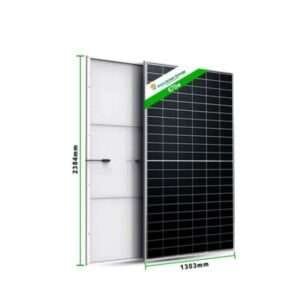 670W MONO PERC HALFCUT SOLAR PANEL
₹26,999.00Original price was: ₹26,999.00.₹23,999.00Current price is: ₹23,999.00. -
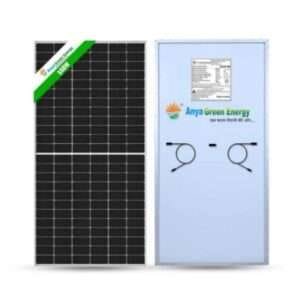 550W MONO PERC HALFCUT SOLAR MODULE
₹22,999.00Original price was: ₹22,999.00.₹19,999.00Current price is: ₹19,999.00. -
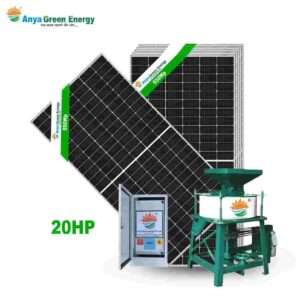 20HP Atta Chakki with Mone Perc Half cut 550W Panel
₹1,200,000.00Original price was: ₹1,200,000.00.₹1,060,000.00Current price is: ₹1,060,000.00. -
 15HP Atta Chakki with Mone Perc Half cut 670W Panel
₹900,000.00Original price was: ₹900,000.00.₹850,000.00Current price is: ₹850,000.00. -
 10HP Atta Chakki with Mone Perc Half cut 550W Panel
₹650,000.00Original price was: ₹650,000.00.₹590,000.00Current price is: ₹590,000.00.