Beyond the Silicon Grid: How Flexible and Ultra Thin Solar Cells Are Quietly Rewriting the Rules of Energy
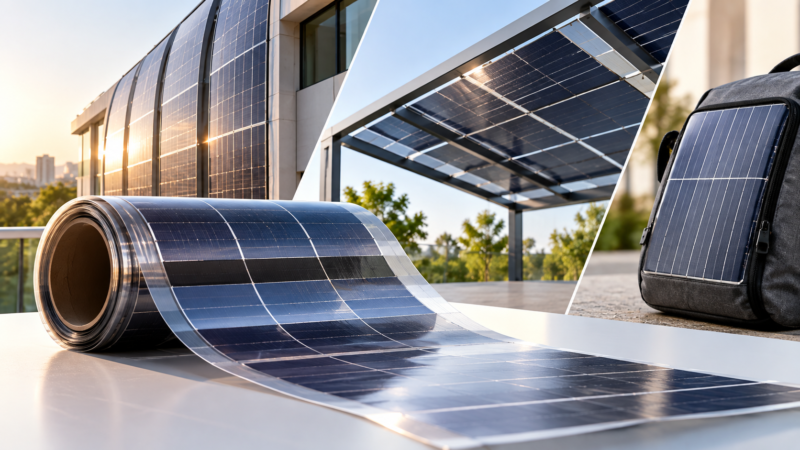
Look out your window for a moment. Look at the glass facades of modern skyscrapers, the sleek curved bodies of electric vehicles, or even the fabric of the backpack resting near your desk. For decades, we have been taught to view these surfaces as static, passive objects—materials that simply occupy space and absorb the elements.
Now, imagine if every single one of those surfaces was silently generating clean electricity.
No heavy glass frames. No rigid silicon slabs anchored to reinforced roof beams. No aesthetic compromises. Just a sheer, almost weightless membrane—thinner than a strand of human hair—harvesting light from the surrounding environment.
This is not a distant vision from a sci-fi novel. It is the immediate reality brought forth by flexible and ultra thin solar cells. While traditional clean energy infrastructure has spent decades focusing on getting bigger and heavier, a quiet revolution in materials science has been moving in the exact opposite direction: going thinner, lighter, and remarkably adaptive.
The Weight of Tradition: Why Silicon Reached Its Physical Limits
To truly appreciate the engineering miracle behind ultra-thin photovoltaics, we first have to ask a fundamental question: Why are standard solar panels the way they are?
For over half a century, traditional solar energy has relied heavily on rigid silicon wafers. Silicon is abundant, reliable, and reasonably efficient at converting sunlight into usable electricity. However, silicon comes with structural baggage. It is inherently brittle, heavy, and unforgiving of curvature.
To protect these fragile silicon wafers from moisture, wind, and impact, manufacturers must encase them in toughened glass, heavy aluminum frames, and dense protective backsheets. The result is a standard solar panel weighing anywhere between 30 to 50 pounds.
While that weight is manageable on a sturdy residential roof, it immediately creates massive engineering bottlenecks elsewhere:
-
Structural Limitations: Millions of commercial warehouses, agricultural structures, and historical buildings cannot support the dead-load weight of conventional solar arrays.
-
Transportation & Logistics: Shipping heavy, fragile glass panels across continents generates a massive carbon footprint before the panels ever generate a single kilowatt-hour.
-
Form Factor Constraints: You cannot curve rigid glass around an airplane wing, stitch it into survival gear, or wrap it around a structural pillar.
Industry engineers realized that if solar power was going to achieve true ubiquity in
flexible and ultra thin solar cells , the energy harvester needed to adapt to the world—rather than asking the world to alter its infrastructure to accommodate the panel.
The Breakthrough: What Makes an Ultra-Thin Solar Cell Tick?
How do you shrink a power generator down to a thickness measuredmicrometers without sacrificing its ability to capture photons?
The secret lies in a transition from bulk material processing to nanoscale molecular engineering. Traditional silicon solar cells rely on thick layers (around 150 to 200 micrometers) to absorb sunlight. In contrast, thin film solar technology and next-generation thin-film materials can absorb the exact same spectrum of light in layers that are less than 2 to 3 micrometers thick—sometimes even nanometers thin.
At this microscopic scale, physics behaves differently. Materials that are rigid when thick become inherently pliable when engineered ultra-thin. Think of a thick sheet of glass versus an optical fiber thread;flexible and ultra thin solar cellsthe material is the same, but the geometry changes its flexibility completely.
Several core technological pathways are driving this shift:
1. Perovskite Photovoltaics
Perhaps the most exciting development in modern photovoltaics is the rise of perovskite materials. Perovskites possess a unique crystalline structure that absorbs light extraordinarily well. Because they can be processed in liquid form, researchers can print them using high-speed roll-to-roll manufacturing—much like printing a newspaper. These printable perovskite solar panels promise high efficiency at a fraction of the material and energy costs of silicon.
2. Organic Photovoltaics (OPVs)
Utilizing carbon-based polymers, organic solar cells can be synthesized into flexible inks. While historically lower in energy conversion efficiency than silicon, OPVs excel in low-light conditions, indoor environments, and applications requiring near-complete transparency or precise color tuning.
3. Gallium Arsenide (GaAs) Epitaxial Lift-Off
For extreme applications where efficiency per gram is the ultimate metric—such as aerospace and satellite deployment—Gallium Arsenide thin films offer incredible efficiency. Using a process called epitaxial lift-off, scientists grow ultra-thin semiconductor layers and peel them off reusable substrates, creating bendable cells capable of surviving harsh cosmic environments.
Lightness Redefined: Key Advantages of Flexible Photovoltaics
When you remove 95% of the weight and 99% of the thickness from a solar collector, something fascinating happens: energy generation ceases to be an “installation process” and becomes a fundamental property of the material itself.
The shift toward lightweight solar energy solutions delivers transformative advantages that extend far beyond aesthetics:
Peel-and-Stick Simplicity
Eliminating heavy mounting racks, steel ballasts, and roof penetrations radically changes labor dynamics. Ultra-thin modules can be manufactured with adhesive backing. Installation on a warehouse roof can literally become as simple as unrolling a membrane and peeling back a protective tape layer.
Unprecedented Specific Power (Watts per Gram)
In mobile applications—from electric cars to high-altitude pseudo-satellites—every single gram counts. Ultra-thin solar cells achieve a “specific power” metric that dwarfs traditional panels. Scientists have produced experimental ultra-thin cells capable of delivering over 20 watts of power per gram of material—an order of magnitude higher than standard arrays.
Seamless Architectural Integration
Building-Integrated Photovoltaics (BIPV) have long been limited by structural constraints. Flexible cells allow windows, curved facades, awnings, and decorative cladding to generate power without compromising architectural vision.
Real-World Impact: Where Are Flexible Photovoltaics Being Used Today?
The versatility of flexible photovoltaics applications is pushing solar energy into domains where traditional glass panels could never venture.
1. Transportation and Electric Vehicles
Integrating solar directly into vehicle bodies has always been hampered by weight and complex curvatures. Ultra-thin cells can be seamlessly integrated into car roofs, hoods, and side panels without altering aerodynamics or adding significant weight, extending daily driving range purely through ambient sunlight.
2. Portable Power and Wearable Tech
Imagine hiking gear with solar capacity woven into the fabric of a tent or jacket, allowing adventurers to charge communication devices without carrying heavy battery banks. Emergency response teams deploying to disaster zones can pack rollable solar mats that set up in seconds, providing instant off-grid power.
3. Urban Infrastructure and Smart Cities
Streetlights, bus stops, curved sound barriers along highways, and smart sensors can now be self-powered. By wrapping these structures in flexible solar skins, cities can build resilient microgrids without taking up extra land footprint.
4. Aerospace and Satellite Operations
Space travel demands extreme weight efficiency. Solar sails and flexible arrays that fold down into tiny volumes during launch and unfold like origami in orbit are already transforming satellite design and deep-space missions.
The Obstacles: What Stands Between the Lab and Mass Adoption?
With such profound advantages, it is fair to ask: Why hasn’t every home and business made the switch to flexible solar?
While the potential is vast, materials scientists and chemical engineers are actively solving three major challenges:
Degradation and Environmental Protection
Traditional solar panels last 25 to 30 years because thick glass shields the silicon from oxygen and moisture. Ultra-thin materials—especially organic cells and perovskites—are exceptionally sensitive to environmental degradation. Developing flexible, transparent barrier films that protect these delicate layers for decades without adding thickness is a primary area of ongoing research.
Scalability and Manufacturing Yields
Printing electronics via roll-to-roll processes requires extreme precision. A dust particle or microscopic tear in a coating measuring just nanometers across can ruin large sections of a roll. Perfecting high-throughput, zero-defect manufacturing lines is essential to driving production costs down.
Commercial Efficiency Gaps
While ultra-thin cells have broken research efficiency records in laboratory environments, commercial mass-produced flexible modules often lag slightly behind premium rigid silicon modules in conversion efficiency. Closing this gap ensures that space-constrained installations yield maximum power output.
The Horizon: What the Next Decade Holds
We are rapidly approaching an tipping point in clean technology where flexible and ultra thin solar cells flexible and ultra thin solar cells energy capture becomes ambient, invisible, and continuous.
Researchers are already working on next-generation tandem solar cells—stacking ultra-thin perovskite layers on top of conventional silicon or flexible substrates to capture different flexible and ultra thin solar cells wavelengths of light simultaneously. Early tests indicate efficiencies pushing past 30%, breaking long-standing theoretical barriers.
Simultaneously, indoor energy harvesting using flexible organic photovoltaics is opening up a market where smart home devices, wireless keyboards, and IoT sensors draw energy from ambient indoor lighting, eliminating the need for single-use batteries entirely.
When solar technology sheds its weight, it ceases to be an external appliance you buy and mount. It becomes a property of the materials we build with—a subtle, functional skin applied to our built environment.
Final Thoughts: A World That Generates Power by Design
The transition toward flexible and ultra thin solar cells represents far more than an flexible and ultra thin solar cells incremental upgrade in renewable energy—it is a fundamental rethinking of how energy generation fits into our daily lives.
By stripping away the weight, rigidity, and aesthetic limitations of traditional solar panels, we are entering an era where virtually any surface illuminated by light can become an active participant in the clean energy transition. From the clothes we wear to the buildings we inhabit and the vehicles we drive, power generation is becoming weightless, flexible, and integrated by design.
The future of energy isn’t just bright—it is light, flexible, and already unfolding around us.


Trusted by 50000+ Customers
Anya Green Energy is a leading solar company and Solar Energy service provider established in 2013. We are recognized by startup India and customer best choice award 2022.
Our Achievements :
Recognized by Startup India.
Purvanchal’s first solar company to operate exclusively with solar products.
Certified by well-known institutions such as MSME, IndiaMart, and Just Dial and many more.
Winner of the Best Customer Choice Award 2022.
Over 50,000 happy customers across India.